



Signature Strips on Plastic Cards: Sizes, Positions and Uses
A signature strip is a panel on a plastic card that takes an ordinary pen, so the card can be signed, or filled in with a name or a date, after it’s printed. It’s the cheapest form of verification we offer: a signed card can be checked against its holder, and once signed no two cards are the same.
This guide covers what a signature strip is, why it’s worth adding, its size and where it can go, the wording around it, how to design the card around it, which pens to use, and how to order cards with one.
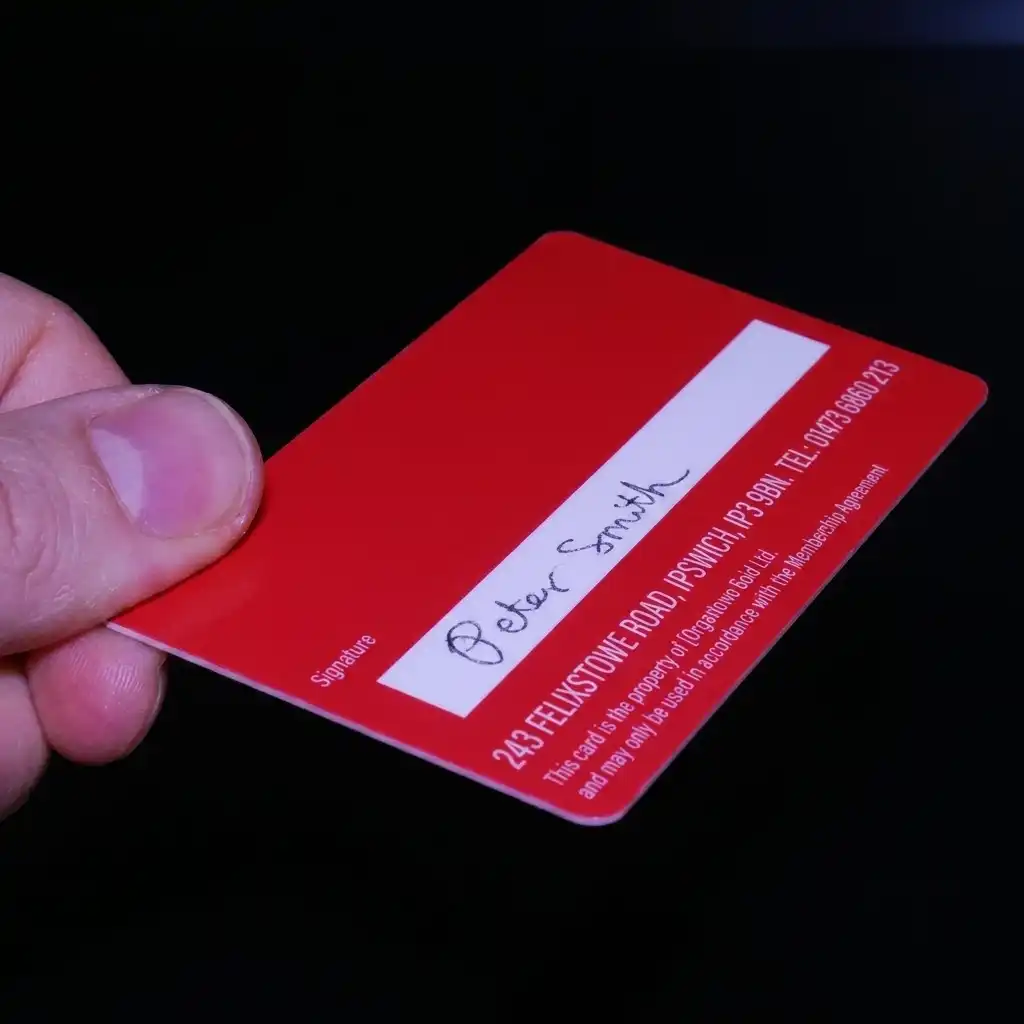
The short versionA typical signature strip is 75 x 8mm, but any size is available. It can go anywhere on the front or back, at least 4mm from the edge, and works best on a white background. Nothing is printed on the strip itself: the label goes beside it. Use an ordinary ballpoint pen. Strips are priced on your quote, so email sales@cpcards.co.uk for a price.
What a signature strip is
A signature strip, also called a signature panel, is a panel added on top of the finished card that takes an ordinary pen. The rest of a full colour PVC card can’t take a pen reliably. The design is printed on a central sheet and bonded between two clear PVC sheets, so the surface is smooth and sealed: that’s what stops the print scratching or wearing off, and it’s also why ballpoint ink skips on it.
When the panel is for something other than a signature, such as a name, an expiry date or the value of a gift card, it’s usually called a write-on panel. It’s the same thing, named for what goes on it.
| Signature strip | |
|---|---|
| Size | Any size is available. A typical strip is 75 x 8mm. |
| Position | Anywhere on the card, provided it stops at least 4mm from the edge. |
| Sides | The front, the back, or both. |
| How many | One or several. |
| Wording | Printed above, below or beside the strip, never on it. |
| Background | White, so the strip stays a crisp white. |
| Pen | An ordinary ballpoint pen. |
| Price | Priced on your quote. Get a quote |
Why add a signature strip?
Size and position
Any size is available, and a typical signature strip is 75 x 8mm. It can go anywhere on the card, on either side, provided it stops at least 4mm from the edge. On a card with a magnetic strip, the signature strip usually sits on the back, below the magnetic strip.
A 75mm strip on an 86mm wide card leaves 5.5mm either side, inside the 4mm margin. A strip doesn’t have to run across the back, though: it can be shorter, upright, or on the front, wherever your design has room for it. More about the strip it often sits under is on our magnetic strips page.
- Magnetic strip, if the card has one: 13 x 86mm, on the back, 3mm down from the top edge. Cards with a magnetic strip must be 760 microns.
- Signature strip. Here the typical 75 x 8mm, below the magnetic strip. It takes an ordinary pen.
- The label. “Signature” is printed above the strip, as part of the design. Nothing can be printed on the strip itself.
- A second panel, shorter, for the expiry date. Any size is available.
- The 4mm margin. A strip can go anywhere, as long as it stops at least 4mm from the edge of the card.
Wording, labels and extra panels
Nothing can be printed on the strip itself, because it sits on top of the card surface. Wording such as “Signature” or “Name” is printed above, below or beside it, as part of your design. The same goes for every write-on panel, whatever it’s for.
| Label | What’s written in | Where it’s used |
|---|---|---|
| Signature | The holder’s signature | Membership, discount and VIP cards |
| Name | The holder’s name, when the card is issued | Membership cards for members who haven’t joined yet |
| Valid until | An expiry or renewal date | Clubs that want one batch of cards to last several years |
| Membership level | The member’s level or tier | Schemes with more than one kind of member |
| ICE contact | An emergency contact | Members out on their own: angling, sailing, walking, running, cycling |
| To, From, Value | Who it’s for, and the amount or item | Gift cards, written on when the card is sold |
Writing a value on a gift card?A written amount is easier to alter than a printed one, so give every card a number and keep a register. Our guide to numbered plastic cards explains how numbering works.
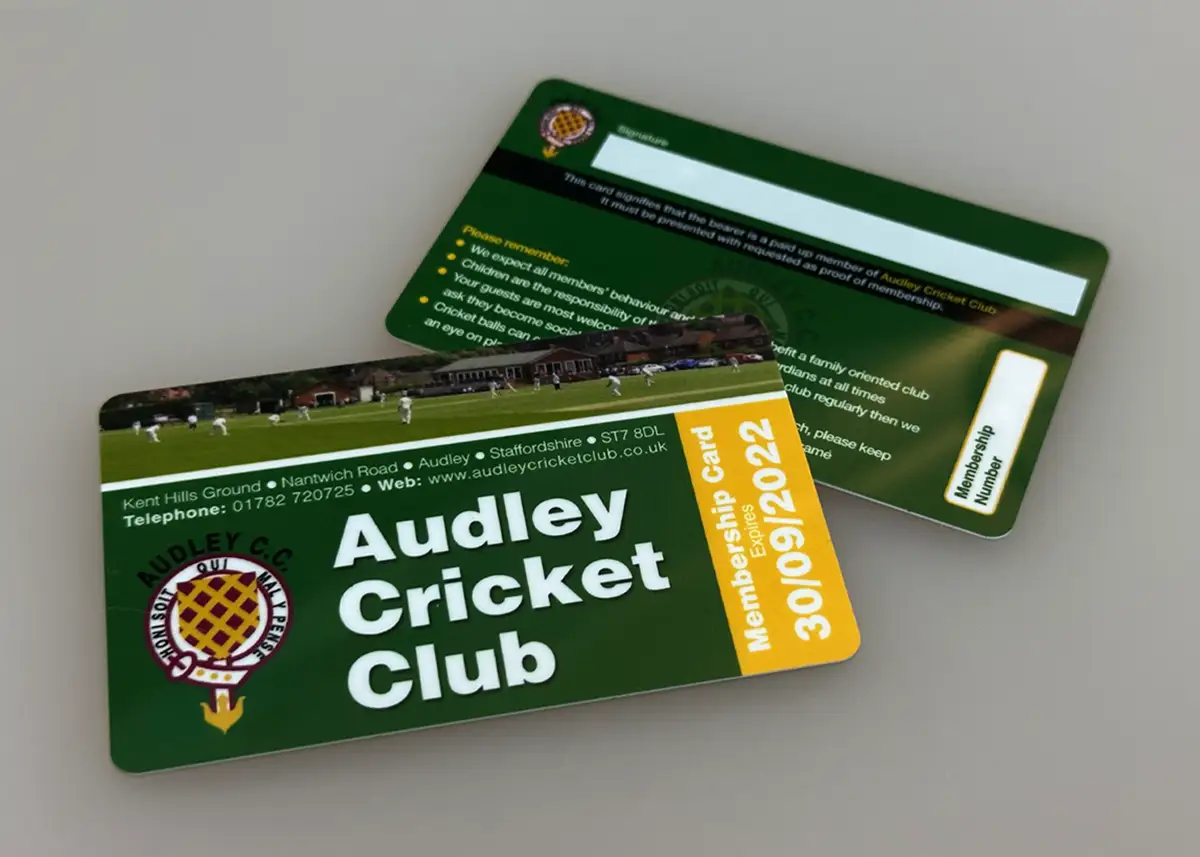
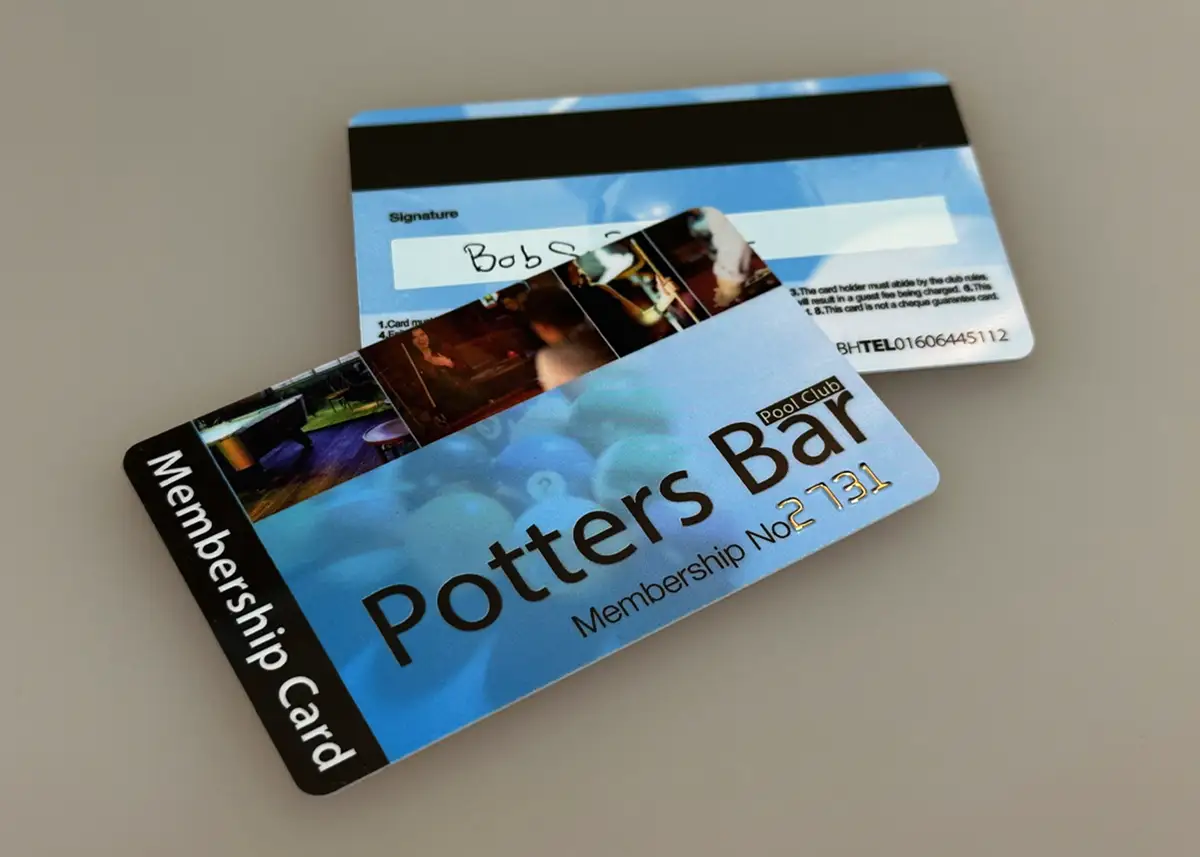
A card can carry one strip or several, on one side or both. Many organisations use two: one to sign, and one for an expiry date or membership level. Of the two cards below, the cricket club card carries a signature strip and a separate panel for the membership number, and the pool club card has its signature strip on the back, below a magnetic strip.
Designing the card around a signature strip
- Put it on white. On a coloured background the strip picks up the colour behind it instead of staying a crisp white, so leave a white area in your artwork where it goes.
- Leave a clear space, and tell us where it goes. The strip is added on top of the finished card, not printed, so your artwork needs a gap for it with nothing important underneath.
- Below the magnetic strip, if the card has one. The magnetic strip runs across the top of the back, so the signature strip goes under it.
- Plan the back early. A magnetic strip, a signature strip and a barcode all want the back of the card, and an 86 x 54mm card fills up quickly. A barcode and a signature strip together is an everyday pairing.
- Keep it 4mm from the edge, and keep the label close enough that it’s clear which panel it belongs to.
- Size each panel for what goes in it. Any size is available, so a panel for a date can be shorter than one for a signature.
- Check it on your proof. Every order gets a free photorealistic proof by email, showing every panel in place before anything is printed. You check the wording and approve it in writing.
Designing in Canva? Our guide to designing plastic cards in Canva shows how to leave space for a strip. For everything else that goes on the back of a membership card, see what to put on a membership card.
Pens, markers and wear
- Use an ordinary ballpoint pen. That’s what signature strips and write-on panels are made for.
- Not on the printed surface. Away from the strip, a PVC card is smooth and sealed, so ballpoint ink skips and most other inks smudge.
- A permanent marker is a stopgap. It writes on the printed surface, and a Premium Matt finish takes it better than High Gloss (£20 +vat per order, whatever the quantity). On either finish the ink sits on top and can be wiped off, so for anything that mustn’t be altered, use a write-on panel.
- The strip is the part that wears first. It sits on the outside of the card, so it takes the rubbing in a wallet that the sealed print doesn’t. The print itself can’t scratch or wear off.
Our guide to writing on plastic cards compares pens, markers and stamp inks on every surface, and how long plastic cards last covers what wears and what doesn’t.
Cards that use signature strips
Our recycled PVC and biodegradable cards are like standard PVC: add a signature strip or write-on panel for anything written by hand. Two materials don’t need one. EcoTough cards take an ordinary pen or pencil anywhere on the card, and Plastic-Free Board cards take pen and ink stamps anywhere.
Prices and ordering
Signature strips are priced on your quote, like our other optional extras. Email sales@cpcards.co.uk, or use our quotation request form, and tell us:
- The card and the quantity, for example 250 full colour membership cards.
- How many strips or panels, and on which side.
- The size, if not the typical 75 x 8mm.
- The wording beside each one, such as “Signature” or “Valid until”.
- Any other extras on the same side, such as a magnetic strip or a barcode, so we can check they fit.
We often reply within minutes, 9am to 5pm, Monday to Friday, and everything from the artwork to your approval is in writing. Standard production is 7 working days from proof approval and payment, including optional extras such as signature strips. Express production of 3 to 4 working days is also available: ask us for cost and availability. We’ve been supplying cards made in England since 1992, and we look after your order from start to finish.
Need the back of the card laid out around the strip? Our design service is £29 +vat, with no limit on reasonable amends.
Questions & Answers
-
What is a signature strip on a plastic card?
A panel that takes an ordinary pen, so the card can be signed or written on after it’s printed. It’s added on top of the finished card, while the printed design is sealed under clear PVC. It’s also called a signature panel, or a write-on panel when it’s for something other than a signature.
-
What size is a signature strip?
Any size is available. A typical signature strip is 75 x 8mm, which leaves 5.5mm either side on our 86 x 54mm cards.
-
Where can a signature strip go on the card?
Anywhere on the front or the back, provided it stops at least 4mm from the edge. On a card with a magnetic strip, it usually goes on the back, below the magnetic strip.
-
Can you print “Signature” on the strip?
No. Nothing can be printed on the strip itself, because it sits on top of the card surface. Wording such as “Signature” or “Name” is printed above, below or beside it.
-
Can a card have more than one signature strip?
Yes. One strip or several, on one side or both. Many organisations use two: one to sign, and one for an expiry date or membership level.
-
What pen works on a signature strip?
An ordinary ballpoint pen: that’s what the strip is made for. Away from the strip, the printed surface of a PVC card doesn’t take an ordinary pen reliably.
-
Does the background behind a signature strip matter?
Yes. On a coloured background, the strip picks up the colour behind it instead of staying a crisp white, so leave a white area in your artwork where it goes.
-
Will a signature strip wear off?
It’s the first part of a card to show wear, because it sits on the outside and takes the rubbing in a wallet. The printed design is sealed under clear PVC, so the print itself can’t scratch or wear off.
-
How much does a signature strip cost?
Signature strips are priced on your quote. Email sales@cpcards.co.uk with the quantity and how many strips you need, and we’ll reply with a price, often within minutes, 9am to 5pm, Monday to Friday.
-
Does a signature strip add to the production time?
No. Standard production is 7 working days from proof approval and payment, including optional extras such as signature strips. Express production of 3 to 4 working days is also available: ask us for cost and availability.
Ready to order cards with a signature strip?

Email sales@cpcards.co.uk with the quantity, the card, and where each strip goes, or attach your artwork, and we’ll email a quote, often within minutes, 9am to 5pm, Monday to Friday.
Your free photorealistic proof shows every strip and label in place before anything is printed.