

Loyalty Card Examples
Loyalty cards are usually barcode- or QR-coded for scanning at the till, letting a retailer or hospitality business track visits or spend without a phone app. Many businesses print a reward tier or stamp grid directly on the card so the incentive is visible at a glance, and order cards in the same design as any matching gift card range. For prices, specifications and how to order, see our loyalty card printing page.
Do you see a design that you like?
Love one of our examples? Let’s use it as inspiration!
If you spot an example design that catches your eye, we can use it as a starting point to create your own design.
We’ll tailor the layout, colours, logos, and text to suit, all included as part of our Design Service.
Just tell us what you like and send over any logos and pictures, and we’ll do the rest.

Beauty Salons


Bowling

Car Wash & Valet


Cinemas


Coffee Shops


DIY Stores


Garden Centres
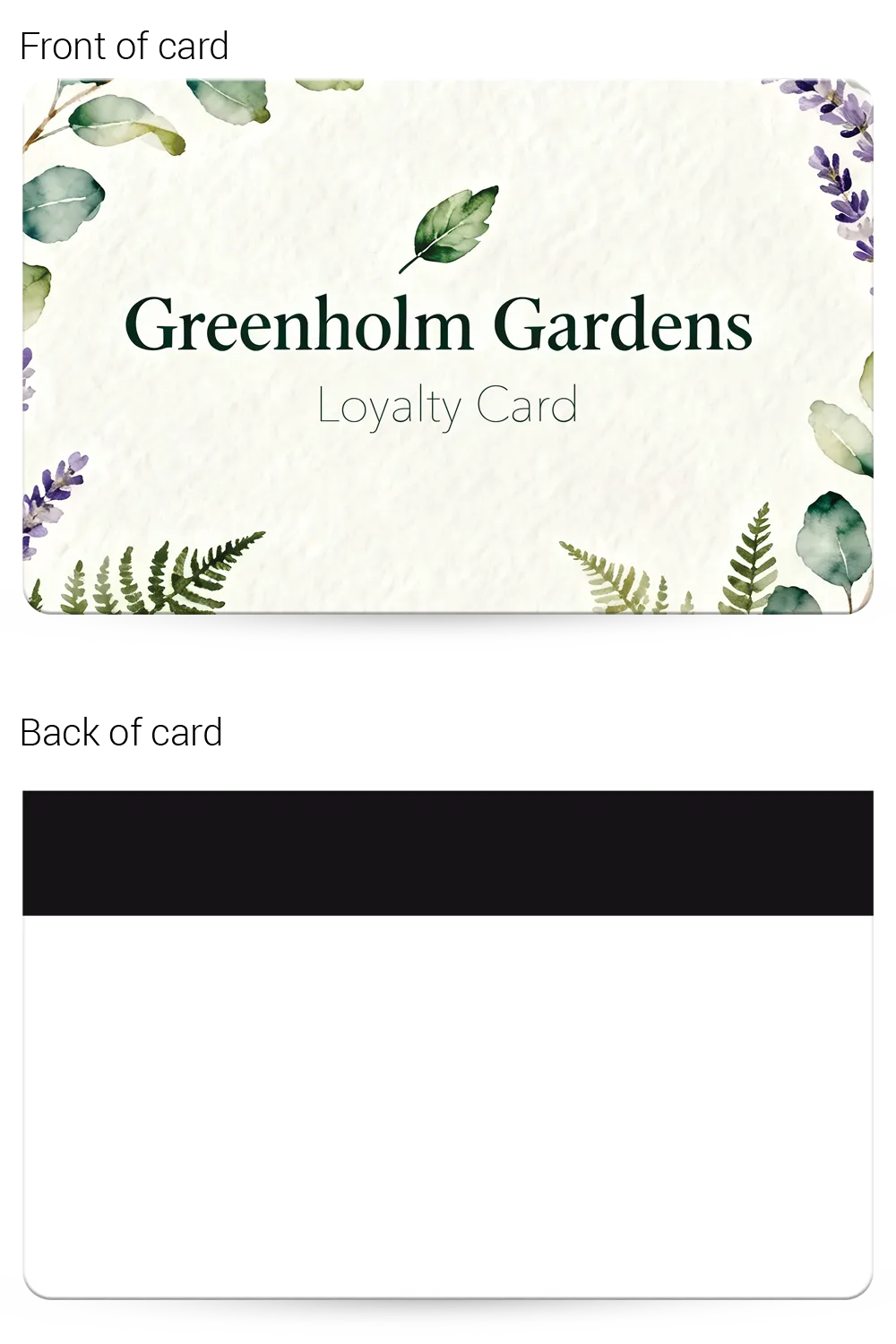
Hair Salons


Hotels


Nail Salons


Pet Shops


Restaurants


Spas


Theme Parks


Stamp Scheme or Points Scheme? Decide That First
Nearly every design decision on a loyalty card follows from one choice, and it is worth making it before anyone opens a design program.
A stamp or visit scheme — buy nine coffees, get the tenth free — needs somewhere physical to record progress. That means a printed grid of boxes and a write-on panel, or a set of spaces a stamp can land in, and it means designing around an area that will be marked up rather than left clean. The advantage is that it needs no technology at all, the customer can see how close they are, and it works the moment the cards arrive.
A points or spend scheme needs none of that. Progress lives in your EPOS against an account, and the card’s only job is to identify the customer — a barcode, a QR code or a magnetic stripe, and a number. The card can then stay clean and brand-led, and the reward can be changed whenever you like without reprinting.
Both are represented in the examples above, and neither is better. What goes wrong is choosing a design first and then discovering there is nowhere to put ten stamps.
Making a Card Worth Keeping in a Wallet
A loyalty card is competing for a slot in a wallet that already contains bank cards, a driving licence and somebody else’s loyalty card. Unlike a membership card, nobody has paid for it, and there is no obligation to keep it. It has to earn the space.
Three things decide whether it does. First, whether it is instantly obvious what the reward is — a card that says what the customer gets outperforms one that just carries a logo. Second, whether using it is frictionless, which usually means the barcode is somewhere a till operator can reach without asking the customer to turn it round. Third, whether it looks like something worth carrying, which is mostly a question of not looking disposable.
That last point is why these are printed on 760-micron solid PVC with the design sealed beneath the surface. A card that is still crisp after a year in a wallet keeps working; one that has gone furry gets thrown away, and with it the scheme.
Getting the Card Talking to Your Till
For anything other than a stamp card, the card has to be readable by whatever you already run. Barcodes are the usual route — Code39, also called 3 of 9, is the most widely supported, with Code128 and EAN5 also available. One question to your EPOS or loyalty provider about which format they expect will save a reprint.
QR codes work too and hold considerably more data, which is useful if you want the code to carry a web address as well as an identifier. They need to be square and at least 15mm to scan reliably from a phone camera, and each one can be different if you supply the details in an Excel file.
Magnetic stripes suit businesses that already have swipe readers; we can encode them for you or supply them blank. And sequential numbering, in any CMYK colour you like, keeps the physical cards in step with your customer list.
For businesses where a wallet card is impractical — anywhere a customer arrives with keys in hand rather than a wallet out — look at our key fob cards or a combo card, which gives the customer both from a single item.
Loyalty Card Printing FAQs
Should we run a stamp scheme or a points scheme?
A stamp scheme needs no technology and lets a customer see their progress, but the card must be designed around a grid and a write-on area. A points scheme keeps the card clean and lets you change rewards without reprinting, but needs your EPOS to track it.
Which barcode format should we use?
Ask your EPOS or loyalty provider. Code39 (3 of 9) is the most widely supported, and we also print Code128 and EAN5. Confirming before printing avoids a reprint.
How big does a QR code need to be?
Square and at least 15mm to scan reliably from a phone. It holds far more data than a barcode, so it can carry a web address as well as a customer identifier.
Can each card have its own number?
Yes. Give us a start number to run on sequentially, or supply exact numbers in an Excel file. Numbering can be printed in any CMYK colour, including one matched to your logo.
What makes a customer actually keep a loyalty card?
Being obvious about the reward, being quick to use at the till, and not looking disposable. Unlike a membership card nobody has paid for it, so it has to earn its place in a wallet.
How thick are your loyalty cards?
760 microns, the same as a bank card, with the design sealed beneath the surface so it does not wear away with daily handling.
What if our customers do not carry a wallet?
Use a key fob card, or a combo card which is a full-size card with a key tag joined to it that the customer snaps apart, so they get both from one item.
Can loyalty cards match our gift cards?
Yes, and most businesses order both in the same design so the two read as a set.