

Plastic Card Printing Glossary
Plastic card printing has its own vocabulary: bleed and safe zones, CR80 and microns, HiCo and LoCo, Mifare and Fudan. This glossary explains each term in plain English, with a link to the guide that covers it in full.
Start with the labelled card below, or jump straight to a letter.
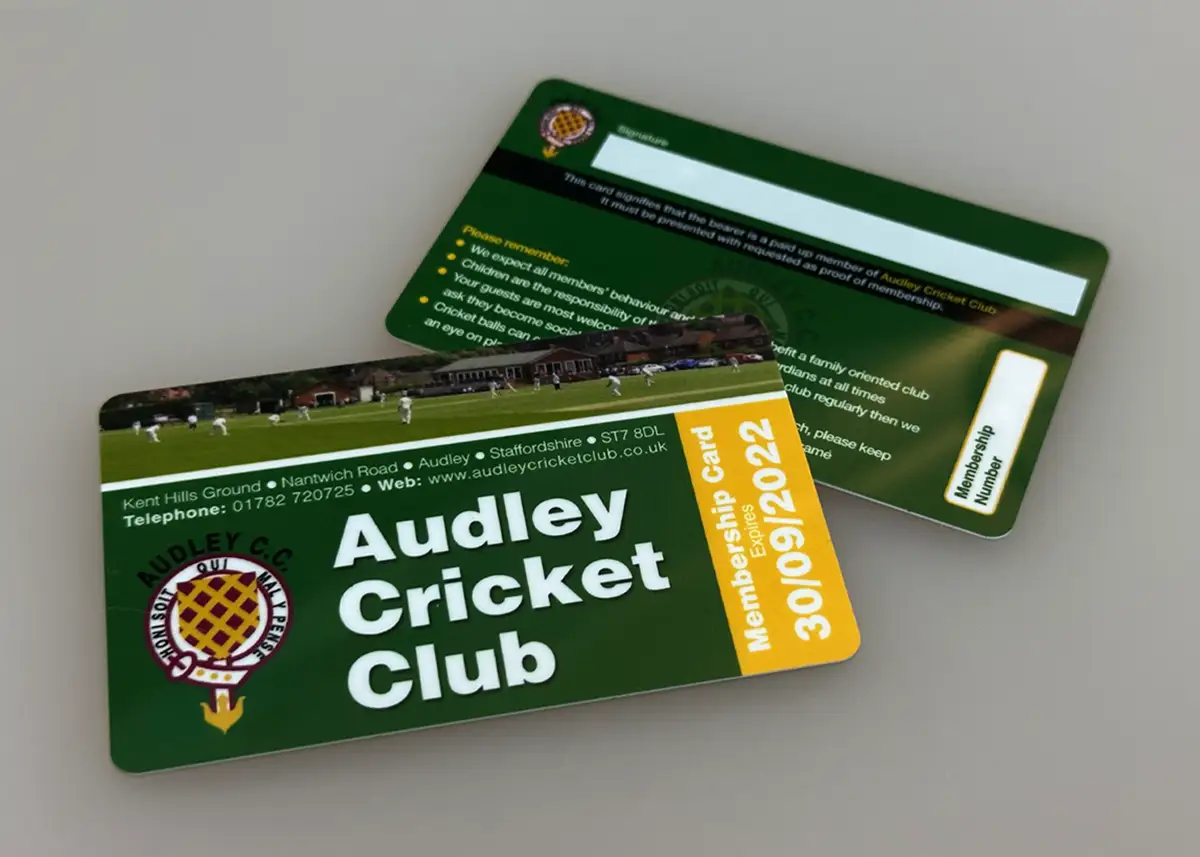
The anatomy of a plastic card
Nine of the terms below, on one card. The front is drawn as artwork, with the bleed still on it; the back is the finished card.
- Bleed: 3mm of background outside the card, trimmed off.
- Cut line: the edge of the 86 x 54mm card, with rounded corners.
- Safe zone: 3mm inside the edge. Keep text inside it.
- Embossing: raised characters in the bottom half.
- Hole: 5mm across, 6mm in from the edge.
- Magnetic strip: 13mm deep, 3mm from the top edge.
- Signature strip: takes an ordinary pen.
- Barcode: with its number printed underneath.
- QR code: at least 15mm square.
A
- Access control
- Using a card to open a door or a barrier. The reader checks the card’s RFID chip, magnetic strip or barcode against a list of who’s allowed in. See RFID smart cards.
- Artwork
- The design file your cards are printed from. For full colour cards it should be 92 x 60mm with bleed, in CMYK, with images at 600dpi or more. See our artwork guides.
- Artwork check
- A free check of your file’s technical set-up, such as bleed, resolution and colour, by a person before anything is printed. It doesn’t check your wording: that’s yours to check on the proof. If the file needs fixing, we can do that for £10 +vat. See artwork checking.
B
- Barcode
- Parallel lines that carry a number for a scanner to read. On our cards they’re printed under the surface, so they can’t rub away. See barcodes and Code39.
- Bleed
- The extra 3mm of background beyond the edge of the card on every side, so the artwork is 92 x 60mm for an 86 x 54mm card. The cards are cut from a sheet, the cut can move by 1 to 2mm, and the bleed stops a white edge showing. See bleed and size help.
- Bonded
- How our full colour PVC cards are made: the printed sheet is bonded between two clear PVC sheets with heat and pressure, so the print is sealed inside the card. See how plastic cards are made.
- Bureau personalisation
- A service where we hold your printed cards in stock and personalise them as you need them, from an Excel file you email us. Ideal for members who haven’t joined yet. See bureau personalisation.
C
- CMYK (full colour, four-colour process)
- Cyan, magenta, yellow and black: the four inks that mix on the press to make every colour on a full colour card. Artwork should be supplied in CMYK. See CMYK printing explained.
- Code39 (3 of 9)
- The most popular barcode type for membership and loyalty cards. It can carry letters as well as numbers. Code128 and EAN5 are the other types we print. Ask your till or software provider which one it reads.
- Coercivity
- How strongly a magnetic strip holds its data, and how well it resists being wiped. See HiCo and LoCo.
- Combo card
- A full-size card joined to a small key tag that snaps off, so one design can live in a wallet and on a key ring. See combo cards.
- CR79
- A card slightly smaller than CR80, made for some badge holders. Our standard cards are CR80. See CR80 v CR79.
- CR80 (ID-1)
- The standard card size: 86 x 54mm, the same as a bank card, defined by ISO/IEC 7810 as ID-1. See CR80 card size.
- Cut line (trim line)
- Where the card is cut out of the printed sheet: the edge of the finished 86 x 54mm card.
D
- Design service
- Our in-house designers create your card from your logo, a sketch or an idea, for £29 +vat with no limit on reasonable amends. See design service.
- Double-sided printing
- Printing on both sides of the card. Our full colour cards are printed on both sides at no extra cost. See double-sided printing.
- DPI (resolution)
- Dots per inch: how much detail an image holds at its printed size. Images on a card need at least 600dpi; a picture from a website is usually far less. See high resolution artwork.
E
- EAN5
- A five-digit barcode type, one of the three we print alongside Code39 and Code128.
- EcoTough
- A lightweight, PVC-free and laminate-free card material made with 20% recycled content, 360 microns thick. See EcoTough cards.
- Embossing
- Raised characters pressed into the card, like the number on a bank card, at 5mm or 3mm tall, and finished in black, silver or gold. See embossing.
- EPOS
- Electronic point of sale: your till system. It may read a barcode, magnetic strip or QR code from a loyalty or gift card.
- Event pass
- A larger plastic pass, 70 x 100mm or 80 x 120mm, usually worn on a lanyard. See event passes.
- Express production
- Production in 3 to 4 working days instead of the standard 7. Ask us for cost and availability. See turnaround times.
F
- Finish
- The surface of the card: High Gloss, which is included, or Premium Matt, which is £20 +vat per order. See High Gloss v Premium Matt.
- Frosted card (translucent card)
- A translucent PVC card with a frosted finish on both sides, printed with hot foil. See clear frosted plastic cards.
- Fudan
- A make of RFID chip, often chosen over Mifare to keep the cost down. We supply Fudan and Mifare cards in 1K or 4K, unencoded. See RFID smart cards.
- Full bleed
- A design whose background runs right to the edge of the card, with no white border. It needs bleed in the artwork.
G
- Gamut
- The range of colours a process can produce. CMYK printing has a smaller gamut than a screen, which is why bright screen colours can print duller. See CMYK v RGB.
- Gift card (gift voucher)
- A card bought by one person and spent by another. See gift cards and how to design a gift card.
H
- HiCo (high coercivity)
- A magnetic strip that holds its data strongly and resists being wiped. More durable than LoCo, and usually black. Check your reader supports it. See HiCo v LoCo.
- High Gloss
- A clear, high-shine finish that makes colours look deeper and more vibrant. Included in the price of our full colour PVC cards.
- Holes and slots
- Punched so a card can hang from a lanyard or clip. Holes are 5mm across, 6mm in from the edge; slots are 15 x 3mm. Not available on RFID cards. See holes and slots.
- Hot foil printing
- Pressing coloured foil onto a card with heat and pressure. Used for our frosted, satin black, metallic and white cards, with up to 4 colours from 42 foils, and no photographs or gradients. See hot foil printing.
I
- ISO/IEC 7810
- The international standard for the size of identity cards. Its ID-1 format is the CR80 card: 86 x 54mm.
K
- Key tag (key fob card)
- A small plastic tag, 54 x 29mm, with a hole for a key ring. See key fob cards.
L
- Landscape
- A card designed wider than it is tall, the usual way round. See portrait or landscape.
- Lanyard
- A cord or strap worn round the neck to carry a card or pass. See lanyards.
- LoCo (low coercivity)
- A magnetic strip that is easier to encode and easier to wipe than HiCo. Usually brown. See HiCo v LoCo.
- Loyalty card
- A card that rewards repeat custom, with stamps or with points read by your till. See loyalty cards and loyalty card ideas.
M
- Magnetic strip (magnetic stripe, magstripe)
- A strip on the back of the card that stores data for a swipe reader: 13 x 86mm, 3mm down from the top edge, in three tracks. Cards with one must be 760 microns. See magnetic stripe cards explained.
- Metallic base card
- A card that is gold or silver all over, rather than foiled in one place. Any CMYK colour prints on it, but not white. See metallic base cards.
- Metallic foiling
- Gold, silver or another metallic foil applied to one part of a design, such as a logo. Foil can’t be reproduced on an ordinary printer. See metallic foiling.
- Micron
- A thousandth of a millimetre. Card thickness is given in microns: 760 microns is 0.76mm, the thickness of a bank card. See plastic card thickness.
- Mifare
- A widely used make of RFID chip. We supply Mifare and Fudan cards in 1K or 4K memory, unencoded, so your system writes its own data. See what is an RFID card?
- Minimum order
- The fewest cards you can order: 25 for our full colour cards. See minimum order quantities.
N
- NFC (near field communication)
- A short-range form of RFID that phones can read. See RFID v NFC.
O
- Optional extras
- Anything added to a printed card: numbering, barcodes, magnetic strips, signature strips, embossing, foiling and more. See optional extras.
- Outlined fonts (fonts converted to curves)
- Text turned into shapes in the artwork, so it prints exactly as set even if we don’t have the font. See which file format to send.
P
- Pantone (spot colour)
- A system of numbered, pre-mixed ink colours. We print in CMYK and don’t match to Pantone colours. See Pantone colours explained.
- PDF (PDF/X)
- The best file format for print-ready artwork: a PDF/X-1a or PDF/X-4, in CMYK, with bleed. See which file format to send.
- Photorealistic proof (email proof)
- A picture of your finished card, front and back, that we email for you to check before anything is printed. Free on every full colour order. See free proof.
- Photoseal
- A self-adhesive seal that attaches a passport-sized photograph to a card, covering one side, for quick identification. See photoseals.
- Plastic-Free Board
- A card made from board with no PVC. It takes pen and ink stamps anywhere. See Plastic-Free Board cards.
- Portrait
- A card designed taller than it is wide, usual for ID cards and passes worn on a lanyard. See portrait or landscape.
- Postal proof (hard copy proof)
- A few real cards printed before the full run and posted to you to approve: £65 +vat, or £35 +vat for a revised one. See postal proofs.
- A flat, non-reflective finish that softens colours, hides scratches on dark designs and helps codes scan. £20 +vat per order.
- PVC (polyvinyl chloride)
- The plastic most cards are made from. Our standard cards are solid PVC, with no paper core. See solid PVC plastic.
Q
- QR code
- A square code read by a phone or scanner, often holding a web address. We recommend at least 15mm square. See QR codes.
- Quiet zone
- The clear space a barcode or QR code needs around it to scan reliably. See QR code or barcode.
R
- Raster image (bitmap)
- An image made of pixels, such as a photo or a JPEG. It needs enough pixels for the printed size. See raster v vector.
- Recycled PVC
- Cards made from 98% recycled PVC, at the same 760 micron thickness as standard PVC. See recycled PVC cards.
- RFID (radio frequency identification)
- A chip and aerial inside the card that a reader detects without contact. See what is an RFID card?
- RGB
- Red, green and blue: how screens make colour. Artwork in RGB is converted to CMYK before printing, and some colours change. See CMYK v RGB.
S
- Safe zone (safe area)
- The area 3mm inside the edge of the card, 80 x 48mm, where all text, logos and barcodes should sit so the cut never touches them. See artwork setup guide.
- Sample pack
- A pack of printed cards to see and feel before you order. Its cost is deducted from your order if you order within 30 days. See sample pack.
- Satin black card
- A solid black PVC card with a satin finish, printed with hot foil. See satin black plastic cards.
- Scratch-off panel
- A panel that hides a code until it’s scratched away, typically 8 x 75mm. Nothing can be printed on it. See scratch-off panels.
- Sequential numbering
- Printing every card with the next number in a run, from a start number you give us. See numbered plastic cards.
- Sheet
- Cards are printed 21 to a sheet, bonded, then cut out, which is why even a small order goes through the full production process. See how plastic cards are made.
- Signature strip (signature panel)
- A panel on top of the card surface that takes an ordinary pen, typically 75 x 8mm. See writing on plastic cards.
T
- Template
- A ready-made artwork file at the right size, with the bleed and safe zone marked. See our artwork guides.
- Thickness
- How thick a card is, given in microns. Our standard cards are 760 microns; RFID cards are 820 and key tags 680. See plastic card thickness.
- Track
- One of the three data sections of a magnetic strip. Track 1 holds letters and numbers, tracks 2 and 3 hold numbers only.
- Turnaround (lead time)
- How long an order takes: 7 working days from proof approval and payment as standard. See turnaround times.
V
- Variable data (personalisation)
- Details that change from card to card, such as names, numbers or barcodes, printed from an Excel file you supply. See Excel file guidelines.
- Vector image
- An image made of lines and shapes rather than pixels, so it stays sharp at any size. Ideal for logos. See raster v vector.
W
- White plastic card
- A gloss white PVC card printed with hot foil, as opposed to a full colour card. See white plastic cards.
- Write-on panel
- Like a signature strip, but for anything written by hand: a name, a date, a value. See writing on plastic cards.
Questions & Answers
-
What does CR80 mean?
CR80 is the standard size for plastic cards: 86 x 54mm, the same as a bank card. It’s the ID-1 format in the international standard ISO/IEC 7810.
-
What is bleed in card printing?
An extra 3mm of background beyond the edge of the card on every side, so the artwork for an 86 x 54mm card is 92 x 60mm. It’s trimmed off when the cards are cut, and stops a white edge showing.
-
What does 760 micron mean?
It’s the thickness of the card. A micron is a thousandth of a millimetre, so 760 microns is 0.76mm, the same as a bank card.
-
What is the difference between HiCo and LoCo?
Both are magnetic strips. HiCo holds its data more strongly and is more durable; LoCo is easier to wipe. HiCo strips are usually black and LoCo brown. Check which your reader supports.
-
What is variable data printing?
Printing details that change from card to card, such as names, numbers or barcodes, from an Excel file you supply, so every card is printed with its own.
-
What is a photorealistic proof?
A picture of your finished card, front and back, that we email for you to check before anything is printed. It’s free on every full colour order, and nothing is printed until you approve it in writing.
-
Are your plastic cards laminated?
Not with a laminating pouch. The printed sheet is bonded between two clear PVC sheets with heat and pressure, so the print is sealed inside a card that’s solid PVC all the way through.
Still have a question?

If there’s a term we haven’t covered, or you’re not sure what your cards need, email us. A real person replies, and we aim to answer within 10 minutes, 9am to 5pm, Monday to Friday.
Everything is in writing, so you can check it again whenever you need to.