

Before You Buy Plastic Cards: 12 Things to Check
Two plastic cards can look the same in a photo on a supplier's website and be completely different things in your customer's wallet.
One has its print sealed inside solid PVC. The other is printed on the surface, or is a paper card with a plastic coat, and within months it scuffs, peels or fades. Most buyers only find out which kind they bought once the cards arrive.
Below are the twelve things worth checking before you choose a supplier. Each one has the question to ask and the answer we give to it. Ask every supplier on your shortlist the same twelve questions and compare the answers.
The short versionAsk where the cards are printed, whether the print is sealed inside the plastic, whether you'll see a proof before anything is printed, and what the final price is with delivery and VAT.
The checklist at a glance
Twelve questions to put to any plastic card supplier. Choose one to read more about it.
- Check 1Where are the cards printed?High quality, printed in the UK, not cheap imports.
- Check 2Is the print sealed inside?Print under clear PVC, not on the surface.
- Check 3Solid PVC or a paper core?Solid plastic, all the way through.
- Check 4What thickness and finish?760 microns, like a bank card, in gloss or matt.
- Check 5Will barcodes and numbers last?Many printers add them on top. Ours are sealed under the plastic.
- Check 6Will you see a proof first?A free, high quality photorealistic email proof. Nothing printed until you approve it.
- Check 7Can you approve a real card?A postal proof from the production presses.
- Check 8Is the price the whole price?Check what's extra: delivery, proofing and VAT.
- Check 9How few can you order?Small runs at a fair price per card.
- Check 10How long, door to door?Production in working days, plus delivery.
- Check 11Will a real person reply?Fast replies, everything in writing, real reviews.
- Check 12Will they put it right?Faulty cards reprinted, with clear terms.
The card itself
Five checks on what you're actually buying. These decide how the cards look after six months in a wallet.
1Where are the cards printed, and who's responsible for them?

Many companies that sell plastic cards work with a specialist manufacturer rather than printing every order themselves. That's normal in printing. What matters is where the cards are made, whether it's the same manufacturer every time, and who puts things right if something goes wrong.
Cards made overseas add shipping time to every order. A seller who moves between factories to chase the lowest price can't promise that your next order will match your last one.
Ask where the cards are printed, and how long the supplier has worked with that printer. Then ask who checks your artwork, sends your proof and deals with any problem. You want one company that takes responsibility from your first email to delivery.
At CP CardsOur cards are high quality and printed in England, not cheap imports. For most orders we use a plastic card manufacturer we've worked with for over 20 years, so the quality stays the same from one order to the next. We've been supplying plastic cards since 1992, and we look after your order ourselves from start to finish: checking your artwork, sending your proof, answering your emails and putting it right if anything is wrong.
2Is the print sealed inside the card, or on the surface?
Few buyers think to ask this, and it decides how long the design on the card lasts.
On a surface printed card the ink is on the outside of the plastic. Every trip in and out of a wallet, every brush against keys and every swipe through a reader wears on the print itself. Logos scuff, small text fades and barcodes stop scanning.
On a card with the print sealed inside, the design is printed onto a central sheet of PVC, which is then bonded between two ultra clear PVC sheets. The surface you touch is the clear layer, so that is where the wear goes, and the print underneath can't scratch or wear off.
At CP CardsEvery full colour PVC card we supply has its print sealed between two clear PVC sheets, on both sides. Our page on solid PVC cards shows how the layers go together.
3Is it solid PVC, or a paper core?
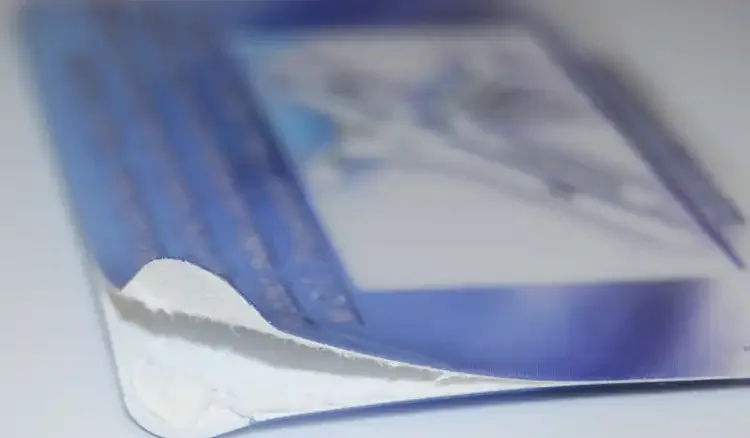
Some cheap ‘plastic cards’ are paper cards with a thin plastic film on each side. In a photo they look the same as a PVC card. In use they behave nothing like one: the film lifts at the corners, the card goes dog eared, and if it gets wet the paper inside swells and the card comes apart.
If the listing doesn't say what the card is made of, ask. The words to look for are solid PVC.
At CP CardsOur full colour PVC cards are solid plastic all the way through. They won't go dog eared or fall apart if they get wet.
4What thickness and finish will you get?
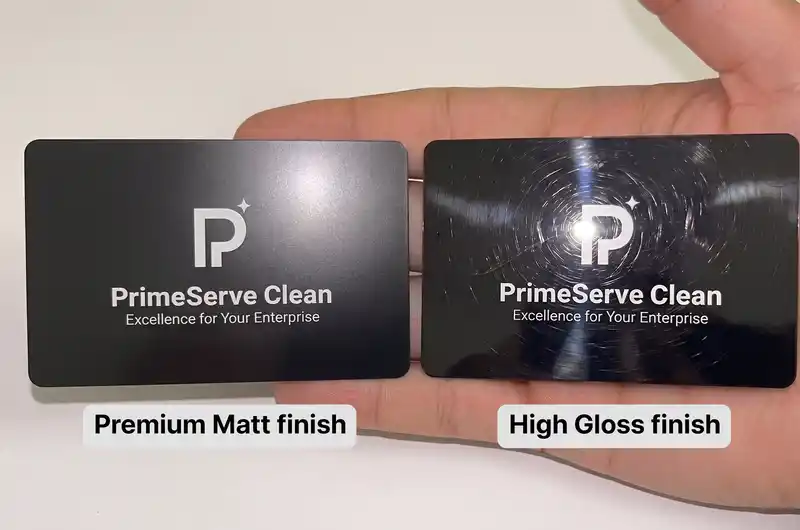
The standard plastic card is CR80 size, 86 x 54mm, and 760 microns (0.76mm) thick. That's the size and thickness of a bank card, and it's what wallets, card holders and card readers are made for. If a quote gives the size but not the thickness, ask, because a thinner card looks the same in a photo.
Ask about the finish too. A full colour PVC card has a high gloss or a matt surface. Gloss makes colours look deeper and richer, but shows fine scuffs as the card is handled. Matt shows scuffs and fingerprints less, and softens the colours a little.
If you want an eco card, ask what it's made of and how thick it is. ‘Eco’ covers some very different materials.
At CP CardsOur standard PVC cards are 760 microns, CR80 size. High Gloss is included in the price, and Premium Matt is £20 +vat per order. For lower-impact cards we also supply recycled PVC (98% recycled), EcoTough, biodegradable and Plastic-Free Board cards.
5Will barcodes, numbers and names last?
Loyalty cards, membership cards and gift cards often carry something unique to each card: a barcode, a membership number, a name or a QR code.
A lot of card companies print these on the surface, on top of the finished plastic, after the card itself has been made. Surface ink is the first thing to wear off. A worn barcode won't scan, and a card that won't scan can't do its job.
Ask whether barcodes and numbers are printed at the same time as the design and sealed under the plastic, or added on top afterwards.
At CP CardsWhen your order has barcodes, sequential numbering or personalisation, they're printed inside the plastic along with your design and sealed under clear PVC, for maximum durability.
Seeing it before it's printed
Two ways to check your cards before the full order goes on the press.
6Will you see a proof before anything is printed?
A proof is a picture of your finished card, made from your artwork, that you approve before printing starts. It's your chance to catch a spelling mistake, a phone number with a digit missing or a logo too close to the edge, before it's on a few hundred cards.
Check the proof is free, that you can ask for changes, and that nothing will be printed until you've approved it. Ask whether anyone checks the artwork file itself as well. A low resolution logo or missing bleed won't always show on a small proof.
At CP CardsEvery full colour order comes with a free, high quality photorealistic email proof, and we aim to send it within an hour. You can ask for changes until you're happy, and nothing goes to print until you've approved it in writing. A person opens and checks every artwork file, and the check is free.
7Can you approve a real printed card first?
An email proof shows the layout and wording. It can't show the exact colour, because every screen shows colour differently, and the same artwork prints differently on plastic than on paper. If a brand colour has to be right, or the order is a large one, ask whether the printer will print a few real cards and post them to you first.
Ask whether those cards come off the same presses as the full order, or are mocked up on a desktop printer. Only cards from the production presses show you what you'll actually get.
At CP CardsOur postal proof is a few real cards, printed on the production presses, bonded and cut to size, and posted to you to approve. It's £65 +vat and adds around 5 working days. It's optional, and most customers choose not to have one. Why colours can look different when printing on plastic is explained on our page about Pantone colours.
Price, timing and delivery
Three checks that stop a cheap quote turning into an expensive order.
8Is the price the whole price?
Two quotes for the same cards can be hard to compare. One includes delivery and the other adds it at the end. One quotes with VAT and the other without. One includes the proof and the finish, and the other charges for each.
Ask for the total for the quantity you want, and compare totals rather than headline prices. The things to ask about:
- Is delivery included, and to where?
- Do you pay for proofs, or for checking the artwork?
- Is the price with or without VAT?
- What do the extras cost, such as a matt finish, a magnetic strip or numbering?
At CP CardsOur prices include your free photorealistic proof and delivery within Great Britain, and as we deal predominantly with businesses VAT is excluded. Quotes are valid for 30 days.
9How few cards can you order?
Some printers only take orders in the thousands, or price small runs so high they're barely worth ordering. If you're a small business, a new club or trying out a design, you want to order the cards you need, not pay for a box you'll never use.
Ask for the minimum order, and ask for prices at two or three quantities. The price per card falls as the quantity rises, so it's worth seeing where the steps are.
At CP CardsYou can order from 25 cards. Standard full colour PVC cards are £75 +vat for 25, £85 +vat for 100 and £245 +vat for 1,000.
10How long will it take, door to door?
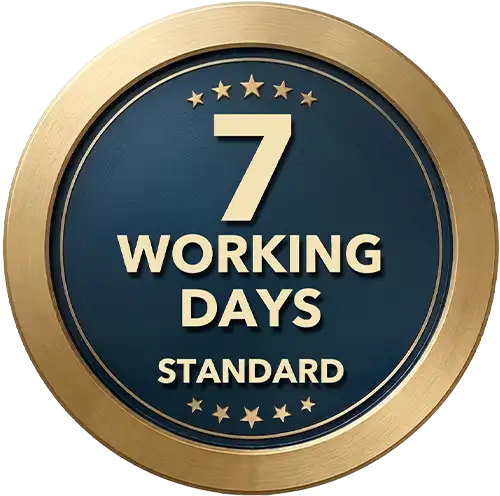
‘Fast turnaround’ can mean almost anything. You need two numbers: how many working days the printer takes to make the cards, and how long delivery takes after that. Check when the clock starts too, whether that's when you order, when you approve the proof or when you pay.
Cards printed overseas add shipping time on top. If the cards are for a launch or an event, work back from the date and leave yourself a margin.
At CP CardsStandard production is 7 working days from proof approval and payment, and an express service of 3 to 4 working days is also available: tell us your deadline and ask us for cost and availability. Orders go by courier, next working day to England, in plain packaging with no invoice inside, so we can send them straight to your own customer. See our delivery prices for elsewhere.
Who you'll be dealing with
The last two checks are about the people behind the cards.
11Will a real person reply, and how quickly?

When something needs sorting, such as a deadline, a change to the artwork or a question about barcodes, you want a quick answer from someone who knows your order, not an automated reply. Ask the supplier how fast they reply, and who replies.
Answers in writing have a benefit of their own. The artwork, the quantities and what was agreed are all there for both of you to check later, and nothing depends on someone remembering a phone call.
Read the supplier's reviews, and read the recent ones, because they tell you how the company treats customers now. Look at what reviewers talk about, not only the star rating.
At CP CardsEmail us at sales@cpcards.co.uk and a real person will reply. We aim to reply within 10 minutes, 9 to 5, Monday to Friday. We work by email, so every detail of your order, from the artwork to your approval, is in writing. We're rated 5.0 on Google from over 240 reviews, and card quality is what reviewers mention most.
12Will they put it right if something goes wrong?
A proof catches most problems before anything is printed, but now and then a fault gets through: a print fault on part of the run, or cards damaged on the way. What matters is what the supplier does next.
Ask what happens if cards arrive faulty, how long you have to report it, and whether they reprint or refund. Read the terms and conditions before you order, not after you've found a problem.
It also helps to know who is responsible for what. A supplier should stand behind their printing. You're responsible for the wording and details you approve on the proof, which is why it's worth checking the proof carefully.
At CP CardsWe check every order by hand and won't put artwork to press if something looks wrong. If any cards arrive defective, tell us in writing within 24 hours of delivery and we'll reprint them. Our terms and conditions set out exactly how it works.
What our customers say
5.0 from 248 Google reviews
Questions & Answers
-
What should I check before buying plastic cards?
Check where the cards are printed, whether the print is sealed inside the plastic or sits on the surface, whether the card is solid PVC or has a paper core, and its thickness and finish.
Check you'll get a free proof before anything is printed, and whether a real printed proof is available. Then check the full price including delivery and VAT, the minimum order, the turnaround in working days, how quickly a real person will reply, and what happens if something goes wrong.
-
What is the difference between surface printed and sealed plastic cards?
On a surface printed card the ink is on the outside of the plastic, so the print takes all the wear and can scuff or wear off.
On a card with the print sealed inside, the design is printed onto a central PVC sheet that is bonded between two clear PVC sheets. The surface you touch is clear plastic, and the print underneath can't scratch or wear off. All our full colour PVC cards are made this way.
-
Are barcodes printed on the surface of the card?
On many cards they are. A lot of card companies print barcodes and numbers on the surface, on top of the finished plastic, where they can scuff and stop scanning.
When barcodes, numbering or personalisation are printed with one of our full colour PVC orders, they're sealed under clear PVC with the design, for maximum durability.
-
How can I tell if a plastic card has a paper core?
Ask the supplier what the card is made of and look for the words solid PVC. A paper-core card is a paper card with a thin plastic film on each side. It looks the same in a photo, but the film lifts at the corners and the card can come apart if it gets wet.
-
Are your plastic cards printed in the UK?
Yes. Our cards are high quality and printed in England, not cheap imports. For most orders we use a plastic card manufacturer we've worked with for over 20 years, so there's no overseas shipping to wait for and the quality stays consistent.
-
Will I see a proof before my cards are printed?
Yes. Every full colour order comes with a free, high quality photorealistic email proof, and we aim to send it within an hour. Nothing goes to print until you've approved it in writing.
If you need to check the colour on a real card, you can order a postal proof for £65 +vat.
-
How long does it take to get plastic cards printed?
Our standard production time is 7 working days from proof approval and payment, and an express service of 3 to 4 working days is also available. Ask us for cost and availability. Cards are then sent by courier, next working day to England.
-
What is the minimum order for plastic cards?
You can order from 25 cards. Standard full colour PVC cards are £75 +vat for 25, including the free proof and delivery within Great Britain.
Put us through the checklist

Email us any of the twelve questions on this page, or ask them with your quote request.
Every full colour order comes with a free photorealistic proof, and nothing is printed until you've approved it.
For a wider look at choosing a supplier, see how to choose a plastic card printer in the UK. Or read about solid PVC cards, postal proofs, printing lead times, plastic card prices, how plastic cards are made, how long plastic cards last and plastic cards vs paper cards.