
Plastic Cards with Barcodes
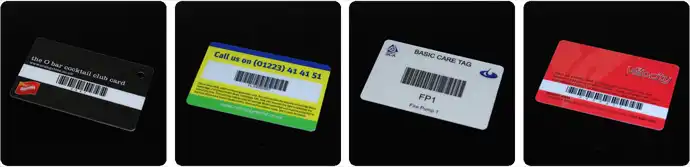
Use: Barcodes are often used for membership and loyalty systems to help record important data.
The barcode number can be linked to a customer which allows important information to be viewed by the operator or points added to the customer's account.
Positioning: The barcode can be located anywhere.
Size: We can print any size you require.
Font: There are a number of different barcodes in use. Examples include code39, code128A and EAN5. We find that code39 is the most popular.
Barcode number: You can either specify a start number, for example: sequential numbering from 0001 onwards or you can supply an Excel document. The barcode can contain letters as well as numbers.
Colour: Barcodes are made up of black parallel lines.
Top Tip: Place your barcode within a white box to ensure the scanner can read it.
See our membership cards for more information.
Barcodes printed on Plastic cards
Barcodes are an invaluable addition to plastic cards such as membership, loyalty and gift cards (to name just a few).
First let’s consider what a barcode actually is; it is a string of numbers and possibly letters, which a machine e.g. a scanner can read. The data can be automatically transferred to a computer software system (Point of Sale system / POS) to assist with data entry, recording and ultimately efficiency.
In everyday use a barcode can provide a business with huge amounts of important information such as tracking busy times in a gym and therefore knowing when more staff members are needed or when off peak / on peak times should be set.
The technology surrounding barcodes and barcode systems is constantly changing, for example many mobile phones are now capable of reading barcodes; barcodes have evolved from simple parallel lines to QR codes which are capable of holding lots of data.
The most popular barcode that we print on plastic cards is code 39 otherwise known as 3 of 9 which is mainly used for identification purposes e.g. sports club members. The second most popular being QR codes, which often link to websites. Other popular barcode types are code 128 and UPC but please ask if you need a different barcode type as I am sure we can help.
There are many ways barcodes can be used to help businesses; a few examples are detailed below:
Tickets: Barcodes can be used for admission to a number of social events such as sports matches, cinemas and theme parks. All our barcodes are printed under the surface and are therefore protected from being rubbed away. This is especially important when the plastic cards are used for season tickets as they need to offer durability.
Gift cards: Plastic gift cards are very popular in many industries. Each card is printed with a different barcode so that it is unique. The cashier usually programs the value of the gift card into the Point of Sale system when the gift card is purchased. When the gift card is redeemed by the recipient, the barcode is scanned to show the value and the purchase amount is deducted from the card. If there is a balance left this will remain on the point of sale system for future use.
Business cards: QR codes can be used as an interactive way to direct a customer to a website, a specific product or service which is advertised on special offer or to allow ease of input / transfer to a smart phone for contact details in the form of a V Card.
Loyalty cards: Barcodes allow each card to be individually identifiable & loyalty points to be easily and accurately added or removed to / from the customer’s account.
Make your customers feel special by offering a loyalty programme.
Membership cards: Allow access to businesses such as gyms. When a new member signs up they are provided with a membership card, which has a unique number. This number is usually the customer’s membership number. The barcode may provide access to a building and allow monitoring of members’ actions. Point of Sale systems may allow reports to be run to easily see which members need to renew.
A few things for you to consider:
If you are unsure which barcode type you need please ask your point of sale system (POS) provider which barcode format you need and if any particular characters are needed.
Please consider asking us to add a human readable version of the barcode as this allows the number to be input manually if this is required or if your scanner is unavailable.
Have a think about the size you require the barcode to be, too small and you may not be able to scan it, too large and it may dominate the plastic card design. We recommend the barcode is placed in a white box to ensure it can be scanned easily.
Finally, please remember that not all plastic cards are the same. Cheap plastic cards are usually cheap for a reason. We print in England, offer great quality & durability and quick turnaround times.
Please don’t risk your time and money having to recall all the plastic cards with barcodes that you have issued to customers or members as a result of buying cheaper, inferior cards.
The Code 39 vs Code 128 Guide: Differences and Similarities
Choosing the right barcode for your business operations means understanding the differences between popular barcode symbologies, such as Code 39 vs Code 128. Both of these barcode types are widely used across a variety of industries, but each serves a unique purpose, depending on the data you need to encode and the available space.
In this guide, we’ll explain the differences and similarities between Code 39 and Code 128. We’ll also talk about when to use each type and how to create and print barcode labels. Whether you’re managing inventory or shipping products, choosing the right barcode can make all the difference to your operational efficiency.
What Is Code 39?
Code 39 is a type of barcode symbology that can encode alphanumeric characters. It is often used to label goods, inventory, ID badges, and more where a simple barcode is needed.
- Character set: Digits 0-9, uppercase letters A-Z, and a few special characters like -, $, +, /, %, ., and space.
- Start/stop characters: Uses an asterisk (*) at the beginning and end.
- Variable length: Initially 39 characters, now increased to 43.
- Self-checking: Doesn’t require a separate checksum but allows for an optional one.
Code 39 is also known as the “3 of 9 code” because each character consists of nine bars/spaces, three of which are wide.
What Is Code 128?
Code 128 is a high-density barcode used for encoding large amounts of data in a small space, commonly found in logistics, shipping, and inventory.
- Character set: Full ASCII 128-character set (A-Z, a-z, 0-9, special characters, and control codes).
- Subsets:
- Code 128A: Uppercase letters, numbers, punctuation, and control codes.
- Code 128B: Uppercase and lowercase letters, numbers, and punctuation.
- Code 128C: Pairs of digits (very compact).
- High data density
- Checksum: Uses modulo-103 for accuracy.
- Start/stop characters: Non-visible subset-specific start/stop symbols.
How Are They Different?
- Character set: Code 39 supports 43 characters; Code 128 supports full ASCII set.
- Data density: Code 128 is more compact.
- Length: Code 39 limited to 43; Code 128 has no character limit.
- Checksum: Optional for Code 39; required for Code 128.
- Start/stop: Visible asterisks in Code 39; special symbols in Code 128.
- Use cases: Code 39 for basic labels and IDs; Code 128 for logistics and complex tracking.
- Error correction: Code 128 includes it; Code 39 does not.
When to Use Code 39
Use Code 39 when data is short, scanners are older, or space is not an issue.
- Inventory management
- ID cards
- Government/military (LOGMARS)
- Basic product labelling
- Healthcare equipment and patient IDs
- Basic shipping and logistics
- Tool/equipment tracking
- Libraries
When to Use Code 128
Use Code 128 when encoding lots of data, using mixed characters, or when accuracy and space-efficiency are important.
- Logistics (e.g., UPS, FedEx, USPS)
- Serialisation and packaging
- Healthcare (e.g., GS1-128 for compliance)
- Retail product tracking and POS
How Are They Similar?
- Both are 1D/linear barcodes.
- Both can encode alphanumeric data.
- Both are widely used in many industries.
- Both can be scanned with standard barcode scanners.
- Both support variable lengths.
- Both use start/stop characters.
- Both have ISO certification.
How to Design and Print Code 39 and Code 128 Labels
- Determine your data: Know your barcode needs before choosing the type.
- Generate the barcode: Use online tools or software; both symbologies are public domain.
- Design the label: Include barcode, text, logos; ensure scannability.
- Print the label: Use thermal printers for best quality; test before mass printing.
Tips for printing:
- Use adequate barcode size to avoid scanning issues.
- High-quality material prevents smudging or fading.
- Keep label layout clean and aligned.
- Ensure label is securely attached to clean surfaces.
Conclusion
Code 39 is ideal for simpler, short-length data when space isn’t constrained. Code 128 is preferred for compact, information-dense applications. In many operations, both can be used for different purposes.