

RFID vs NFC — What's the Difference for Plastic Cards?
NFC is a type of RFID. But not all RFID is NFC — and if you order the wrong chip format, your cards will not work with your readers. This is one of those areas where a small technical misunderstanding leads to an expensive mistake.
This guide explains the difference clearly, and tells you exactly what to specify when ordering.
The relationship between RFID and NFC
RFID (Radio Frequency Identification) is the broad technology. It covers any system that uses radio waves to communicate wirelessly between a card and a reader. NFC (Near Field Communication) is a specific subset of RFID — it operates at a fixed frequency of 13.56MHz, over a maximum range of around 4cm, and follows standardised protocols that allow it to work with smartphones and readers from different manufacturers.
Think of it this way: all NFC is RFID, but most RFID is not NFC.
How RFID works in a plastic card
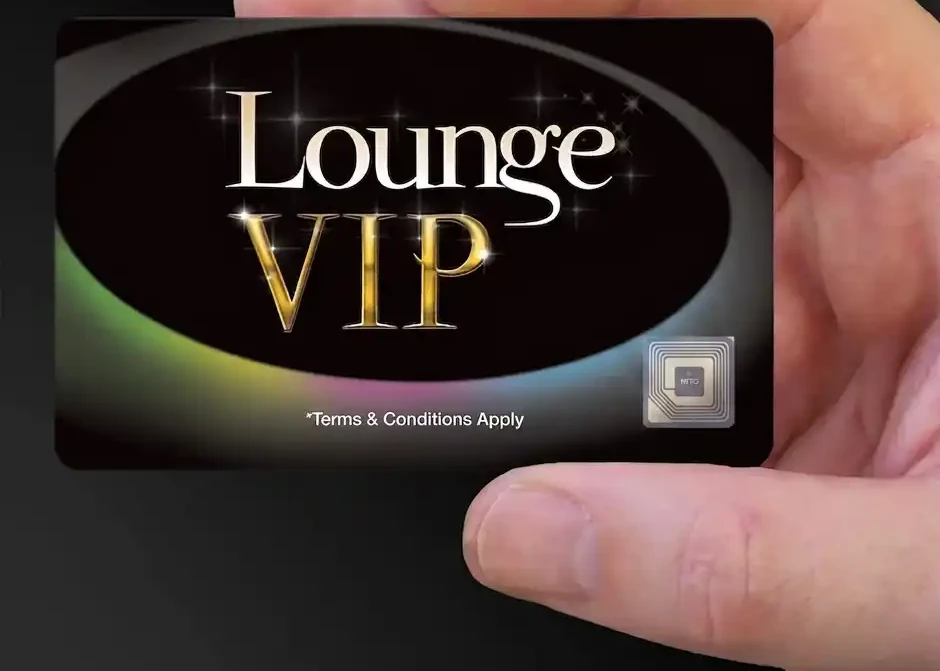
An RFID card contains a chip and an antenna, both embedded inside the card body between the PVC layers. The card looks and feels like a standard plastic card — there are no visible components. When the card is brought close to a reader, the reader emits a radio signal that powers the chip wirelessly and triggers it to transmit its stored data back to the reader. No battery required.
The whole process takes milliseconds. To the user, it is instantaneous.
RFID frequencies — why they matter
Different RFID systems operate at different frequencies, and a card built for one frequency will not work with a reader built for another. The two frequencies you will encounter on plastic cards are:
| 125kHz (Low Frequency) | 13.56MHz (High Frequency / NFC) | |
|---|---|---|
| Standard | Older, simpler | Modern |
| Common formats | EM4100, HID Prox, Indala | MIFARE Classic, MIFARE DESFire, NTAG series |
| Read range | Up to around 10cm | Up to around 10cm |
| Data | Typically read-only – a fixed ID number that cannot be changed | Read-write, with encryption and multiple applications on one card |
| Works with smartphones | No | Yes – both Android and iOS |
| Two-way communication | No – transmits to a reader only | Yes – can receive data back from a reader |
| Typical use | Legacy access control – offices, car parks, older gym entry systems | Contactless payment, modern access control, transport cards, consumer loyalty |
125kHz (Low Frequency) — the older, simpler standard. Common formats include EM4100, HID Prox, and Indala. Read range up to around 10cm. These cards are typically read-only — they store a fixed ID number that cannot be changed. Widely used in legacy access control systems in offices, car parks, and older gym entry systems. Cannot interact with smartphones.
13.56MHz (High Frequency / NFC) — the modern standard. Common formats include MIFARE Classic, MIFARE DESFire, and NTAG series. Read range up to around 10cm. Supports read-write capability, encryption, and multiple applications on one card. Can interact directly with NFC-enabled smartphones — both Android and iOS. Used in contactless payment, modern access control, transport cards, and consumer-facing loyalty applications.
What NFC adds over standard RFID
NFC is not just a frequency — it is a set of standardised protocols built on top of 13.56MHz RFID. Those standards are what allow NFC cards to work with smartphones without a dedicated reader, and what allow different manufacturers' systems to communicate with each other reliably.
NFC also supports two-way communication. A standard 125kHz RFID card only transmits data to a reader. An NFC card can receive data back from a reader, which enables more sophisticated applications — updating stored data, logging transactions on the card, and so on.
Which one do you need?
If you have existing access control readers: check what frequency your readers operate at before ordering anything. If they are 125kHz, you need 125kHz cards — NFC cards will not work with them regardless of what anyone tells you. If they are 13.56MHz, specify the correct chip format for your system (MIFARE Classic, DESFire, etc.).
If you want cards that work with smartphones: you need NFC (13.56MHz). This is the only practical option for cards that tap into a phone app, trigger a URL, share contact details, or interact with any consumer device.
If you are building a new system from scratch: specify NFC (13.56MHz). Modern access control systems increasingly support 13.56MHz readers, and NFC gives you more capability and future-proofing than 125kHz.
What to specify when ordering
Tell your card printer the exact chip format you need, not just "RFID" or "NFC" — those terms are too vague to guarantee compatibility with your system.
| Chip format | Frequency | Best for |
|---|---|---|
| EM4100 | 125kHz | Basic legacy access control. Read-only, fixed ID. |
| HID Prox | 125kHz | HID-compatible access control systems. |
| MIFARE Classic 1K | 13.56MHz | Widely used. Good for loyalty and basic access control. Moderate security. |
| MIFARE DESFire EV2 / EV3 | 13.56MHz | High security, multi-application. Used in transport cards and secure ID systems. |
| NTAG213 / 215 / 216 | 13.56MHz | NFC tag standard. Ideal for smartphone-facing applications – digital business cards, NFC loyalty tap, URL redirect on tap. |
If you are not certain which format your system uses, check with your access control or loyalty software supplier before ordering. Getting it wrong means cards that do not work, and cards cannot be re-chipped after printing.
Can you have both frequencies on one card?
Yes — dual-frequency cards exist, combining a 125kHz chip and a 13.56MHz NFC chip in a single card body. These are useful when you need backward compatibility with legacy readers while also supporting modern NFC applications or smartphone interaction. They cost more than single-frequency cards but can save the cost of replacing readers during a system upgrade.
Ready to order?

We supply RFID and NFC plastic cards printed in England, with free UK delivery. If you know your chip format, get a quote and we will turn around a proof quickly. If you are not sure what you need, get in touch and we will help you work it out before you commit.
View our plastic card printing options or contact us with your requirements.