
How Plastic Cards Are Made
A plastic card isn’t printed on its own. Your design is printed 21 times on a large sheet, that sheet is bonded between two clear PVC sheets with heat and pressure, and only then are the cards cut out.
That order of events is why the print on a good plastic card sits inside the card rather than on top of it, and why it can’t wear off. This guide follows a full colour order from the artwork you send to the box that arrives, with diagrams of each stage.
The short versionArtwork, proof, print 21 to a sheet, bond between clear PVC, cut out, add the extras, check, deliver. Our cards are printed in England, and standard production is 7 working days from proof approval and payment.
The process at a glance
Eight stages, the same for every full colour PVC order whether it’s 25 cards or 5,000. Most of the time goes on the stages in the middle, because a sheet has to be printed, bonded and cut before a single card exists.
- ArtworkYou send your design, or our in-house designers create one for £29 +vat.
- ProofWe email a free photorealistic proof, usually within the hour. Nothing is printed until you approve it in writing.
- PrintYour design is printed in full colour, 21 cards to a sheet.
- BondThe printed sheet is bonded between two clear PVC sheets with heat and pressure.
- CutThe cards are cut out to 86 x 54mm, with rounded corners.
- ExtrasSignature strips, scratch-off panels, embossing and holes are added, and magnetic strips encoded.
- CheckWe check every order by hand before it goes out.
- DeliverYour cards go by courier in plain packaging, with no invoice inside.
Artwork and proof
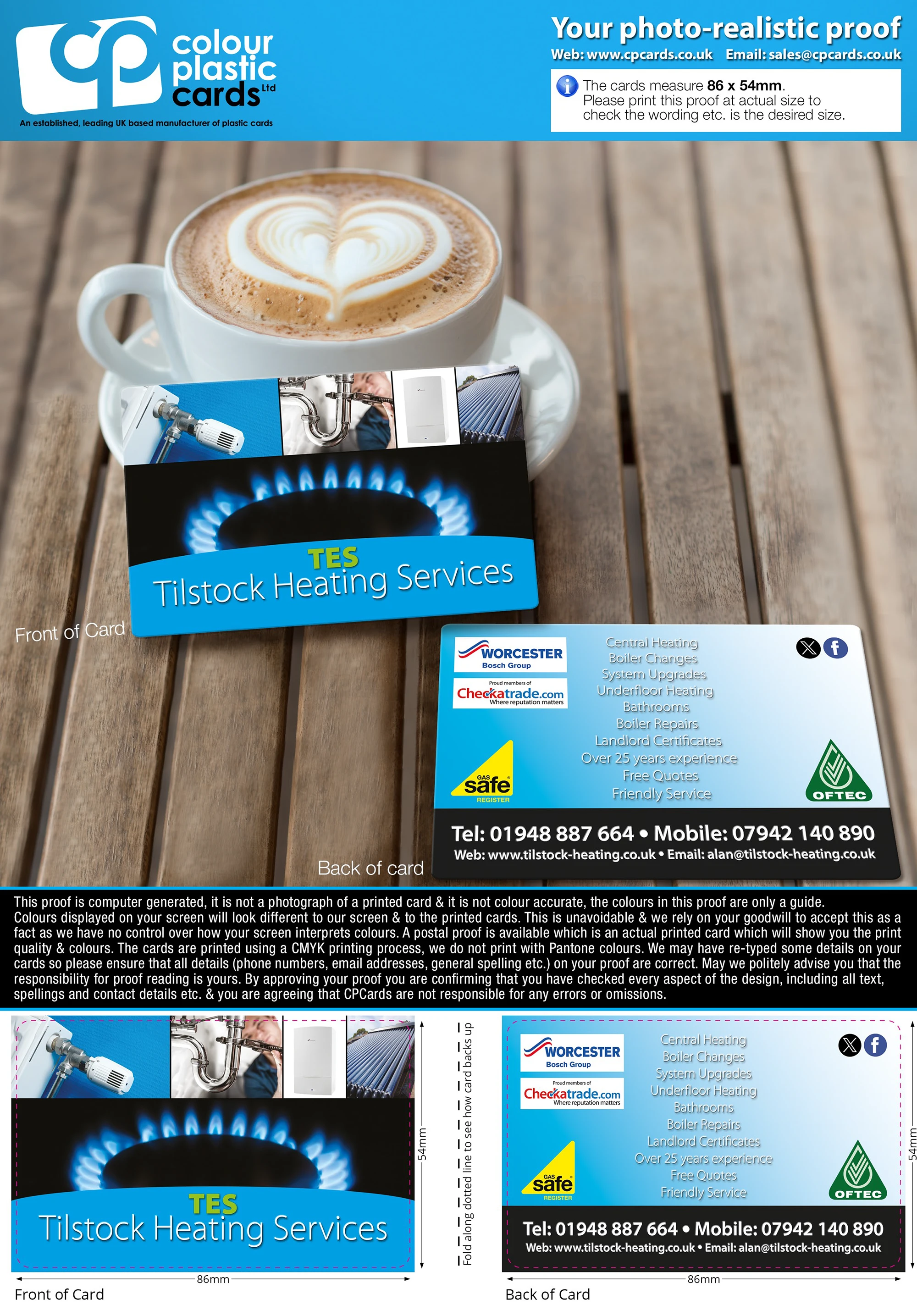
Everything starts with a print-ready file: your design at 92 x 60mm, which is the 86 x 54mm card plus 3mm of bleed all round, in CMYK. If you don’t have one, our design service will create it for £29 +vat, and if your file needs fixing we can do that for £10 +vat. The artwork setup guide covers bleed, resolution and colour.
A person then checks the file for technical problems, such as missing bleed or a low-resolution image, and builds a free photorealistic proof of your card, which we aim to email within the hour. Checking the wording, spelling and numbers on the proof is down to you: you can ask for changes until it’s right, and nothing goes to print until you’ve approved it in writing.
If a colour has to be right, or you need to test a barcode on your own scanner, you can ask for a postal proof instead: a few real cards from the production presses, posted to you. It’s £65 +vat and adds around 5 working days.
Printing, 21 to a sheet
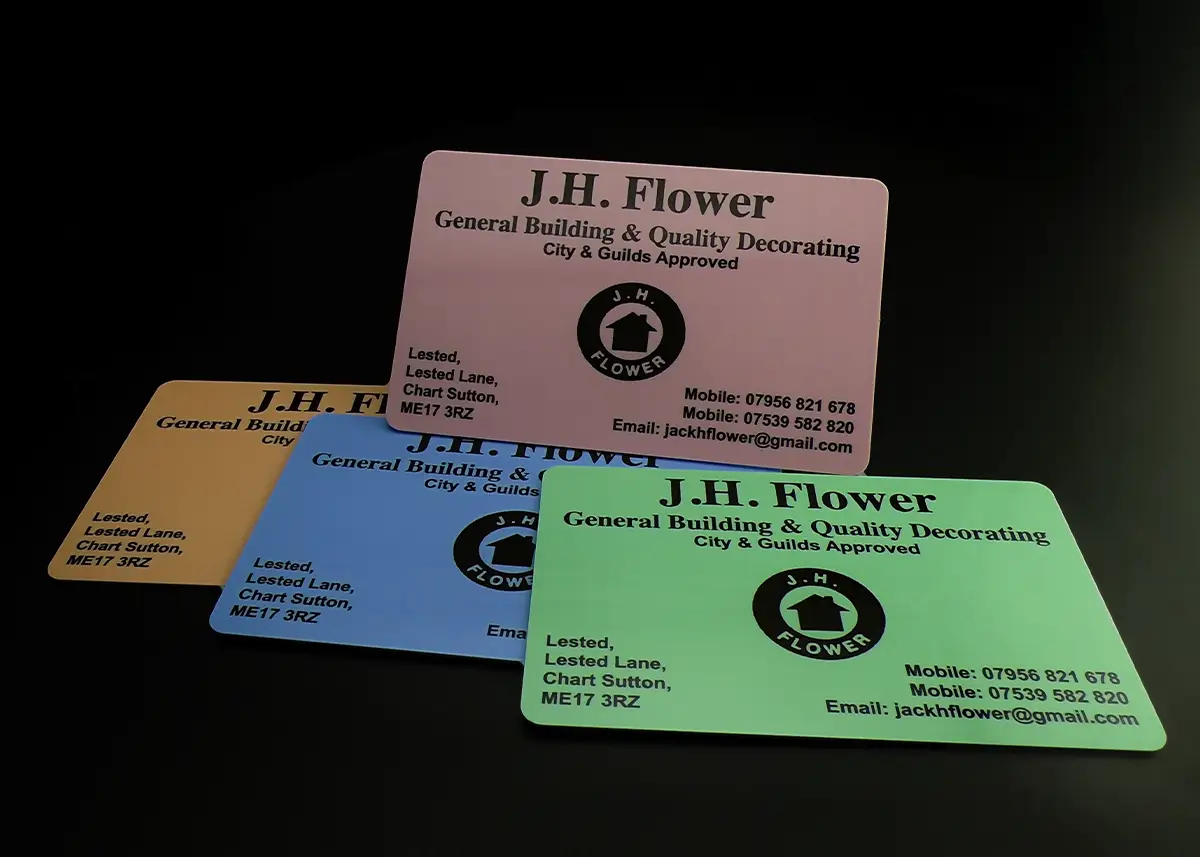
Cards are printed in sheets, not one at a time. Your approved design is laid out 21 times on a sheet and printed in full colour CMYK, the four process inks that mix to make every colour on the card. The card is printed on both sides at no extra cost.
If every card carries something different, such as a name, a membership number or its own barcode, those details are printed as part of the same run, straight from the spreadsheet you send us. Every card on the sheet is then different, but they’re all printed together.
Bonding between clear PVC
The printed sheet goes between two sheets of clear PVC, and heat and pressure bond all three into one solid sheet. This is the step that turns printed plastic into a card: it takes the sheet up to its finished thickness of 760 microns (0.76mm, the same as a bank card) and gives the surface its finish, High Gloss or Premium Matt.
Bonding is also what protects the print. Once the clear PVC is bonded over it, nothing touches the ink again: not fingers, not keys, not the inside of a wallet. Our page on solid PVC plastic has an exploded drawing of the three layers in a single card.
Why the finish is chosen earlyThe clear PVC changes how the colours look. High Gloss makes them deeper and brighter, and Premium Matt softens them. That’s why we ask which finish you want before you approve the proof. High Gloss is included in the price; Premium Matt is £20 +vat per order. See High Gloss v Premium Matt.
Cutting the cards out
The bonded sheet is cut into individual cards: 86 x 54mm with rounded corners, the size of a bank card, which is known as CR80. That’s why your artwork needs 3mm of bleed. The cut can’t land on exactly the same line on every card, so the background runs past the edge and is trimmed off, and the 3mm safe zone inside the edge keeps your text well clear of the cut.
It’s also why even one card costs real money to make. A single card still needs a whole sheet to be printed, bonded and cut, just like a full order, which is why our minimum order is 25 cards. More on that in minimum order quantities.
Adding the extras
Optional extras don’t all go on at the same time. Some are printed with the design and sealed in with it, some sit on top of the finished card, and some go right through it. Where an extra sits decides how it wears.
- Signature strip or write-on panel. Sits on top of the card surface, so it takes an ordinary pen. Nothing can be printed on the strip itself.
- Scratch-off panel. Also on top, covering a code that’s printed underneath.
- Embossing. Raised characters pressed through the card, so they show through on the back.
- Holes and slots. Punched right through, 6mm in from the edge, for a lanyard or clip.
- Your design, barcodes, QR codes, numbers and names. Printed with the design and sealed under the clear PVC, so they can’t rub away.
- RFID chip. Built into the core of the card, out of sight.
The layers, from the top: clear PVC, your printed front, the PVC core, your printed back and clear PVC again. A magnetic strip runs along the back of the card, 3mm down from the top edge, and can be encoded for you or left blank for you to encode. Metallic foiling is applied with heat and pressure, by the same hot foil process as our foil cards.
Checking and delivery
We check every order by hand, and we won’t put artwork to press if there’s a technical problem with it, such as missing bleed or a low-resolution image.
Orders go by courier in plain, unbranded packaging with no invoice or paperwork inside, so you can send them straight to a customer. If any cards arrive defective, tell us in writing within 24 hours of delivery and we’ll reprint them. Our terms and conditions set out exactly how that works.
How long it takes
| Stage | How long |
|---|---|
| Photorealistic email proof | We aim to send it within the hour |
| Standard production | 7 working days from proof approval and payment |
| Express production | 3 to 4 working days: ask us for cost and availability |
| Postal proof (optional) | Adds around 5 working days |
| Delivery | By courier once your cards are despatched |
The clock starts when you approve the proof and pay, so the quickest orders are the ones with print-ready artwork and a fast approval. Tell us your deadline when you ask for a quote and we’ll tell you straight away whether it can be met. Our guide to turnaround times covers what else affects it.
Why the print lasts
Not every plastic card is made this way. Some are printed on the surface of a blank card, with the ink exposed. Daily handling wears that print away, starting with the corners and anything that rubs against a wallet, and a worn barcode stops scanning.
The extras that sit on the surface, such as a signature strip or a scratch-off panel, are there to be written on or scratched, so they show their use. Everything printed with your design stays as it was printed. Our checklist before you buy plastic cards explains how to ask a supplier which kind of card you’re getting.
Hot foil and eco cards are made differently
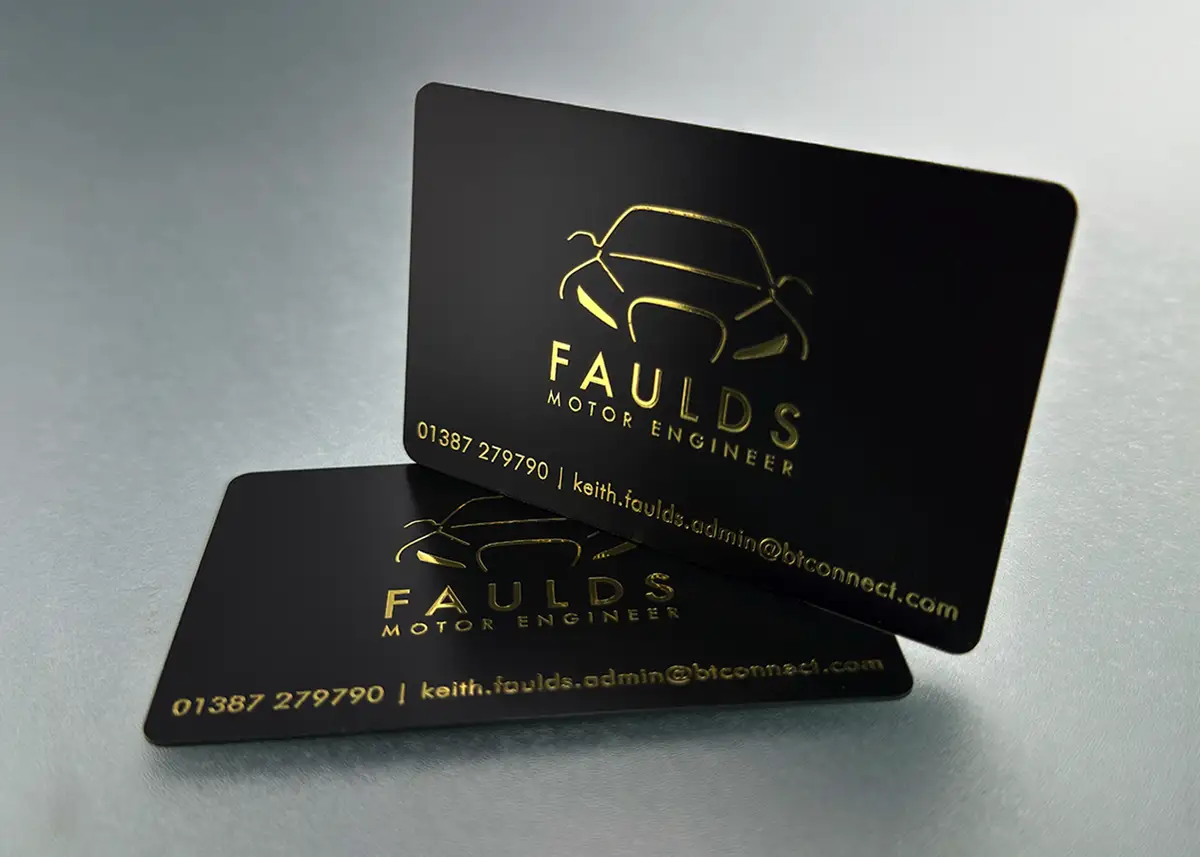
Everything above is how our full colour PVC cards are made. Two other kinds of card are made another way.
- Hot foil cards. Our clear frosted, satin black, metallic and white cards start as solid coloured PVC, and the design is pressed onto them with heated foil, up to 4 colours from a range of 42 foils. Foil prints solid colour only, so there are no photographs or gradients. See how hot foil printing works.
- Eco materials. EcoTough is a lightweight PVC-free and laminate-free material, and Plastic-Free Board contains no PVC at all, so neither is bonded between clear PVC and neither has a gloss or matt finish. Biodegradable and recycled PVC cards are printed in full colour like our standard cards.
Questions & Answers
-
How are plastic cards printed?
Full colour plastic cards are printed in CMYK, 21 to a sheet. The printed sheet is bonded between two clear PVC sheets with heat and pressure, which takes it to 760 microns thick, and then the cards are cut out to 86 x 54mm.
-
Is the print on the surface of the card?
Not on our full colour PVC cards. The print is sealed under clear PVC, so it can’t wear off with handling. Signature strips and scratch-off panels are the exceptions: they sit on top of the card by design.
-
Are your cards made in the UK?
Yes. Our cards are printed in England. For most orders we use a plastic card manufacturer we’ve worked with for over 20 years, so the quality is the same every time.
-
Why can’t you print just one card?
Because one card takes the same work as a full order: a whole sheet is printed, bonded and cut to make it. That’s why our minimum order is 25 cards. If you need to see a real card first, ask for a postal proof.
-
How long does it take to make plastic cards?
Standard production is 7 working days from proof approval and payment. Express production of 3 to 4 working days is also available: ask us for cost and availability.
-
When are barcodes and numbers added?
They’re printed with your design, from the spreadsheet you send us, and sealed under the clear PVC with everything else, so they can’t rub away. Signature strips and scratch-off panels are added on top of the finished card.
-
How thick is a finished card?
Our standard full colour PVC cards are 760 microns, which is 0.76mm, the same as a bank card. RFID cards are 820 microns, biodegradable cards 800 and key tags 680.
-
Can I see a real card before the whole order is made?
Yes. A postal proof is a few real cards printed on the production presses, bonded and cut to size, and posted to you. The first one is £65 +vat, a revised one is £35 +vat, and it adds around 5 working days.
Ready to order?
Every full colour order comes with a free photorealistic proof before anything is printed, so you see your card exactly as it will be made.
Send us your artwork, or tell us what you need, and we’ll email a quote within about 10 minutes, 9am to 5pm, Monday to Friday.
Solid PVC plastic, plastic card thickness, turnaround times, postal proofs, or every term on this page in our plastic card printing glossary.