
Plastic Cards for Cafés and Coffee Shops
The card most cafés start with is a coffee stamp card: buy nine, get the tenth free. After that come gift cards to sell over the counter, a staff or local discount card, a Google review card, and plastic business cards for catering and event enquiries.
This page covers what each card is for, how to set up a stamp card that brings people back, whether to stamp or punch, cards your till can read, and what a first order looks like.

The short versionStart with a ten-box stamp card, buy nine and get the tenth free, and stamp the first box when you hand it over. Use a quick-drying ink or a punch, because ordinary ink smudges on gloss PVC. Add gift cards before Christmas. If your till runs a points scheme, order cards with a barcode instead of boxes.
Which plastic cards does a café need?
Every card below is the size of a bank card, 86 x 54mm and 760 microns thick, printed in full colour on both sides. The print is sealed inside the card, so it can’t scratch or wear off in a wallet full of coins and keys.
| Card | What it’s for | Worth adding |
|---|---|---|
| Stamp card | Bringing regulars back for the tenth coffee | Ten boxes, the rules on the back |
| Points card | A loyalty scheme run on your till or an app | A different number on every card, as a barcode or QR code |
| Gift card | Selling coffee, cake or afternoon tea as a present | Write-on panels for the amount, a number on every card |
| Staff or local discount card | A standing discount for your staff or people who work nearby | The holder’s name or a number, and a valid-until panel |
| Google review card | Asking happy customers for a review | A QR code at least 15mm square |
| Plastic business card | Catering, private hire and wholesale enquiries | A QR code to your menu or booking page |
How to set up a coffee stamp card
A stamp card needs no system: the boxes are the record. Buy nine, get the tenth free is the usual offer because it is easy to explain at the counter and easy to cost. The free coffee is a tenth off the ten coffees it took to earn it.
Hollin & Hearth is a made-up café. The QR code is an illustration and won’t scan.
- Ten boxes for a weekly visit. A regular who comes in once a week fills the card in about ten weeks. If most of your trade is daily commuters, ten boxes go in a fortnight, so think about whether the reward should be bigger rather than the card longer.
- Stamp the first box when you hand it over. The card starts with progress made. Some cafés stamp two.
- Say what earns a stamp. “One stamp for every hot drink” settles whether a tea, a hot chocolate or a takeaway counts before anyone asks at a busy moment.
- Size the boxes for your stamp. Stamp circles are typically 10 to 12mm across, spaced so stamps don’t run into each other. Our guide to designing a loyalty card covers the layout.
- Use a stamp of your own. A stamp with your logo is harder to copy than a generic star, and a shaped punch is harder still.
For rewards that go beyond coffee, such as a free cake after five or a tiered card for your best customers, see our loyalty card ideas. To work out how many to order, see how many loyalty cards should I order?
Stamp, punch, or a card you can write on?
The printed surface of a PVC card is sealed and non-porous, so the ink pad you use on paper loyalty cards will smudge. There are three ways round it.
Our guide to writing and stamping on plastic cards compares pens, inks and punches on each surface.
Cards your till can read
If your till or a loyalty app already runs a points scheme, the card doesn’t need boxes. It needs a number that your system recognises, printed as a barcode or QR code. We print a different number on every card, either in sequence or from a spreadsheet your system gives you, so your system can link each card to a customer.
- Ask your till supplier first which barcode types it reads and whether it can import a list of card numbers. Our guide to loyalty cards and EPOS systems goes through the questions to ask.
- Test before the full run. A postal proof (£65 +vat, around 5 working days) puts real printed cards in your hands, so you can scan one on your own till before the rest are printed.
- Think about key fobs. A key fob card, 54 x 29mm with a 4mm hole, lives on the customer’s keys, so it’s there when they are. A combo card is a full-size card and a key fob joined together, which the customer snaps apart.
Not sure whether you need a barcode or a QR code? See QR code or barcode, and for whether to use a card at all, digital v plastic loyalty cards.
Gift cards for a café
Cafés usually sell one of two kinds: a named treat, such as afternoon tea for two or a coffee and cake, or a money value. A named treat is the easier present to buy. Name the experience rather than the dishes, because menus change, and leave prices off the card for the same reason.
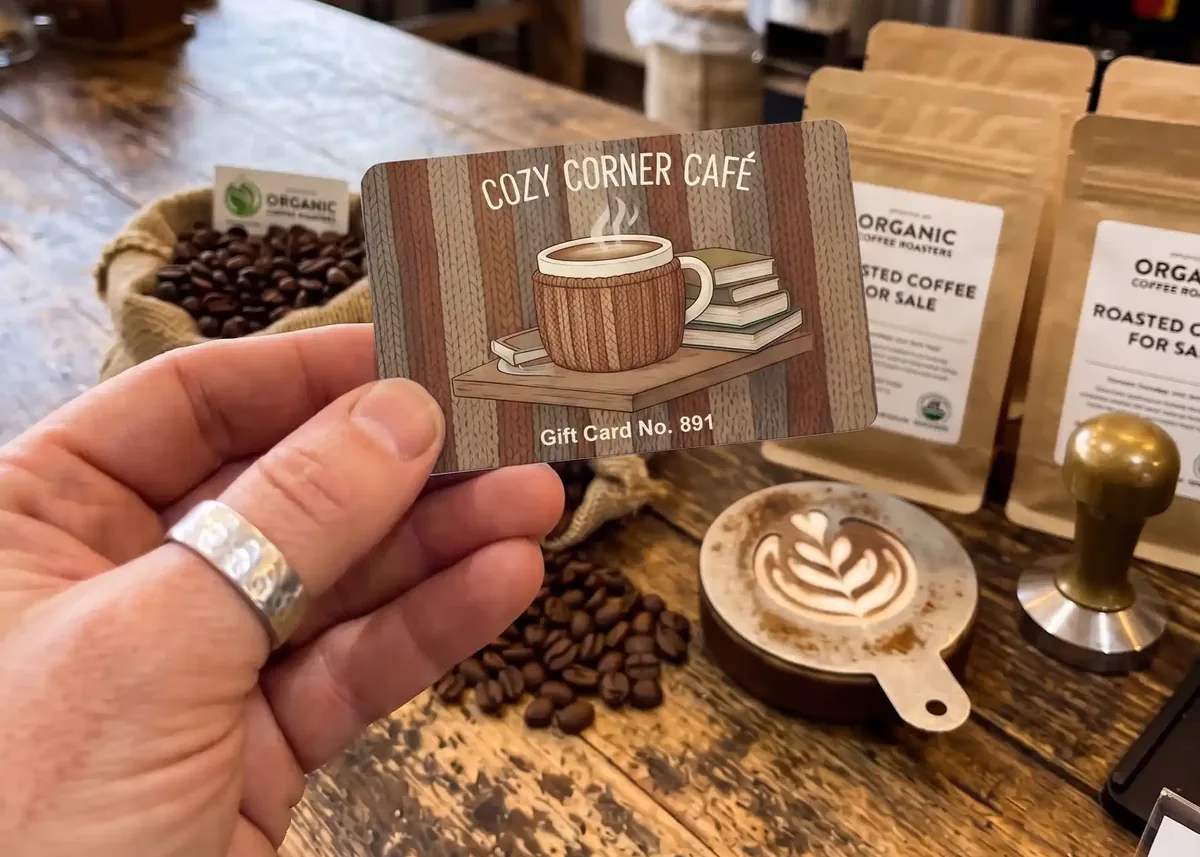
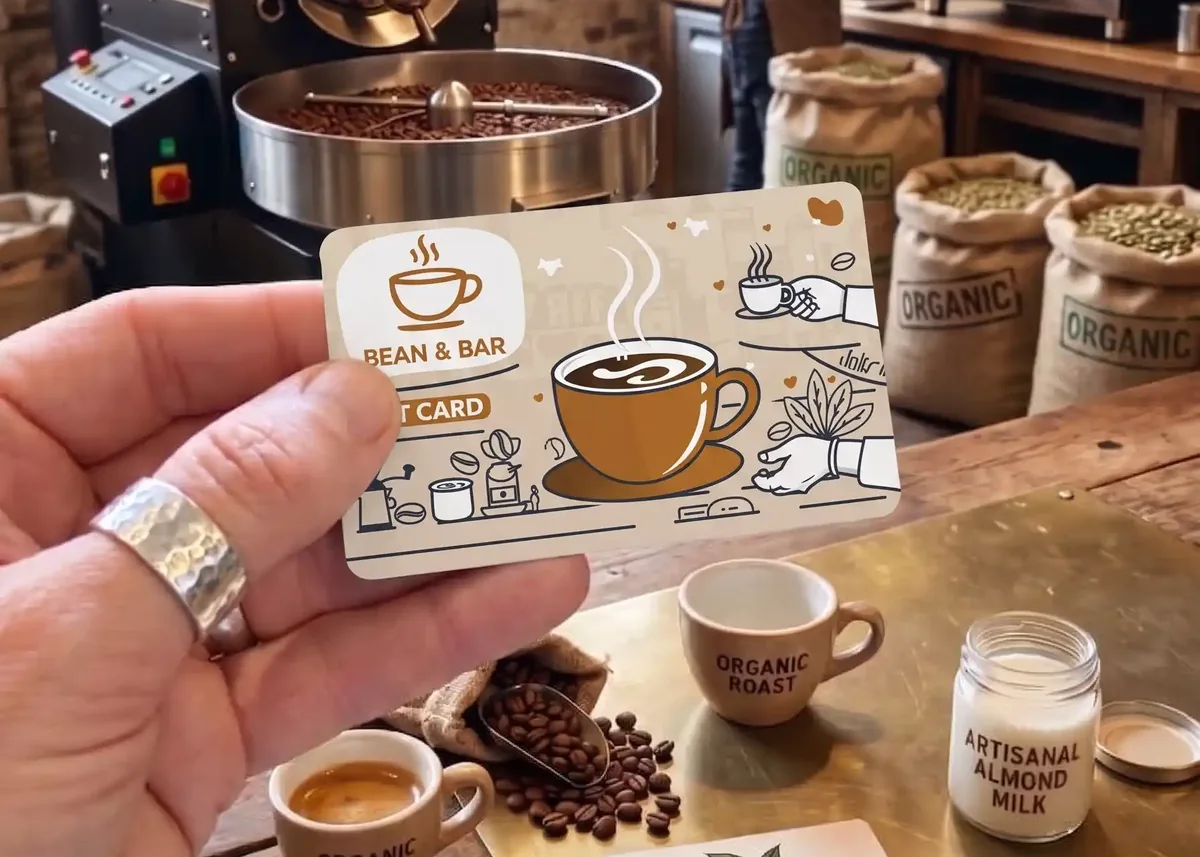
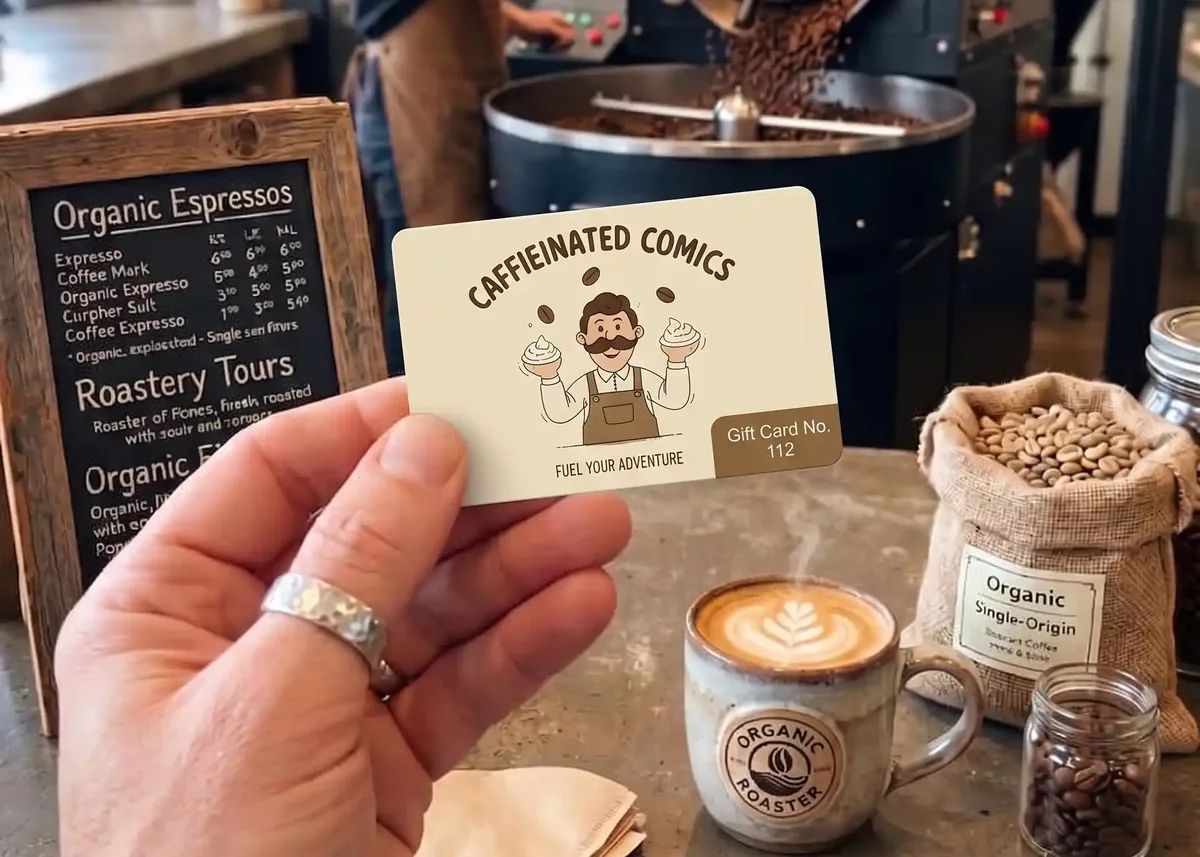
- A number on every card and a register of what each was sold for, so a card can only be spent once.
- Write-on panels for the amount or the treat, the valid-until date and the initials of whoever sold it. They take an ordinary ballpoint pen.
- Order in good time if most of your gift cards sell at Christmas: cards take 7 working days from proof approval and payment.
- Something to hand it over in. A card carrier or wallet turns a card into a present.
Our gift card printing guide sets out four ways to run gift cards, with terms to copy, and how to design a gift card covers the layout. Whether VAT is due when you sell a card or when it’s spent depends on what it can be spent on: see gift card VAT and expiry rules.
Staff and local discount cards
Staff discount card
Printed with each person’s name or a number, a staff card shows the discount is theirs, and doubles as informal ID on a busy shift.
Local discount card
A standing discount for people who work in the offices and shops around you. A valid-until panel lets you renew it each year.
See discount cards for the options, and numbered plastic cards for printing a name or number on each one.
Review cards and business cards
A Google review card has a QR code that opens your review form in one step. Hand one over at the till when a customer is pleased.
Ask, don’t rewardSince 6 April 2025 the Digital Markets, Competition and Consumers Act 2024 has made it unlawful in the UK to hide that a review was incentivised, and Google’s policy bans rewards for reviews. So no free coffee for a review: the card should simply ask.
Plastic business cards earn their place if you do catering, private hire or sell beans wholesale. They wipe clean, and a QR code on the back can open your menu or booking page. See what to put on a business card.
What to order
A typical first order for an independent café:
- Stamp cards for a year of new regulars, with ten boxes on the front and the rules on the back
- Gift cards with write-on panels and a number on every card, ordered in time for Christmas
- Premium Matt (£20 +vat per order) if staff will write on the cards with a marker, or High Gloss (included)
- Optional: review cards for the counter, with a QR code to your Google review form
The prices below are for full colour cards, which covers stamp cards, gift cards, discount cards and business cards. Barcodes, write-on panels and numbering are priced on your quote.
| Quantity | Price | Per card |
|---|---|---|
| 25 cards | £75.00 +vat | £3.00 |
| 50 cards | £79.00 +vat | £1.58 |
| 100 cards | £85.00 +vat | 85p |
| 200 cards | £99.00 +vat | 49.5p |
| 250 cards | £109.00 +vat | 43.6p |
| 500 cards | £175.00 +vat | 35p |
| 1,000 cards | £245.00 +vat | 24.5p |
Full colour on both sides, High Gloss, 86 x 54mm and 760 microns thick. Prices include free delivery within Great Britain and one design printed from your print-ready artwork, with a free photorealistic proof. Prices exclude VAT and optional extras.
Not sure? Just askEmail us a line about your café and the cards you have in mind, and we’ll suggest a set-up with a quote, usually within about 10 minutes, 9am to 5pm, Monday to Friday. Our design service can lay out the cards for £29 +vat.
Questions & Answers
-
What loyalty card works best for a coffee shop?
A ten-box stamp card: buy nine coffees, get the tenth free. A customer who comes in once a week fills it in about ten weeks, and the reward costs you a tenth of those ten coffees.
-
How many stamps should a coffee loyalty card have?
Ten suits customers who come in about once a week. Match the number to how often your regulars visit: the first free coffee should be reachable within a few weeks, or the card gets forgotten.
-
What ink should I use to stamp plastic loyalty cards?
A quick-drying ink made for non-porous surfaces. An ordinary water-based ink pad smudges on gloss PVC. A punch needs no ink at all, and Plastic-Free Board cards take ordinary ink stamps anywhere.
-
Can a café loyalty card work with our till?
Yes, if your till or loyalty software reads barcodes or QR codes. We print a different number on every card, as a barcode or QR code, either in sequence or from a list your system gives you.
-
Can we sell gift cards as well?
Yes. Cafés usually sell a named treat, such as afternoon tea for two, or money values. Print a number on every card and keep a register, so you know which cards have been spent.
-
Can we give customers a free coffee for leaving a Google review?
No. UK law and Google’s own policy both prohibit rewarding customers for reviews. A review card should ask for honest feedback and nothing more.
-
What is the minimum order?
25 cards. Prices per card fall as the quantity rises, so many cafés order a year’s worth of stamp cards at once.
-
How long do the cards take?
7 working days from proof approval and payment. Express production in 3 to 4 working days is sometimes possible: ask us for cost and availability.
Ready to order?
Tell us which cards your café needs, stamp cards, gift cards or both, and we’ll quote for them together.
Your free photorealistic proof shows every box, panel and number in place before anything is printed.