

Can You Write on Plastic Cards?
Not with an ordinary pen on the printed surface. A PVC card is smooth and sealed, so ballpoint ink skips and most other inks smudge. What you write on is a signature strip or write-on panel, which takes an ordinary pen.
This guide covers which pens and stamp inks work on which surface, how to use write-on panels, how to stamp or punch a loyalty card, and the card you can write on anywhere.
The short versionFor anything written by hand, add a signature strip or write-on panel: it takes an ordinary ballpoint pen. For loyalty stamps, use a quick-drying ink made for non-porous surfaces, or a sturdy hole punch. Plastic-Free Board cards take pen and ink stamps anywhere.
What works on which surface
The printed surface of a PVC card is sealed and non-porous: ink has nothing to soak into, so it either won’t take or sits on top and smudges. Write-on panels are made to be written on, and our Plastic-Free Board cards take ink anywhere.
| The printed surface of a PVC card | A signature strip or write-on panel | A Plastic-Free Board card | |
|---|---|---|---|
| Ordinary ballpoint pen | No Skips, and what does write rubs off | Yes What the panel is for | Yes Anywhere on the card |
| Permanent marker | Short term Takes better on Premium Matt than High Gloss, but can still rub or wipe off | Yes | Yes |
| Ordinary ink stamp pad | No Sits on top and smudges | Test first | Yes Anywhere on the card |
| Quick-drying ink for non-porous surfaces | Yes Let it dry before the card goes back in a wallet | Yes | Yes |
| Hole punch | Yes Use a sturdy punch: the card is 0.76mm thick | Avoid It punches through what’s written | Yes |
Test before you commitPens and inks vary, so try yours on a real card before a scheme launches. A sample pack has cards in both finishes to test on, and its cost is deducted from your order if you order within 30 days.
Signature strips and write-on panels
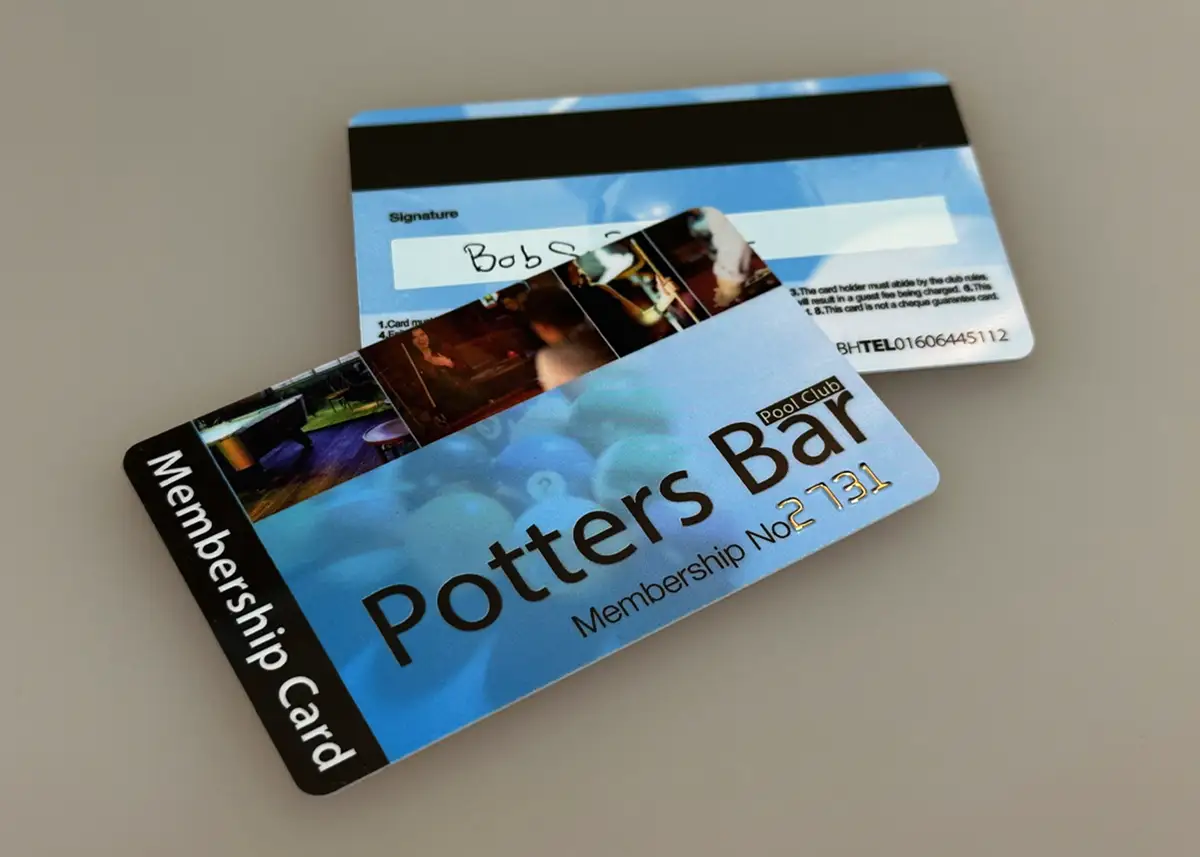
A signature strip, or write-on panel, is a panel that sits on top of the card’s surface and takes an ordinary pen. It’s the answer whenever something has to be written on a card after it’s printed: a signature, a name, an expiry date, a membership level, an appointment, or the value of a gift card.
- Any size, almost anywhere. A typical signature strip is 75 x 8mm, and a panel can go anywhere on the card, provided it stops at least 4mm from the edge.
- Labels go beside the panel. Nothing can be printed on the strip itself, so wording such as “Signature” or “Valid until” is printed above, below or beside it.
- One panel or several, on one side or both. Many organisations use two: one to sign, one for an expiry date or membership level.
- Put it on white. On a coloured background the panel picks up the colour behind it instead of staying a crisp white.
- It’s cheap security. A signed card can be checked against a specimen signature you hold, and once signed no two cards are the same.
Full specifications are on our optional extras page. For what to write on a membership card, see what to put on a membership card.
Stamping and punching loyalty cards
- Use the right ink. An ordinary water-based ink pad smudges on gloss PVC. A quick-drying ink made for non-porous surfaces such as plastic, glass and metal stays put once it has dried.
- Give it a few seconds. Let the stamp dry before the card goes back in a wallet.
- Or use a punch. A punch needs no ink at all, and a shaped punch, such as a star, a heart or your logo, is harder to fake than a round hole. A plastic card is 0.76mm thick, so use a sturdy punch rather than a paper punch.
- Size the boxes for your stamp. Stamp circles are typically 10 to 12mm across, spaced so stamps don’t run into each other.
- Make your stamp your own. A stamp with your logo or initials is harder to copy than a generic tick or star.
Our guide to loyalty card ideas covers how many stamps to use and what to give as the reward.
What about permanent markers?
A permanent marker does write on the printed surface of a PVC card, which is why staff reach for one, and the finish makes a difference. A Premium Matt finish takes the ink better than High Gloss, where a marker smears more easily and rubs away sooner. If you know your cards will be written on with a marker, choose matt: it’s £20 +vat per order, whatever the quantity.
On either finish, though, the ink doesn’t soak in. It can rub off in a wallet and wipes off with alcohol, so anything written that way can be changed or removed. That’s fine for a temporary note. For anything that has to last, or that someone might want to alter, such as a value or an expiry date, use a write-on panel.
The card you can write on anywhere
Our Plastic-Free Board cards are made from board with no PVC, and their surface takes pen and ink stamps anywhere, so they don’t need a write-on panel at all. They’re printed in full colour on both sides, and they suit stamp cards, appointment cards and anything else that’s filled in by hand.
Board cards don’t have a High Gloss or Premium Matt finish, and they can’t take a magnetic strip, metallic foiling or a scratch-off panel. If your card needs those, choose PVC with a write-on panel.
What not to use
If details change often, such as a member’s level, don’t write them at all: print them. Our bureau personalisation service holds your cards and prints each member’s details as they join, and numbered cards can link each card to your records.
Questions & Answers
-
Can you write on a plastic card?
Not reliably on the printed surface of a PVC card with an ordinary pen. Add a signature strip or write-on panel, which takes an ordinary pen, or choose Plastic-Free Board cards, which take pen and ink stamps anywhere.
-
What pen should I use on a signature strip?
An ordinary ballpoint pen. That’s what signature strips and write-on panels are made for.
-
Can I stamp plastic loyalty cards?
Yes, with a quick-drying ink made for non-porous surfaces. An ordinary water-based ink pad smudges on gloss PVC. A sturdy hole punch is the alternative, and needs no ink at all.
-
Will a permanent marker stay on a plastic card?
It writes, and a Premium Matt finish takes the ink better than High Gloss. On either finish, though, it sits on top of the print, so it can rub off in a wallet and wipes off with alcohol. Use a write-on panel for anything that has to last.
-
Can you print on the signature strip?
No. The strip sits on top of the card surface, so wording such as “Signature” or “Valid until” is printed above, below or beside it.
-
How big is a signature strip?
Any size is available. A typical signature strip is 75 x 8mm, and it can go anywhere on the card provided it stops at least 4mm from the edge.
-
Why should a signature strip go on a white background?
On a coloured background, the panel picks up the colour behind it instead of staying a crisp white.
-
Are there plastic cards you can write on anywhere?
Our Plastic-Free Board cards are made from board with no PVC, and their surface takes pen and ink stamps anywhere, so they don’t need a write-on panel.
Ready to order?

Tell us what needs writing or stamping on your cards and we’ll include the right panels on your quote.
Your free photorealistic proof shows every panel in place before anything is printed.