


How to Stop Gift Card Fraud in Your Business
To stop gift card fraud, give every card its own number and record each one when it’s sold, with the amount paid. Check that record before you accept a card, and mark the card used once it’s spent. A card is then worth nothing until it’s recorded as sold, so a stolen or made-up card can be refused, and no number can be spent twice.
This guide is for small businesses selling their own plastic gift cards: the risks, the fix for each, and a checklist for your staff. For card security in general, see our guide to stopping cards being copied.
The short versionNumber every card. Record each one in a register or on your till when it’s sold, with the amount and the seller’s initials, and check that record before you accept a card. Write values on a write-on panel and initial them. Put any online code under a scratch-off panel, never in the barcode. Keep unsold cards locked away, check the cards sold against the money taken every day, and never read a code out to a caller.
What are the main gift card fraud risks for a small business?
The nine to plan for are copied cards, altered values, guessed numbers, cards given away without payment, refunds put onto gift cards, stolen stock, cards spent twice, codes read from photos and scam calls. Each has a fix, and most of the fixes are habits at the till rather than anything you buy.
| Risk | How it happens | The fix |
|---|---|---|
| Copied cards | A card is photocopied, scanned or printed at home. A photocopy of a barcode still scans. | Check every card’s number in your register, so each number can be spent only once. A copy is then worth no more than the original, and a made-up card carries a number you never sold. |
| Altered values | A written amount is changed with a pen, so £10 becomes £40. | Record the value in your register when the card is sold. If the card and the register disagree, the register is right. |
| Guessed numbers | Card numbers run in order, so someone works out another one and quotes it when booking or buying online. | Ask to see the card. For cards spent online, add a random secret code under a scratch-off panel. |
| Cards given away without payment | A card goes to a friend, or is rung through with no money taken. | Record every card against a payment, with the seller’s initials, and check the cards sold against the money taken every day. |
| Refunds put onto gift cards | A member of staff puts a refund onto a gift card instead of paying it back to the customer, and keeps the card. | Refunds go back the way the customer paid. A refund onto a gift card needs a manager. |
| Stolen unsold stock | Unsold cards go missing from a drawer or a display. | Unsold cards are worth nothing until they’re recorded as sold. Keep them locked away and count them. |
| The same card spent twice | A spent card is used again, perhaps with a different member of staff. | Check the register before accepting a card, then mark it used or note what’s left. |
| Codes taken from photos online | A customer posts a photo of their card, or someone photographs a card on your display, and reads the code. | Keep secret codes under a scratch-off panel and out of the barcode, and ask customers not to post pictures of their cards. |
| Scam calls asking staff for codes | Someone asks staff, by phone, email or text, to send gift cards or read out the codes on them. | Treat it as a warning sign, as the government’s Stop! Think Fraud campaign advises, and check in person. Our suggestion: a rule that nobody in your business ever asks for codes that way. |
Fake vouchers do turn up. In 2023 the Horticultural Trades Association announced it would stop supplying paper National Garden Gift Vouchers. Among the reasons it listed was an increased risk of fraudulent vouchers in circulation, as experienced in 2021 and 2022. Plastic cards can be imitated too, so the fixes below rely on your records rather than the card alone. Our guide to paper vouchers and plastic gift cards compares the two.
How do numbered cards and a register stop gift card fraud?
They make a card worth nothing until it’s recorded as sold. The number on the card is what counts: your register, or your till, holds what that number is worth, so staff check the record, not the card, before accepting it.
That one rule deals with most of the risks above. A stolen card isn’t on the register as sold, and a made-up card carries a number you never sold. A card spent twice is already marked used, so copying a card can’t double its value. Guessed numbers are the exception, because a guessed number can belong to a real card that was sold.
Numbers in order are fine when every card is handed over at your counter and checked in your register. Random numbers are safer when your till holds the balances or a card can be spent online, and a card spent online needs a secret code as well. Our guide to numbered gift cards explains when to use random numbers.
A register can be a notebook or a spreadsheet: the card number, the date it was sold, what it’s for, the amount paid, who sold it, and when it was used. Our gift card printing guide covers keeping track of gift cards from sale to spending, and our gift card register template is ready to fill in.
How do I stop someone changing the value on a gift card?
Record the value in your register when the card is sold, and treat the register as the true value. Staff also write the amount on the card’s write-on panel and initial it, so a changed figure stands out against the register.
A write-on panel, also called a signature strip, takes an ordinary ballpoint pen. Write the valid-until date there too. Don’t write on the printed surface: a PVC card is sealed, so ballpoint ink skips, and other inks can be wiped off and changed. Avoid correction fluid, because a card that’s been altered by hand invites more alterations.
Printing the value takes the pen out of it, but each printed value is a separate design, quoted separately. Our gift card printing guide compares the ways of setting up the value.
How do secret codes stop someone else spending a gift card online?
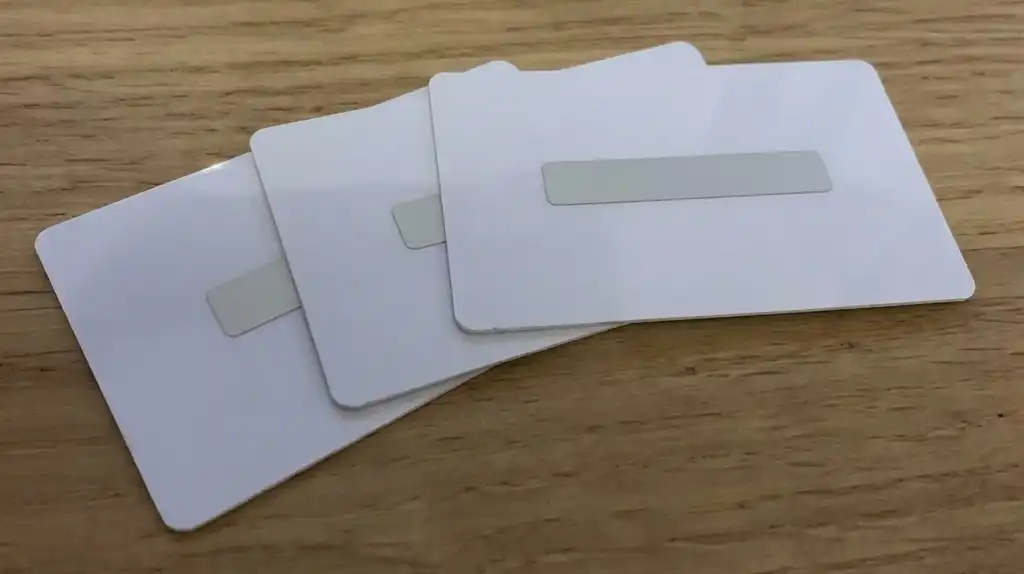
A secret code under a scratch-off panel stays hidden until whoever holds the card scratches it, so someone who copies the card number from your display or a photo, or guesses it, still can’t spend the card online. You only need codes if a card can be spent without being handed over, online or by quoting a code.
Make each code random and unrelated to the card number, and keep it out of the barcode, because anyone can scan a barcode with a phone. Our guide to numbered gift cards shows how to set up a PIN under a scratch-off panel, and our guide to gift card codes in Excel or CSV lays out the file.
- Check the panel before you sell a card. If it’s been scratched, someone may have the code: don’t sell the card, and stop its number on the register.
- Mark each code off once it’s spent, so the same code can’t be spent twice.
- Ask customers not to post photos of their card. A code printed in the open, or one that’s been scratched, can be read from a picture.
How do I stop staff misusing gift cards?
Make every gift card sale, refund and redemption leave a record with someone’s initials on it, let only a manager do the risky jobs, and check the records every day. Clear routines protect honest staff too.
- Every card against a payment. The register line shows the card number, the amount, how it was paid and who sold it.
- Manager-only jobs: giving a card away, putting a refund onto a gift card, cancelling a redemption and changing a balance. Ask your till supplier whether yours can limit these to a manager. On a paper register, these lines need a manager’s initials.
- A daily check. Add up the gift cards sold on the register and match them with the gift card money in the till. Check the cards spent against the register too.
- Refunds the way the customer paid. A refund owed for faulty goods has to go back by the same means of payment, unless the customer expressly agrees otherwise (Consumer Rights Act 2015, section 20). Any refund onto a gift card needs the receipt and a manager, so it can’t become a way of taking money.
- Free cards on the register too. A card given as a prize or to say sorry still costs you its value when it’s spent, so record it as free, with who agreed it. Our guide to gift card VAT covers how free cards are treated.
Where should I keep unsold gift cards?
Most of them locked away, with a note of which numbers you hold, and only a few at the till or on display. A card is worth nothing until it’s recorded as sold, so a stolen card can be refused, but locking the stock away stops the problem starting.
- Count the stock now and then. Mark any missing numbers on the register, so staff know to refuse them.
- Never load a value in advance. If your till or gift card system holds the balances, load the value when the card is sold. A card with value already on it can be spent by whoever takes it.
- Put only cards with no value yet on display. If you hang cards on a hook in euro slot carriers, the value goes on at the till when the card is sold. A code that can be spent online needs to be under a scratch-off panel too. A card with its code printed in the open, as gift cards for Shopify POS have, stays behind the counter, because anyone who copies the code can spend the card once it’s sold. Our gift card display ideas have more.
How do I stop fraud when I sell gift cards online?
Delay when a new card can be spent, so a card bought with stolen payment details can’t be used before the real cardholder notices. Online, most of the risk is in the payment. Gift Up!, a gift card platform, names three main kinds of fraud: stolen payment cards used to buy gift cards, attacks that test stolen card details, and guessed codes.
Gift Up! suggests a ‘valid from’ date, so the real cardholder has time to spot the charge, and Giftpro, a gift voucher system, recommends 48 hours. Giftpro says that when a voucher bought with stolen card details is spent, its clients usually face a chargeback and also lose the cost of what they provided. We read these pages in November 2026, so check what your own gift card system offers. Selling both kinds? Our guide to digital and plastic gift cards compares them.
What should staff do if someone asks for gift card codes?
Say no, and check with the owner or manager in person. A request to send gift cards, or to share the numbers on them, is a warning sign of fraud, and money paid that way is unlikely to come back.
- The government’s advice. The UK government’s Stop! Think Fraud campaign lists anyone who “asks you to send gift cards” among its warning signs. It also warns of criminals pretending to be senior staff, sometimes with faked audio or video, to push staff into urgent payments.
- Make it a rule. Stop! Think Fraud says that if your business has a rule that the boss or senior managers never ask staff for urgent payments, every member of staff should know it. Our suggestion: add gift cards to the rule. Nobody in your business will ever ask staff, by phone, email or text, to buy gift cards, read out codes or send photos of cards.
- Check another way, without blame. The National Cyber Security Centre says staff should know the normal way things like payments are done, so unusual requests stand out, and should confirm important requests another way, such as in person. It also says not to reprimand staff who are caught out, because people who fear trouble report mistakes late, if at all.
- Tell your customers too. Citizens Advice says never give the numbers on the back of a gift card or voucher to anyone you don’t know. The NCSC suggests telling customers what you’ll never ask for. A line on your website or card, such as “We’ll never call, email or text you to ask for your card’s code”, helps.
Which security features can be printed on a gift card?
A number, a write-on panel, a scratch-off panel with a code under it, a barcode or magnetic strip carrying the card number, and metallic foiling. All of them can go on our standard full colour PVC gift cards. Scratch-off panels, magnetic strips and foiling aren’t available on EcoTough or Plastic-Free Board. The register, the daily check and the locked drawer are yours.
- The card number, in the barcode and printed under it. Your till scans it, or staff read it, to find the card in your register. It isn’t a secret.
- The scratch-off panel hides a random secret code for spending online. A typical panel is 8mm x 75mm, stops at least 4mm from the edge, and can’t be printed on.
- The write-on panel, or signature strip, for the amount and the seller’s initials. It takes an ordinary ballpoint pen, and a typical one is 75 x 8mm. Put it on a white area of your design: on a colour, the strip picks up the colour behind it.
| Feature | What it stops | Worth knowing |
|---|---|---|
| A number on every card | Made-up and stolen cards, and any card spent twice, copies included, when each number is checked against your register | From a start number or your own list, in any colour. Re-orders carry on from the last number. Numbered cards |
| Write-on panel | Values changed after the sale, when the amount is also in your register | At least 4mm from the edge, on a white area of the design, with nothing printed on it. On every card type. Signature strips |
| Scratch-off panel | Codes read or photographed before the card is used | Codes come from your spreadsheet. Not on EcoTough or Plastic-Free Board. Scratch-off panels |
| Barcode or magnetic strip | Typing mistakes, and numbers your till doesn’t know or has already used up | On full colour PVC cards, barcodes are printed under the surface, so they can’t be scratched or rubbed away. Magnetic strips need 760 micron cards and aren’t on EcoTough or Plastic-Free Board. Gift cards with barcodes |
| Metallic foiling | Copies made on an ordinary printer | Gold or silver foil on a logo or other simple line art, which gives the impression of a security mark. Not on EcoTough or Plastic-Free Board. |
On full colour PVC cards everything printed, numbers and barcodes included, is sealed under clear PVC, so it can’t scratch or wear off. The write-on panel sits on top, so it can be written on. Numbers, panels, barcodes, magnetic strips and foiling are priced on your quote. Our guide to stopping cards being copied compares every security feature, embossing and a metallic base card included.
What should a gift card checklist for staff say?
What to do at each step, short enough to pin up by the till. Print this one, or put it into your own words:
- Selling: take payment first, write the card in the register with the amount and your initials, then write the amount on the card’s panel and initial it.
- Accepting: check the card number in the register first. Then mark it used, or write down what’s left.
- Doesn’t match? If the card isn’t on the register as sold, is already used, or shows a different amount, don’t accept it: fetch the manager, who goes by the register.
- Refunds: back the way the customer paid. Onto a gift card only with the manager.
- Free cards: only with the manager’s initials in the register.
- Stock: unsold cards stay locked away, never loose on the counter. Before you sell a card with a scratch-off panel, check the panel hasn’t been scratched.
- Codes: never read out a code, send a photo of a card or buy gift cards because someone asked by phone, email or text, even if they say they’re the boss. Check in person.
- End of the day: the gift cards sold on the register match the money in the till.
- Not sure? Ask the manager straight away. Nobody gets into trouble for asking.
What should I do if I find gift card fraud?
Stop the card numbers involved, keep every record as it is, and report it.
- Stop the cards. Mark the numbers as stopped in your register or on your till, so staff refuse them.
- Keep the evidence: the cards, receipts, till records and register pages, unchanged.
- Tell your bank or payment provider as soon as possible if you’ve lost money, or think a fraudster has access to your bank account.
- Report it to Report Fraud, the national reporting centre for fraud and cyber crime, or in Scotland to Police Scotland. The UK government’s Stop! Think Fraud reporting page explains how. Forward a suspicious email to report@phishing.gov.uk before you delete it.
- Close the gap. Change the routine that let it happen, and tell your staff what’s changed.
Your gift card terms and conditions should also say what happens if a card is lost or stolen.
How do I order gift cards with these security features?
Email sales@cpcards.co.uk or use our gift card quote form. We often reply within minutes, 9am to 5pm, Monday to Friday. Tell us:
- How cards will be checked: a register, your till, or codes typed online.
- The numbers: a start number, or your own list in an Excel or CSV file, plus any secret codes, one row per card.
- The panels: how many write-on panels, what each is for, and whether you need a scratch-off panel.
- Your artwork, at 92 x 60mm with 3mm of bleed, or your logo and wording for our £29 +vat design service.
- How many cards you need.
Our gift cards are 86 x 54mm and 760 microns thick, printed in full colour on both sides, then bonded between clear PVC sheets and cut, so the print can’t scratch or wear off. Every order gets a free email proof, so you can check the layout and wording before anything is printed. The colours on the proof are a guide only, because every screen shows colour differently.
Check your number list and code file before you send them, so no number or code appears twice. Our artwork check is technical, so it doesn’t cover numbers, codes or wording, and codes are printed as supplied.
Production takes 7 working days from proof approval and payment. Express takes 3 to 4 working days: ask us for cost and availability. Delivery is free within Great Britain, and our delivery prices list the charges for Northern Ireland, the Republic of Ireland and the Channel Islands.
How much do they cost?
Gift cards start at £75.00 +vat for 25, and 100 cost from £85.00 +vat. The price per card falls as the quantity goes up, because much of the work in an order is the same whatever the quantity. Extras such as numbering and scratch-off panels are priced on your quote, and our gift cards page has the full price table.
Where does this advice come from?
From the UK government’s Stop! Think Fraud campaign, the National Cyber Security Centre, Citizens Advice, the Consumer Rights Act 2015, the Horticultural Trades Association and two gift card platforms, Gift Up! and Giftpro. We read them on 13 November 2026, and advice changes, so follow the links for the current version.
- Stop! Think Fraud (UK government): Recognise the tactics, Protecting your business and Reporting fraud.
- National Cyber Security Centre: Phishing attacks: defending your organisation.
- Citizens Advice: Check if you can get your money back after a scam.
- Consumer Rights Act 2015: Consumer Rights Act 2015, section 20, on legislation.gov.uk.
- Horticultural Trades Association: paper voucher withdrawal.
- Gift card platforms: Gift Up!, What about fraud?, and Giftpro, Why do we recommend a delayed validity period? and its post Tackle fraud with Giftpro Protect.
This page is general information, not legal advice.
Questions & Answers
-
How do I stop gift card fraud in a small business?
Give every card its own number, and record each one when it’s sold, with the amount paid and the seller’s initials. Check that record before you accept a card, and mark the card used once it’s spent. Then a stolen or made-up card can be refused, and no number can be spent twice. Check the cards sold against the money taken every day.
-
Can plastic gift cards be copied?
Any printed card can be imitated, and a photocopy of a barcode still scans. What protects you is the record behind the card: a number is worth something only once it’s recorded as sold, and it can be spent only once. So a copy is worth no more than the original, and a made-up card carries a number you never sold. Metallic foiling helps too, because real foil can’t be reproduced on an ordinary printer.
-
How do I stop people changing the value on a gift card?
Record the value in your register when the card is sold, and treat the register as the true value. Staff write the amount on the card’s write-on panel, which takes an ordinary ballpoint pen, and initial it. If the card and the register disagree, the register is right. Printing the value instead takes the pen out of it, but each printed value is a separate design.
-
Can someone guess a gift card number?
Yes, if the numbers run in order, because one number gives away the next. Numbers in order are fine when every card is handed over at your counter and checked in your register. If your till holds the balances or a card can be spent online, random numbers are safer: use the format your till supplier asks for. For cards spent online, add a random secret code under a scratch-off panel as well.
-
Does a scratch-off panel stop gift card fraud?
It stops one kind: a secret code being read or photographed before the person given the card scratches the panel. Use a panel if customers spend the card online or by quoting a code, and keep the code out of the barcode, because anyone can scan a barcode with a phone. If every card is spent at your till, a printed number and a register do the same job more simply.
-
How do I stop staff fraud with gift cards?
Make every card sale leave a record: the card number, the amount, how it was paid and who sold it. Let only a manager give a card away, put a refund onto a gift card, cancel a redemption or change a balance. Then check the gift cards sold against the money taken every day, so a missing payment shows up the same day.
-
Is it a scam if someone asks staff for gift card codes?
Treat it as a warning sign, and check in person before doing anything. The UK government’s Stop! Think Fraud campaign lists anyone who asks you to send gift cards among its warning signs, and Citizens Advice says never give the numbers on the back of a gift card to anyone you don’t know. Our suggestion: tell staff that nobody in your business will ever ask for codes by phone, email or text.
-
Where do I report gift card fraud?
Report it to Report Fraud, the national reporting centre for fraud and cyber crime, or in Scotland to Police Scotland. The UK government’s Stop! Think Fraud site explains how. If you’ve lost money, or think a fraudster has access to your bank account, tell your bank or payment provider as soon as possible. Keep the cards, receipts and register entries as they are.
-
Where can I get gift cards with security features printed in the UK?
CP Cards supplies them, printed in England. Our minimum order is 25 cards, from £75.00 +vat, with numbering and scratch-off panels priced on your quote. Delivery is free within Great Britain, and our delivery prices list the charges for Northern Ireland, the Republic of Ireland and the Channel Islands. Every order gets a free email proof, so you can check the layout and wording before anything is printed. For a quote, email sales@cpcards.co.uk or use our quote form.
Ready to order numbered gift cards?

Tell us how your cards will be checked, the numbers and codes you need, and how many cards. We’ll quote by email, often within minutes, 9am to 5pm, Monday to Friday.