
Gift Card Terms and Conditions: Template and Wording to Copy
Gift card terms and conditions say how a card can be spent, how long it lasts and what happens if it’s lost. On the back of the card, print five to seven short lines: the valid-until date, how to spend it, two or three lines of terms, and where to find the full terms. Put the full terms on your website or card wallet. By law, your terms must be fair and clear.
This guide builds on the terms in our gift card printing guide, with wording to copy for money cards and for treatment and experience cards, the terms to avoid, and where each line goes on a printed plastic gift card and its wallet.
The short versionWrite terms that match how you really run your cards, in plain words. On the back of the card, print five to seven short lines at 6pt or larger: the valid-until date, how to spend it, two or three lines of terms (balances, cash and lost cards) and where to find the full terms. Put the full terms on your website or inside a card wallet, use the same words everywhere, and point out anything that could catch someone out before they pay.
Why does a gift card need terms and conditions?
Because a gift card is paid for now and spent later, often months later, and its terms set out what you’ve promised: what it buys, for how long, and what happens if something goes wrong. Clear terms save arguments at the till, and they matter to buyers. In the Gift Card & Voucher Association’s State of the Nation 2025 report, expiry dates were the most common reason UK consumers gave for not buying gift cards, cited by 28%.
What the law expects of your terms
The terms are part of what you agree when you sell a card, so the Consumer Rights Act 2015 applies to them. In plain words:
- An unfair term isn’t binding on your customer (section 62). A term is unfair if, against good faith, it tips the rights and obligations significantly against the customer.
- Written terms must be transparent: plain, intelligible language that’s legible (section 68). On a card, that starts with a type size people can read.
- If a term could mean two things, the meaning most favourable to the customer wins (section 69).
- Important terms must stand out. The CMA’s guide to writing a fair contract says a term that could significantly affect the customer must be made prominent, and important information shared early, for example in summaries and FAQs.
- Enforcers can act. The CMA or Trading Standards can stop you using terms that aren’t transparent, even if they aren’t unfair, and you risk a penalty.
This page is general information, not legal advice. If you’re unsure whether a term is fair for your business, take legal advice before you print it.
What should the short terms on the back of a gift card say?
Five to seven short lines: the valid-until date, how to spend it, two or three lines of terms, and where to find the full terms. How to spend it takes a line, or two if you take bookings. The lines of terms cover balances, cash and lost cards. At 7pt they all fit on the back with room for a card number and a QR code.
- The card number, at 10pt or more, matching a line in your gift card register.
- Valid until, on a write-on panel filled in when the card is sold, so the period runs from the day of sale.
- How to spend it, then three lines of terms, at 7pt in a plain font, dark on a light background.
- A QR code to the full terms, drawn here at 16mm square. We recommend at least 15mm.
- The web address of the full terms, for anyone who doesn’t scan.
- The safe area, 3mm inside the edge. Keep all the text inside it.
Please show this card when you pay[, or quote its number when you order online].
[Bookings are subject to availability.]
[Any balance stays on the card until the date above. / Must be used in one visit.]
No cash alternative[, and no change given].
Treat this card like cash: it can’t be replaced if lost.
Full terms: [web address] [or scan the QR code].
Keep terms at 6pt or larger: 7pt reads more easily on a card held in the hand. Use a plain sans-serif such as Arial in a dark colour on a light background, and if small text has to be white on a dark colour, use a regular or bold weight. Our guide to font size on plastic cards shows each size to scale.
Where should the full gift card terms go?
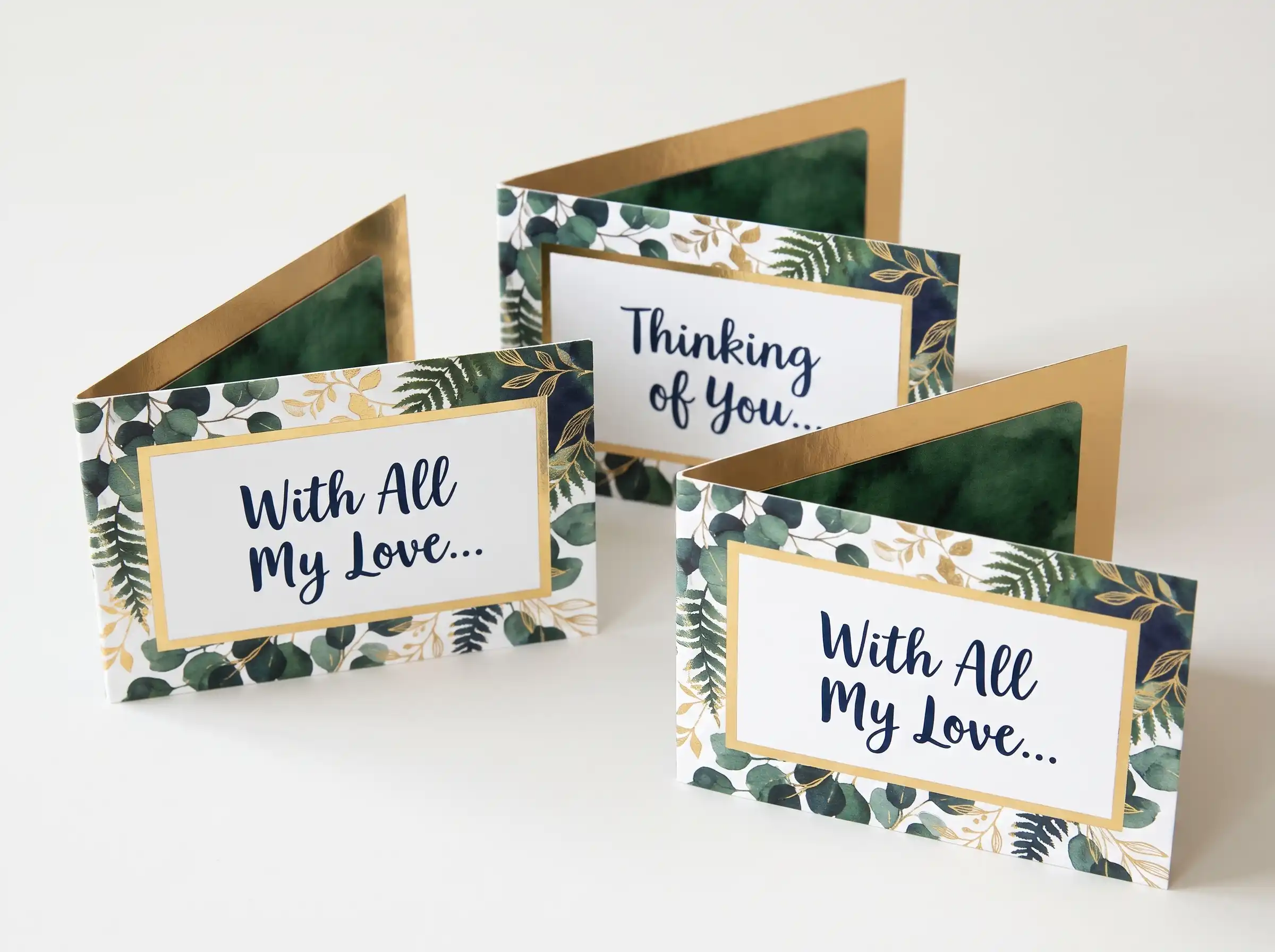
On your website, where a QR code or web address on the card takes people, and inside a card wallet if you hand cards over at the counter. Show them before people pay too: at the till, and on your website if you sell cards online.
A QR code that’s the same on every card is part of your artwork and costs nothing extra. Print the web address beside it, and link both to a page that keeps its address, because the cards will sit in purses and drawers for months.
A landscape wallet is 75 x 210mm flat and folds to 75 x 105mm, with four printed faces. Inside, die cut slits hold the card on one panel, and the other panel can carry your full terms, facing the card when the wallet is opened. Use the outside for your design and a space for a handwritten message: folded, it fits a standard envelope.
- The full terms, ten short clauses on the inside left panel.
- The machined crease down the middle.
- Die cut slits at two corners, where our artwork template puts them.
- The card, held by its corners, the right way up when the wallet opens.
Wallets are printed in full colour on 350gsm silk board and supplied unattached to the cards. Our design service can set up the wallet and the card together, and our guide to designing a gift card carrier covers the rest of the layout.
What should gift card terms and conditions include?
Who issues the card, how to spend it, what happens to a balance, how long it’s valid, lost cards, resale, what happens if you sell or close the business, refunds and changes to the terms. Copy the blocks below into your full terms, choose between the options in [brackets], and delete any line that doesn’t match how you work. They extend the lines in our gift card printing guide, so the two read the same.
Questions: [email address].
It can be used [in store and online / in store only], in full or part payment.
[Not for resale.] [It can’t be used to buy other gift cards.] [It can’t be used with other offers.]
Check your balance [in store / on our website].
No cash alternative, and no change given.
The valid-until date is written on the card when it’s sold.
After that date the card can’t be used[, and any balance is lost].
If we decide to close, we’ll give at least [four weeks’] notice [on our website and in store], so you can spend your card.
Where the law gives you a refund, we’ll refund you the way you paid.
These terms don’t affect your statutory rights.
If we change them, cards already sold keep the terms they were sold under.
Choosing between the options
- Balances. If a balance can stay on the card, give your register a balance column, so you can see what’s left on each card. If a card must be used in one visit, print that on the card and say it at the till: the CMA says a term that could significantly affect the customer must be made prominent.
- Valid until. An expiry date must be clear and the terms fair. Write the date on the card when it’s sold, and choose a period that gives the person receiving it a fair chance to use it. In a Which? survey in October 2021, only 53% of people given a gift card in the past year said its expiry date was clearly stated. Our gift card VAT and expiry rules have more.
- Lost cards. Offer replacements only if every card has its own number and you keep a register, so you can check the balance and stop the old card being used. Ask for the receipt too, so nobody can claim a card just by knowing its number. Our free gift card register template helps, and how to stop gift card fraud covers the rest.
- Selling or closing. Don’t promise more than you can keep. If a business becomes insolvent, card holders are usually unsecured creditors and often get nothing back: see what happens to gift cards if a business closes.
- Refunds. For things bought in person, GOV.UK says you don’t have to refund a customer who has simply changed their mind. Customers who buy at a distance, such as online, have extra rights to cancel, so check how they apply before you sell cards that way.
What terms do treatment, experience and booking cards need?
Say what the card is for, what happens if the price or the menu changes, how to book, and whether the card covers tips and service charges. Add these blocks to the ones above.
[Upgrades and extras can be paid for on the day.]
Please quote your card number when you book, and bring the card with you.
If you can’t come, please give us [24 hours’] notice and we’ll rebook you.
- Leave the price off the card. A printed price is out of date the day your prices change, and you still honour a card that names a treatment or an experience.
- Missed bookings. Keeping the whole value of a card because someone missed a booking could be unfair: see the terms to avoid.
- Tips and service charges are your choice. Say which on the card or in the full terms, and make sure your staff know.
For more on your own trade, see gift cards for salons and barbers, gift cards for restaurants, pubs and bars, gift vouchers for hotels, spa gift vouchers and gift vouchers for leisure venues.
Which gift card terms could be unfair?
Terms that keep a customer’s money whatever the reason, hide a catch, or mislead people about their rights. These are the common ones, with something fairer to do instead.
| Avoid | Why to avoid it | Do this instead |
|---|---|---|
| “A missed booking uses up the whole card.” | The CMA’s guidance says a term is unlikely to be fair if it makes prepayments non-refundable whatever the reason the customer cancels. Keeping money is more likely to be fair when it reflects a genuine estimate of your direct loss. | “If you can’t come, give us [24 hours’] notice and we’ll rebook you.” |
| “No refunds under any circumstances.” | GOV.UK says it’s illegal to restrict customers’ rights or mislead them about their rights, and gives a sign saying no returns or refunds as an example. | “No cash alternative. These terms don’t affect your statutory rights.” |
| “Refunds are given as a credit note only.” | When a customer is owed a refund for faulty goods, it must go back the way they paid, unless they expressly agree otherwise (section 20 of the Act). The CMA’s guidance gives allowing only credit notes, rather than cash refunds, as an example of a term that limits customers’ legal remedies. | “Where the law gives you a refund, we’ll refund you the way you paid.” |
| Limits that only appear on your website | The Act’s list of terms that may be unfair (Schedule 2) includes binding customers to terms they had no real chance to read before they bought, and the CMA says terms that could significantly affect them must be prominent. | Print the valid-until date and any one-visit rule on the card, and show the full terms before people pay. |
| “Valid for one year.” | If a term could mean two things, the meaning most favourable to the customer wins. A year from the sale, or from the first use? | “Valid until [the date written on the card].” |
The Act’s list is a guide to terms that may be unfair, not a ban. Whether a term is unfair depends on the circumstances, including everything else in your terms.
Where does each line go on the card and the wallet?
The lines someone needs at the till go on the card. Everything else goes in the full terms, on the wallet and your website, with the card pointing to them.
| Term | On the card | In the full terms |
|---|---|---|
| Valid until | On the back, on a write-on panel filled in at the till | How long cards last, and what happens to a balance after the date |
| How to spend it | One line, or two if you take bookings | Where it can be used, any limits, how to book and the notice you need |
| Balances, cash, lost cards and tips | Two or three lines of terms: the ones people need at the till | In full, with how a replacement works, if you offer one |
| Treatment and experience cards | What it’s for, printed or written on | What happens if the price or the menu changes |
| Resale, refunds, selling or closing | Not needed | In full |
| Where the full terms are | A QR code at least 15mm square, and the web address | Not needed |
- Keep text at 6pt or larger, and anything important 3mm inside the trim.
- Put write-on panels on white, at least 4mm from the edge, with the label beside the panel: nothing can be printed on the panel itself. They take an ordinary ballpoint pen.
- Don’t print a year. A written valid-until date means one batch of cards lasts as long as it takes to sell.
- Check the wording on your proof. Our artwork check is technical, covering bleed, resolution, colour mode and set-up, so the words and dates are yours to check before you approve it.
Where does this information come from?
From the Consumer Rights Act 2015, guidance from the CMA and GOV.UK, the Law Commission and two surveys, all read on 13 November 2026. Laws and guidance change, so follow the links for the current position.
- Consumer Rights Act 2015, on legislation.gov.uk: section 20, section 62, section 64, section 68, section 69 and Schedule 2.
- Competition and Markets Authority: Writing a fair contract for customers, and its unfair contract terms guidance (CMA37), both updated 22 July 2026.
- GOV.UK, Accepting returns and giving refunds: the law.
- Law Commission, Consumer prepayments on retailer insolvency, 2016.
- Gift Card & Voucher Association, State of the Nation 2025, November 2025.
- Which?, news story on its gift card survey, 12 November 2021.
How do I order gift cards with my terms printed on them?
Email sales@cpcards.co.uk or use our gift card quote form. We often reply within minutes, 9am to 5pm, Monday to Friday. Tell us:
- Your artwork, at 92 x 60mm with 3mm of bleed, or your logo and wording for our £29 +vat design service.
- Your terms: the short lines for the card, and the full terms if you’d like them on a wallet.
- How many cards, and whether you’d like numbering or a write-on panel for the valid-until date. Extras like these are priced on your quote.
- Whether you’d like wallets. Cards and card carriers are quoted together as one job.
Our gift cards are 86 x 54mm and 760 microns thick, printed in full colour on both sides, then bonded between clear PVC sheets and cut, so the print can’t scratch or wear off, terms included. Every order gets a free email proof, so you can check the layout and wording before anything is printed. The colours on the proof are a guide only, because every screen shows colour differently.
Production takes 7 working days from proof approval and payment. Express takes 3 to 4 working days: ask us for cost and availability. Delivery is free within Great Britain, and our delivery prices list the charges for Northern Ireland, the Republic of Ireland and the Channel Islands.
How much do they cost?
Gift cards start at £75.00 +vat for 25, and the price per card falls as the quantity goes up, because much of the work in an order is the same whatever the quantity.
| Quantity | Price from |
|---|---|
| 25 | £75.00 +vat £3.00 each |
| 50 | £79.00 +vat £1.58 each |
| 100 | £85.00 +vat 85p each |
| 200 | £99.00 +vat 49.5p each |
| 250 | £109.00 +vat 43.6p each |
| 500 | £175.00 +vat 35p each |
| 1,000 | £245.00 +vat 24.5p each |
Prices are for one design from your print-ready artwork, with free delivery within Great Britain. They exclude VAT and extras such as numbering and write-on panels, which are priced on your quote.
Landscape wallets start at £89.00 +vat for 25. Our card carriers and wallets page has every quantity.
Questions & Answers
-
Do gift cards need terms and conditions?
In practice, yes. A gift card is paid for now and spent later, and the terms say what you’ve promised: how it can be spent, how long it lasts and what happens if it’s lost. Under the Consumer Rights Act 2015, written terms must be in plain, legible language, and an unfair term isn’t binding on the customer.
-
What should the terms on the back of a gift card say?
Five to seven short lines: a valid-until date, how to spend it, two or three lines of terms, and where to find the full terms, by web address or QR code. The lines of terms cover balances, cash and lost cards. Keep the text at 6pt or larger, and 7pt reads more easily.
-
Do gift card terms have to be printed on the card?
Not all of them. Print the main terms on the card, especially anything that could catch someone out, such as a valid-until date or a rule that the card must be used in one visit. Put the full terms on your website or a card wallet. The CMA says terms that could significantly affect a customer must be prominent.
-
Can gift card terms include an expiry date?
Yes. A gift card can carry an expiry date, as long as the date is clear and the terms are fair. Print “Valid until” on the card, write the date in when it’s sold, and say in the terms what happens to any balance after that date. Our gift card VAT and expiry rules have more.
-
Can a business refuse to refund a gift card?
Yes, if the customer bought the card in person and has simply changed their mind. GOV.UK says a business doesn’t have to refund a customer who no longer wants something they bought in person. Customers who buy at a distance, such as online, have extra rights to cancel. Don’t write “no refunds under any circumstances”, though: it’s illegal to mislead customers about their rights.
-
What happens to gift cards if a business is sold or closes?
If a business becomes insolvent, card holders are usually unsecured creditors and often get nothing back. If you sell, agree with the buyer who will honour the cards you’ve already sold, and say in your terms what you’ll do. If you close by choice, give card holders notice and a chance to spend them. See what happens to gift cards if a business closes.
-
Can customers use a gift card to pay a tip or service charge?
That’s your choice, so say which in your terms, for example “Tips and service charges can’t be paid with this card”. Put it on the card or in the full terms, and make sure your staff know, so customers hear the same answer every time.
-
What if the price of a treatment goes up after the gift card was sold?
Honour the card. If it names a treatment or an experience rather than an amount, say in the terms that it covers that treatment whatever its price on the day, and leave the price off the card. If you stop offering it, let the holder use the amount paid towards something else.
-
Is this gift card terms template legal advice?
No. It’s general information, with wording to adapt to how you run your own cards. Your terms are your decision. If you’re unsure whether a term is fair for your business, take legal advice before you print it.
-
Where can I get gift cards printed with my terms and conditions in the UK?
CP Cards supplies them, printed in England. The minimum order is 25 cards, from £75.00 +vat, and card wallets can carry your full terms. Delivery is free within Great Britain, and our delivery prices list the charges for Northern Ireland, the Republic of Ireland and the Channel Islands. Every order gets a free email proof, so you can check the layout and wording before anything is printed. For a quote, email sales@cpcards.co.uk or use our quote form.
Ready to print your gift card terms?

Send us your design, or your logo and wording, with the terms you want on the card and the wallet. We’ll quote by email, often within minutes, 9am to 5pm, Monday to Friday.