


Digital vs Plastic Gift Cards: Which Should You Sell?
Sell both if you can. An e-gift card suits last-minute buyers: it’s bought online at any hour and can be emailed straight away, with no stock to hold. A plastic gift card suits giving in person: it can be wrapped, handed over in a card wallet and kept on show by your till. One gift card system can run both.
This guide compares the two for the buyer and for your business, and shows how one system can hold the balances of both. Prices for printed cards are on our gift cards page. Comparing loyalty schemes instead? See digital vs plastic loyalty cards.
The short versionE-gift cards win on speed: bought at any hour, emailed in moments, nothing to stock. Plastic gift cards win as presents and at the counter, where customers see them. If you have a website and a counter, sell both on one gift card system: it emails a code for each e-gift card, and your plastic cards carry codes it accepts, which staff enter when each card is sold. Check that your system takes printed cards before you order them.
How do e-gift cards and plastic gift cards work?
An e-gift card is a code sent by email. A plastic gift card is a printed card that’s handed over: its value is printed on it, written on when it’s sold, or held on your till or gift card system against the card’s number.
E-gift card
For the buyer: they choose an amount on your website or gift card page, pay, and enter the recipient’s email address, or their own. The recipient gets an email with a unique code, and spends it by typing the code at your online checkout or showing it in your shop.
For your business: the platform makes the code, takes the payment, sends the email and keeps the balance. There’s nothing to print or stock, and the platform usually charges on each card sold.
Plastic gift card
For the buyer: they buy the card at your counter, or you post it, and give it like any present, perhaps in a card wallet with a handwritten message. The recipient brings it back and hands it over when they pay.
For your business: you order printed cards in advance and keep them by the till. When one is sold, staff write in the amount, or enter the card’s number on your till so it holds the value. We supply the cards; the balances live on your till, your gift card system or a simple register.
Our gift card printing guide explains the ways to set printed cards up, with or without a till.
How do e-gift cards and plastic gift cards compare?
E-gift cards are quicker to buy and send, and plastic cards are better as presents and at the counter. This is how they compare on the points that matter most to a small business.
| E-gift card | Plastic gift card | |
|---|---|---|
| Buying at the last minute | Bought online at any hour, and can be emailed straight away. Square, SumUp and Giftpro all pitch e-gift cards for last-minute presents. | Bought in person while you’re open, or ordered in time for the post. |
| Delivery by email | Yes, to the buyer or the recipient. Many platforms let the buyer choose the day it’s sent. | No. It’s handed over at your counter, or posted by you. |
| Presenting it as a present | An email, a printout or, on some platforms, a pass in a phone wallet. | Something to wrap and hand over, in a card wallet or carrier with a handwritten message. |
| On display at the counter as a reminder | Only if you put up a sign: nothing sits by the till. | Cards or card wallets on show by your till remind customers that you sell them, while they’re paying. If a card’s code can be spent online, show empty carriers or wallets, and keep the cards behind the counter. |
| Fees | Set by the platform: usually a charge on each card sold, sometimes a monthly fee as well. | The cards, once: from £75.00 +vat for 25. A system that holds the balances may charge as well. |
| Stock to hold | None. Each code is made when a card is sold. | A box of printed cards, kept safe until each is sold. Order more before your busy seasons. |
| When an email goes astray | It can land in spam or go to a mistyped address. Platforms let you resend it, and some can send it to a different address. | There’s no email to lose. A lost card is lost, unless your system can cancel it and issue a new one. |
| Fraud | Platforms warn about stolen card details used to buy e-gift cards online, and some suggest a short delay before a new card can be spent. | Sold face to face. Keep unsold cards safe: any loaded with value before they’re sold are worth money, so store those like cash. |
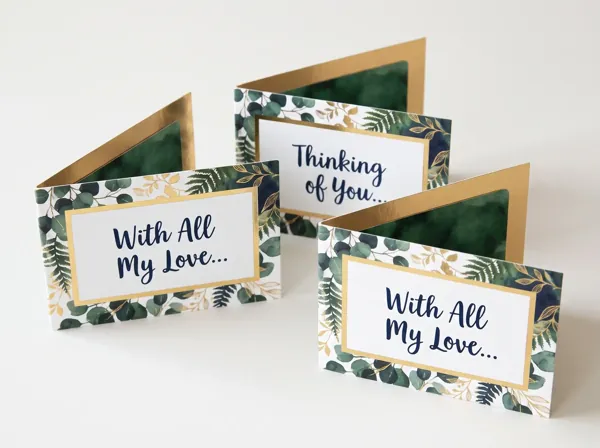
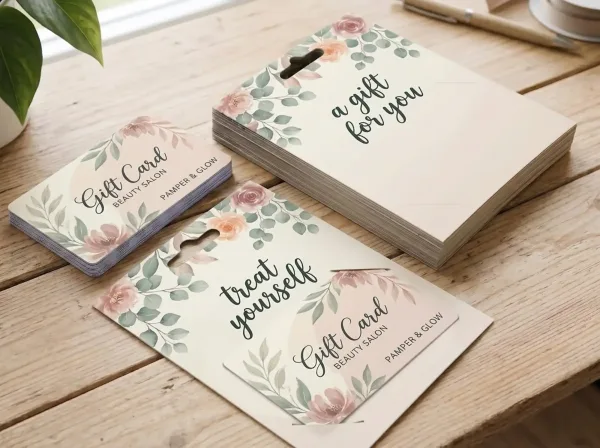
Our card carriers and wallets come in four formats, printed in full colour with your design. Our guide to gift card printing costs shows what the cards and carriers cost.
An e-gift card uses no plastic. If that matters to your customers, printed gift cards also come in recycled PVC, biodegradable plastic and PVC-free EcoTough: our guide to eco plastic cards compares them.
Do people still buy plastic gift cards?
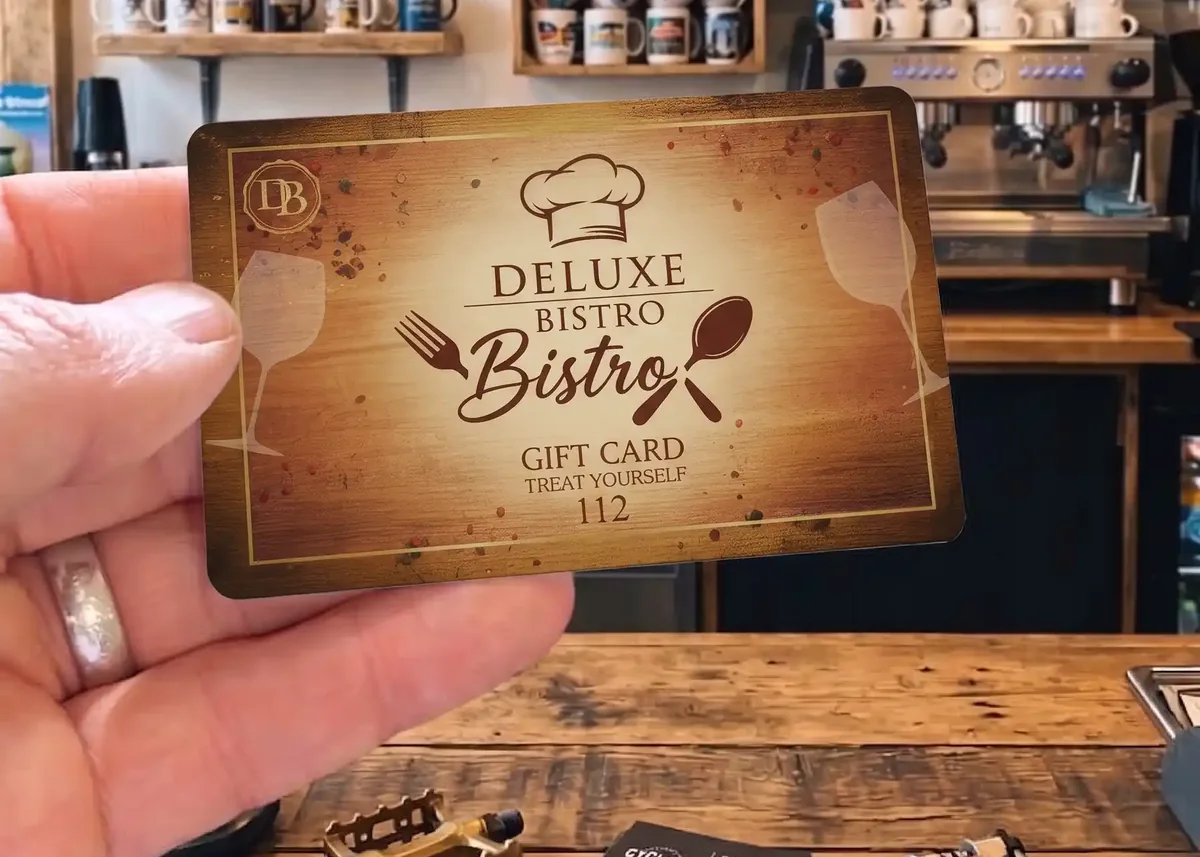
Yes. In the second half of 2025, physical gift cards were 46% of the sales reported by members of the Gift Card & Voucher Association (GCVA), and their sales grew 21% on a year earlier. Digital cards were 52%, and paper vouchers 2%. The GCVA counts plastic and cardboard cards as physical, and paper vouchers separately. These are the members’ figures, compiled by GlobalData, not the whole UK market.
Physical cards do best at Christmas. In their report on the second half of 2023, KPMG and the GCVA say physical gift card sales always rise around Christmas, because they’re convenient and suit giving as a gift. KPMG’s figures for GCVA members show digital cards at 52% of sales in the first half of 2024, but below half in the second.
Shoppers still buy them in person. In the first half of 2025, 48.8% of gift card buyers bought at least one physical card in a shop, the highest share since the first half of 2022, while 29.6% bought a digital card (GCVA State of the Nation 2025). The same report finds that in-store and online gift card sales play complementary roles rather than competing ones.
In January 2026, the GCVA and GlobalData found that physical cards are still seen as the more thoughtful present. Square’s own UK help says many customers still prefer physical gift cards because they’re tangible and easy to give.
Should my business sell e-gift cards, plastic gift cards or both?
Sell both if you have a counter and a website. Lead with plastic cards if your gift buyers come through the door, and with e-gift cards if they buy online.
Plastic gift cards
If most gift buyers come through your door: cafés, salons, barbers and independent shops. Cards by the till remind customers to buy one, and with numbered cards and a gift card register you need no software.
E-gift cards
If you sell mostly online, or have no counter to sell from. There’s nothing to stock or post, and buyers can send one at the last minute.
Both, on one system
If you have a counter and a website. E-gift cards catch the buyer who leaves it late, plastic cards catch the customer at your till, and one system holds every balance.
| Business | What we’d suggest |
|---|---|
| Shops | Both, if you sell online: plastic cards by the till and e-gift cards on your website, on the same system, so a card can be spent in either. |
| Cafés, restaurants and pubs | Plastic cards at the counter, handed over in a wallet as a present. Add e-gift cards if your till or booking system sells them. |
| Salons, barbers and spas | Plastic cards for treatments bought as presents, and e-gift cards for buyers who book online. |
| Hotels, leisure venues and experiences | Both: plastic cards in a wallet for buyers who want something to give, and e-gift cards for buyers who leave it late. |
| Online-only businesses | E-gift cards. Add printed cards only if your system can link an online order to a card you post. |
Our guides to gift cards for shops, gift cards for restaurants, pubs and bars, gift cards for salons and barbers, gift vouchers for hotels and gift vouchers for leisure venues go further.
An honest noteWe supply plastic gift cards, so we’re not neutral. If your customers only buy online, sell e-gift cards: printed cards earn their place where people can see them and hand them over.
Can you sell e-gift cards and plastic gift cards on one system?
Yes, if your gift card system accepts printed cards as well as e-gift cards. One system then holds every code and balance: it emails a code for each e-gift card it sells, and your plastic cards carry codes it accepts, which staff enter when each card is sold. Either kind is then spent the same way: the code finds its balance.
- Codes first. Your system makes a batch of codes for printing, or you make your own in the format it accepts. Gift Up!, for one, recommends printing codes on the cards in advance.
- Printing. Send us the codes in an Excel or CSV file, and each card is printed with its own. Our guide to gift card codes in Excel or CSV shows how to lay the file out.
- Selling online. The system makes a new code for each e-gift card and emails it.
- Selling at the counter. Staff take payment and enter the printed card’s code, so the system knows the card is sold and what it holds.
- Spending. The code finds the balance, whichever kind of card it’s on. A Shopify gift card, for example, can be spent in your shop or online, and its balance updates across every channel.
Posting printed cards to online buyers. Some systems can tie an online order to one of your printed cards. With Gift Up!’s postal orders, staff change the order’s provisional code to the printed card’s code when they post it. Gift Card Hero, an app for Shopify, can give an online order an unused printed code and show staff which card to send. Shopify alone doesn’t link online orders to printed cards.
What to print on the cards
- The code, large and clear. Staff type it at the till and customers type it online, so use capitals in groups of four, with no look-alike characters such as 0 and O.
- Where to spend it: in your shop, and online if your system allows.
- Keep it safe. Anyone with the code can spend the card once it’s sold.
- Your terms, in a line or two, with the rest on your website.
Keep the codes safe. Once a card is sold, anyone who knows its code can spend it online. Staff have to read the code to sell the card, so a scratch-off panel can’t hide it. Keep unsold cards behind the counter rather than on an open display, where someone could copy a code and wait for the card to be sold, and keep your codes file safe too. More in our guide to stopping gift card fraud.
Which gift card systems take printed cards as well as e-gift cards?
Shopify, Gift Up!, Wix and SumUp do. Square’s gift card system takes only plastic cards ordered through Square, and Squarespace has no plastic cards at all. This is what each system’s help pages say: we read them in November 2026, and features change, so confirm with your supplier.
| System | E-gift cards | Printed cards from another supplier |
|---|---|---|
| Shopify | Yes. Online orders create digital gift cards, emailed with a code Shopify makes. | Yes, in Shopify POS. Each card needs its own printed code of 8 to 20 letters and numbers, which staff type in. See our guide to gift cards for Shopify POS. |
| Square | Yes. Square eGift cards are emailed with a unique code. | Not as Square gift cards. Square’s UK help says only plastic cards ordered through Square can be loaded, sold or accepted that way. You can record another supplier’s card with a custom payment method, but Square only logs the sale and doesn’t hold the card’s balance. Anything more needs a developer or an app. See plastic gift cards and Square. |
| Gift Up! | Yes, by email, sent now or on a day the buyer chooses. | Yes. It manages printed cards alongside e-gift cards, and staff record each card when it’s sold. It supports barcodes including Code 128, Code 39 and QR codes. |
| Wix | Yes, bought online through your website. | Yes, at Wix’s mobile point of sale, with codes of 8 to 16 letters or numbers. |
| SumUp | Yes, by email, or printed on a connected receipt printer. | Yes. SumUp Gift Cards take cards printed elsewhere: sell each one as a Classic card, and staff scan or type its own printed code. Or let SumUp make the code, and write it on the card’s write-on panel. |
| Squarespace | Yes, emailed as a unique code. | No. Squarespace doesn’t sell physical or plastic gift cards, and its codes can’t be customised. |
Choosing your own codes? A code of 8 to 16 letters and numbers meets the rules for Shopify POS, Wix and Gift Up! alike, and we found no length rule in SumUp’s help. Make them random, with no two the same, and leave out characters that look alike, such as 0 and O or 1 and I. Other tills, such as Lightspeed and PayPal Zettle, are covered in our guide to gift cards with barcodes.
Gift Up!’s help page on physical cards lists cpcards.co.uk among the UK and EU printers it would look at. It also says it doesn’t recommend, or have partnerships with, any printer.
How do I order plastic gift cards to sell beside e-gift cards?
Email sales@cpcards.co.uk or use our gift card quote form, and tell us which gift card system you use. We often reply within minutes, 9am to 5pm, Monday to Friday. Send us:
- Your system’s name, and what it needs on each card: a code to type, a barcode or a QR code.
- Your codes, in an Excel or CSV file, one row per card. Each code is printed as it appears in your file, and we can’t check codes against your system, so check the file before you send it.
- Your artwork, at 92 x 60mm with 3mm of bleed, or your logo and wording for our £29 +vat design service.
- How many cards, and any card wallets or carriers to go with them. We quote the cards and carriers together.
- Whether you’d like a postal proof: a few real cards, posted to you to try on your own till before the rest are printed. It’s optional, £65 +vat, for full colour cards, and takes around 5 working days. See postal proofs.
Our standard PVC gift cards are 86 x 54mm and 760 microns thick, printed in full colour on both sides, then bonded between clear PVC sheets and cut, so the print can’t scratch or wear off. Every order gets a free email proof, so you can check the layout and wording before anything is printed. The colours on the proof are a guide only, because every screen shows colour differently.
Production takes 7 working days from proof approval and payment. Express takes 3 to 4 working days: ask us for cost and availability. Delivery is free within Great Britain, and our delivery prices list the charges for Northern Ireland, the Republic of Ireland and the Channel Islands.
How much do they cost?
Gift cards start at £75.00 +vat for 25, and the price per card falls as the quantity goes up, because much of the work in an order is the same whatever the quantity.
| Quantity | Price from |
|---|---|
| 25 | £75.00 +vat £3.00 each |
| 50 | £79.00 +vat £1.58 each |
| 100 | £85.00 +vat 85p each |
| 200 | £99.00 +vat 49.5p each |
| 250 | £109.00 +vat 43.6p each |
| 500 | £175.00 +vat 35p each |
| 1,000 | £245.00 +vat 24.5p each |
Prices are for one design from your print-ready artwork, with free delivery within Great Britain. They exclude VAT and extras such as codes, numbering and barcodes, which are priced on your quote.
Questions & Answers
-
Should I sell digital or plastic gift cards?
Both, if you have a counter and a website. E-gift cards suit last-minute buyers and need no stock, because the code is emailed. Plastic gift cards suit people buying a present in person, and cards on show by your till remind customers that you sell them. If your customers only buy online, e-gift cards alone will do.
-
What’s the difference between an e-gift card and a plastic gift card?
How it reaches the person who spends it. An e-gift card is a code sent by email, which they type at your online checkout or show in your shop. A plastic gift card is printed with your design and handed over or posted, with its value printed on it, written on when it’s sold, or held on your till against its number.
-
Can e-gift cards and plastic gift cards run on one system?
Yes, if your gift card system accepts printed cards. It holds every code and balance: it emails a code for each e-gift card, and your plastic cards carry codes it accepts, entered when each card is sold. Shopify POS and Gift Up! both take printed cards, but Square’s UK help says only plastic cards ordered through Square can be sold as Square gift cards.
-
Do people still buy plastic gift cards?
Yes. In the second half of 2025, physical gift cards, plastic or cardboard, were 46% of the sales reported by members of the Gift Card & Voucher Association, and their sales grew 21% on a year earlier. Digital cards were 52%. These are the members’ figures, compiled by GlobalData, not the whole UK market.
-
Are e-gift cards cheaper than plastic gift cards?
Not always. An e-gift card costs nothing to print, but the platform usually takes a charge on each card sold, and some add a monthly fee. Plastic cards are a one-off cost when you order them, from 25 cards, though a gift card system that holds their balances may charge as well. Check each platform’s own pricing page.
-
What if an e-gift card email doesn’t arrive?
Ask the recipient to check their junk and spam folders, then resend it from your gift card platform. A mistyped email address is the other usual cause, and some platforms, such as Square, can resend to a different address. Gift Up! suggests replying to the customer’s own email with a downloaded copy of the card.
-
Can a plastic gift card be spent online?
Yes, if your gift card system takes online payment by code and the card carries one. A Shopify gift card, for example, can be spent in your shop or online, and its balance updates everywhere. Anyone who sees the code can spend the card once it’s sold, so keep unsold cards behind the counter.
-
Can I post plastic gift cards to customers who buy online?
Yes, if your system can link an online order to a printed card. With Gift Up!’s postal orders, staff change the order’s provisional code to the code on the card they post. Gift Card Hero, an app for Shopify, can give an online order an unused printed code. Shopify alone doesn’t link online orders to printed cards.
-
Where can I get plastic gift cards printed in the UK?
CP Cards supplies them, printed in England. Our minimum order is 25 cards, from £75.00 +vat, with codes, numbers and barcodes priced on your quote. Delivery is free within Great Britain, and our delivery prices list the charges for Northern Ireland, the Republic of Ireland and the Channel Islands. Every order gets a free email proof, so you can check the layout and wording before anything is printed. For a quote, email sales@cpcards.co.uk or use our quote form.
Ready to sell plastic gift cards too?

Tell us which gift card system you use and how many cards you need. We’ll quote by email, often within minutes, 9am to 5pm, Monday to Friday.