
Loyalty Stamp Cards: Which Card and Which Stamp?
A board card takes a stamp best: our Plastic-Free Board cards take an ordinary ink stamp anywhere on the card. A sealed PVC card is non-porous, so an ordinary ink pad smudges. On PVC, use a quick-drying ink made for non-porous surfaces, or a sturdy punch, which needs no ink at all.

The short versionOrdinary ink stamp: Plastic-Free Board. PVC card: quick-drying ink for non-porous surfaces, or a sturdy shaped punch. Ten 12mm boxes fit in two rows on an 86 x 54mm card. Test your ink on a real card first.
Which card takes a stamp best?
Plastic-Free Board takes an ordinary ink stamp or a pen anywhere. A PVC card needs the right ink or a punch, because its printed surface is sealed and ink sits on top.
| Ordinary ink stamp | Quick-drying ink | Punch | Pen | |
|---|---|---|---|---|
| Plastic-Free Board, 620 microns | Yes Anywhere | Yes | Yes | Yes Anywhere |
| Standard PVC, 760 microns: the printed surface | No Sits on top and smudges | Yes Let it dry first | Yes Use a sturdy one | No Ballpoint skips |
| Standard PVC: a write-on panel | Test first | Yes | Avoid Punches through what’s written | Yes What it’s for |
| EcoTough, 360 microns | Not confirmed | Not confirmed | Not confirmed | Yes Anywhere |
Pens and inks vary, so try yours on a real card first: our sample pack has the different card types, and its cost is deducted if you order within 30 days. Our guide to writing on plastic cards has the full table.
What does uncoated paper mean, and do I need it?
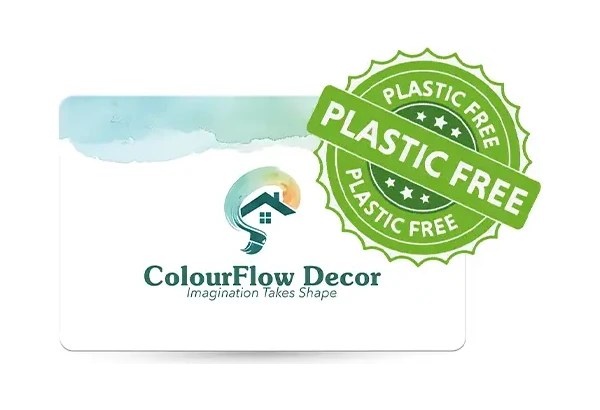
You only need to think about it if staff will use an ordinary ink pad. Uncoated paper or board has no sealed coating on its surface, so ink can be absorbed into it, where a coated stock has a harder time taking ink. So for ink stamps on paper, the general answer is uncoated rather than coated.
The board card we supply is Plastic-Free Board: 86 x 54mm and 620 microns thick, with no PVC and no gloss or matt finish. We don’t describe it as uncoated, but its surface takes pen and ink stamps anywhere. No card makes ink dry instantly, and drying time depends on your pad, so test it.
Plastic-Free Board
If staff will use an ordinary pad or a pen, or you want no plastic in the card. Board is durable for everyday wallet use. See paper and cardboard membership cards for how long board lasts.
Standard PVC
If the card spends months in a wallet, like a salon card. The print is sealed between clear PVC sheets, so it can’t scratch or wear off.
Board can’t take a magnetic strip, metallic foiling, a metallic base or a scratch-off panel. See plastic v paper cards.
Which ink should I use to stamp a plastic card?
Use a quick-drying ink made for non-porous surfaces, and let each stamp dry for a few seconds before the card goes away. An ordinary water-based pad smudges on gloss PVC.
- Read the label. Look for “non-porous” or “plastic, glass and metal”. “Quick-drying” alone doesn’t tell you it suits plastic.
- Check it suits your stamp. Ask the stamp’s seller before you buy.
- Use a dark ink on a pale box. That’s our suggestion, so the stamp shows at a glance.
Our guide to stamping and punching loyalty cards has more.
How do you lay out stamp boxes on an 86 x 54mm card?
Start from the safe area, then fit the boxes to your stamp. Keeping everything 3mm inside the edge leaves 80 x 48mm. Stamp circles are typically 10 to 12mm across. Ten 12mm boxes with 3mm gaps fill 72 x 27mm, leaving about 21mm for your name, offer and rules. These figures are our design suggestion, not a printing rule. To print a few at home first, see how to make your own loyalty cards.
- Safe area. 3mm inside the edge. Backgrounds run on to the 3mm bleed, so artwork is 92 x 60mm.
- The box. Measure the mark your stamp makes, and make the box 1 to 2mm wider. A 12mm box suits a mark up to about 10 or 11mm, and a 10mm box about 8 or 9mm. For a full 12mm mark, ten 13mm boxes still fit, at 77mm across.
- The gap. About 3mm, across and down, so stamps don’t run into each other.
- The last box. “Free” explains the offer in one word.
Keep the rules short and no smaller than 6pt. See designing a loyalty card, font sizes and plastic card size.
How many stamp boxes should a card have?
Match the boxes to how often people visit. Ten suits a weekly coffee customer, and six suits a salon client who comes every six weeks. Our guide to starting a loyalty card scheme has the fill-time table and the sums, and this table shows what fits on the card.
| Boxes | Suits | Layout | Height left for wording |
|---|---|---|---|
| 5 | Nail and beauty salons | 1 row of 5 at 12mm | 36mm |
| 6 | Hair salons, dog groomers | 2 rows of 3 at 15mm | 15mm |
| 8 | Barbers, bakeries | 2 rows of 4 at 15mm | 15mm |
| 10 | Cafés, pet shops, launderettes | 2 rows of 5 at 12mm | 21mm |
| 12 | Longer schemes | 2 rows of 6 at 10mm | 25mm |
| 15 | Longer schemes, on one whole side | 3 rows of 5 at 12mm | 6mm |
A beauty salon stamp card can also carry a write-on panel on the back for the next appointment. For rewards by trade, see loyalty card ideas and salon loyalty cards.
Should the stamps go on the front or the back?
Either: our cards are printed in full colour on both sides at no extra cost. On the front, people see their progress each time they take the card out, and the rules go on the back. On the back, the front stays free for a full-bleed picture or a large logo, like the one in the photo at the top of this page. Keep the back pale so the stamps show.
Can you use a plastic punch card instead of a stamp?
Yes. A plastic punch card needs no ink and no drying time. A PVC card is 0.76mm thick, so buy a sturdy punch, not one made for paper.
- The shape. A star here, punched right through the card.
- Along the edge. A hand punch only reaches so far in, so we suggest the two long edges. Measure yours.
- Wording in the middle. It stays whole, whatever gets punched.
Every hole shows on both sides, so keep those places clear on the back. A punch often suits a barber’s counter better than an ink pad: see cards for barbers.
How do you stop people copying your stamp?
Make the mark your own and keep it out of reach, because that makes it harder to copy.
- A distinctive stamp. Your logo or initials are harder to copy than a generic tick or star.
- Staff keep it. Keep the stamp or punch behind the counter.
- A shaped punch. A star, a heart or your logo is harder to fake than a round hole.
- Initials or a date. This needs a pen, so it suits board cards or a write-on panel.
None of these stops someone determined. If that matters, a points card keeps the record on your system: see adding a barcode to a loyalty card and stopping cards being copied.
What do you do with a full stamp card?
Take it back, give the reward, and hand over a new card with the first box or two already stamped. That’s our suggestion: a card you’ve taken back can’t be redeemed twice.
- Keep a note of rewards given, so you can see whether the scheme pays its way.
- Recycle what you can. Board where card is collected, PVC where facilities accept it.
- Allow for reissues when you order. As a made-up example, 40 regulars filling a card every ten weeks use about 200 cards a year. See how many loyalty cards to order.
How much do stamp cards cost, and how do I order?
Standard PVC stamp cards start at £75.00 +vat for 25, and Plastic-Free Board at £89.00 +vat for 25.
| Quantity | Standard PVC | Plastic-Free Board |
|---|---|---|
| 25 | £75.00 +vat £3.00 each | £89.00 +vat £3.56 each |
| 50 | £79.00 +vat £1.58 each | £95.00 +vat £1.90 each |
| 100 | £85.00 +vat 85p each | £103.00 +vat £1.03 each |
| 200 | £99.00 +vat 49.5p each | £125.00 +vat 62.5p each |
| 250 | £109.00 +vat 43.6p each | £139.00 +vat 55.6p each |
| 500 | £175.00 +vat 35p each | £217.00 +vat 43.4p each |
| 1,000 | £245.00 +vat 24.5p each | £318.00 +vat 31.8p each |
Full colour on both sides, from one design printed from your print-ready artwork. Prices are for the cards only, so a stamp, ink or punch is a separate cost, and they exclude VAT and optional extras. Delivery is free within Great Britain, and our delivery prices list the charges for Northern Ireland, the Republic of Ireland and the Channel Islands. Need a different quantity? Ask us for a quote.
To order, email sales@cpcards.co.uk or use our quote form, with the card, the quantity and the number of boxes. Send artwork made with our artwork guides, or your logo and wording for our design service at £29 +vat.
Our artwork check is technical (bleed, resolution, colour mode and set-up), so check the layout and wording yourself on your free photorealistic email proof. The colours on the proof are a guide only, because every screen shows colour differently. If a colour has to be right, add a postal proof to your order: £65 +vat, around 5 working days.
Standard production is 7 working days from proof approval and payment. Express takes 3 to 4 working days: ask us for cost and availability.
Questions & Answers
-
Which card takes an ink stamp best?
Plastic-Free Board: its surface takes ordinary ink stamps anywhere on the card, with no need for a write-on panel. A sealed PVC card is non-porous, so an ordinary ink pad sits on top and smudges: use a quick-drying ink made for non-porous surfaces, or a sturdy punch.
-
What paper type is best for a loyalty stamp card?
For ordinary ink pads, an uncoated paper or board generally takes ink better than a coated one, because ink can be absorbed into it. Of the cards we supply, Plastic-Free Board (620 microns) is the one that takes ordinary ink stamps anywhere, though we don’t describe it as uncoated. No card makes ink dry instantly, so try your own stamp on a sample before you order.
-
What size is a stamp card, and how big should the boxes be?
Our stamp cards are 86 x 54mm, the size of a bank card. Stamp circles are typically 10 to 12mm across. As a guide, ten 12mm boxes with 3mm gaps fit in two rows inside the 3mm safe area, with about 21mm left for your name and offer.
-
How many stamps should a loyalty card have?
Match it to how often people visit. Ten suits a weekly purchase like coffee, which fills in about ten weeks. Six suits a hair salon client who comes every six weeks or so: about 36 weeks, which is the long end. If the first reward is a year away, most cards are forgotten.
-
Can plastic loyalty cards be punched?
Yes. A plastic punch card needs no ink and no drying time, but use a sturdy punch, because a PVC card is 0.76mm thick. Every hole shows on both sides, so keep those places clear on the back, and don’t punch through a write-on panel.
-
How do I stop people copying my loyalty stamp?
Use a stamp with your own logo or initials, and keep it behind the counter. On a board card or a write-on panel, staff can also initial or date each box. A shaped punch is harder to fake than a round hole, and a points card avoids the problem, because the record is on your system.
-
Should a café use a printed stamp card or an app?
A plastic stamp card is the quickest and cheapest scheme to start, and every customer can join it without a phone. An app tells you more about who visits, but usually means a monthly subscription. Our guide to digital v plastic loyalty cards compares the two.
-
Where can I get loyalty stamp cards printed in the UK?
CP Cards supplies them, printed in England, from a minimum of 25 cards. Standard PVC cards start at £75.00 +vat for 25, and Plastic-Free Board at £89.00 +vat for 25. Delivery is free within Great Britain, and our delivery prices list the charges for Northern Ireland, the Republic of Ireland and the Channel Islands. Every order gets a free email proof. For a quote, email sales@cpcards.co.uk: we often reply within minutes, 9am to 5pm, Monday to Friday.
Ready to order your stamp cards?

Tell us how many cards you need, how many boxes and how you’ll mark them, and we’ll quote by email.
Your free photorealistic proof shows every box in place, so you can check the layout and wording before anything is printed.