
How to Design an Event Pass
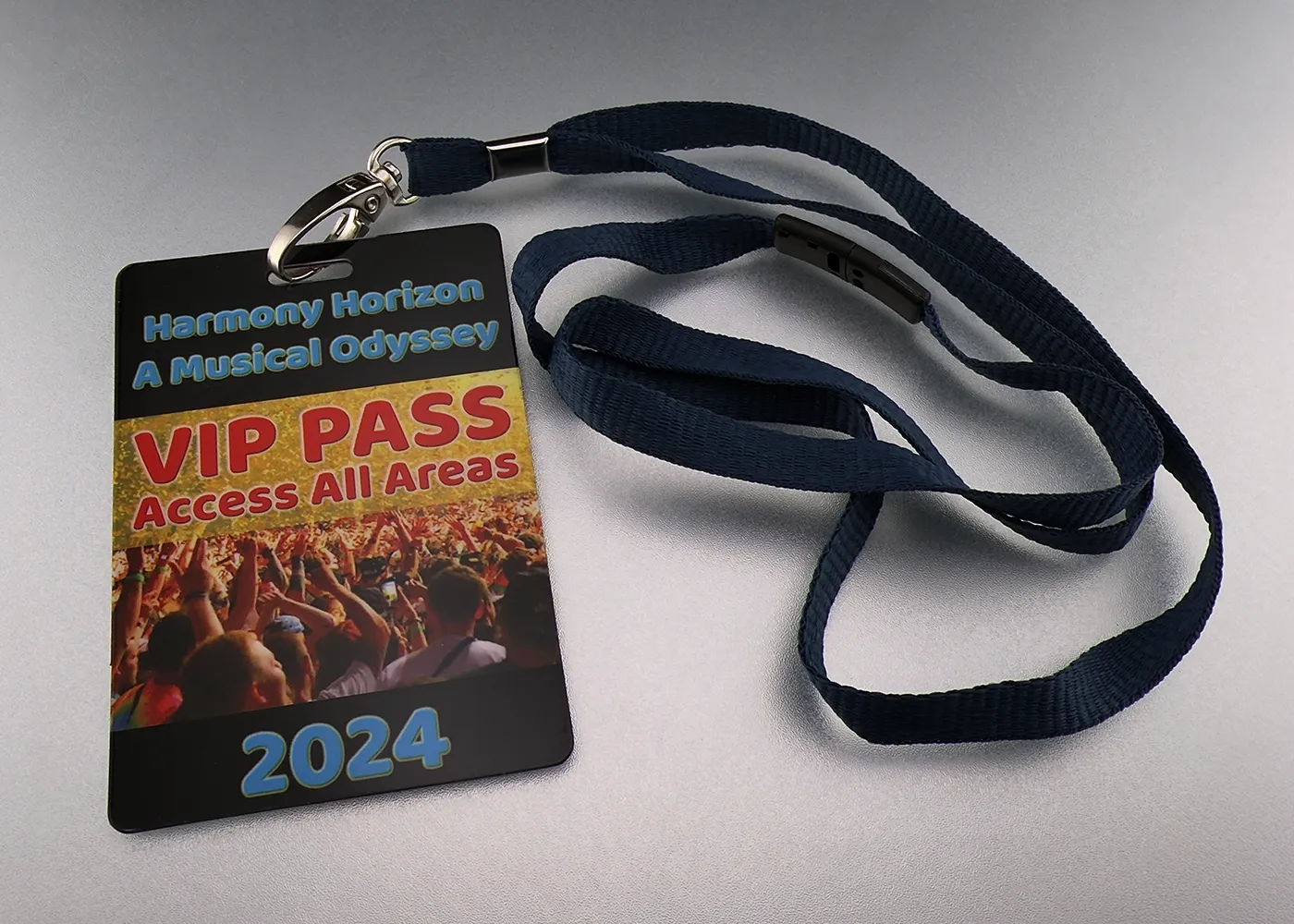
To design an event pass, start with the size and the access levels. Our plastic event passes are 70 x 100mm, portrait, and 680 microns thick, printed in full colour on both sides. Give each access level its own colour and one large word, keep the top clear for a lanyard hole, and send names and numbers in a spreadsheet.
This guide takes each of those in turn, then covers scanning, lanyards, security, laminated passes, prices and timing.
The short versionSet the artwork up at 76 x 106mm for a 70 x 100mm pass. Give each access level one colour and one big word, on both sides. Send names, numbers and QR codes in a spreadsheet, keep the top 12mm clear for the hole or slot, and put the conditions of entry on the back. Approve your proof and pay at least 7 working days before you need the passes, plus delivery.
What size is an event pass?
Our plastic event passes are 70 x 100mm and portrait, with a larger 80 x 120mm size too. The extra room over an 86 x 54mm bank card is what lets a steward read the access level across a barrier, not just at arm’s length. Portrait suits a pass that hangs from a lanyard: see portrait or landscape cards.
| Event pass | |
|---|---|
| Size | 70 x 100mm, or 80 x 120mm |
| Thickness | 680 microns (0.68mm) of solid plastic |
| Printing | Full colour on both sides, at no extra cost |
| Finish | High Gloss, or Premium Matt for £20 +vat per order |
| Artwork size | 76 x 106mm for a 70 x 100mm pass, or 86 x 126mm for 80 x 120mm: the pass plus 3mm of bleed all round |
| Safe area | Keep all wording at least 3mm inside the edge |
| Minimum order | 25 passes |
Our event pass templates cover both sizes, in Photoshop and PDF, and the artwork guide with them explains the set-up. Use CMYK, outline your fonts, and send each side as a separate file. Set black backgrounds and black text to C0 M0 Y0 K100: a black mixed from all four inks puts down too much ink and prints muddy.
Send logos and photos at 300dpi or more (600dpi is better), ideally as PDF, EPS, Illustrator or Photoshop files. Leave optional extras such as names, numbers, a different code on each pass and a signature strip out of the artwork, and send a PDF visual with it that shows where they go.
On our plastic passes the print is sealed between clear PVC sheets bonded together, so it can’t scratch or wear off, even where a lanyard clip rubs. For an event that would rather avoid plastic, passes also come in Plastic-Free Board, 620 microns thick. Board isn’t sealed like PVC, and for anything outdoors we suggest plastic. Board passes also don’t take our High Gloss or Premium Matt finish, a scratch-off panel or a postal proof.
What goes on an event pass?
The front tells a steward who you are and where you can go, in the second it takes to walk past them. The back tells the holder the rules and what to do if the pass is lost. Here’s a made-up festival pass, front and back, drawn to scale.
- Clear zone. Where the hole or slot is punched: keep words and faces out of it.
- Event name and dates. So stewards can see which days the pass is valid.
- Access level. The biggest thing on the pass, readable from across a gate.
- Name and role. Printed for each holder from your spreadsheet.
- Pass number. So you know who has which, and can cancel a lost one.
- QR code. For scanning at the gate: at least 15mm, on white.
- The access level again. A pass on a lanyard often hangs back to front.
- Where it gets you. The areas the pass covers.
- Conditions of entry. Three or four short lines; the rest can go on your website.
- Lost or found. Where to hand it in, and who to contact.
- Signature strip. Optional, signed on collection. Nothing is printed on the strip.
Sponsor logos and artwork are fine, as long as the access level still stands out. Keep small print at 6pt or larger: our guide to font sizes on plastic cards shows each size to scale, and our event pass examples show more layouts.
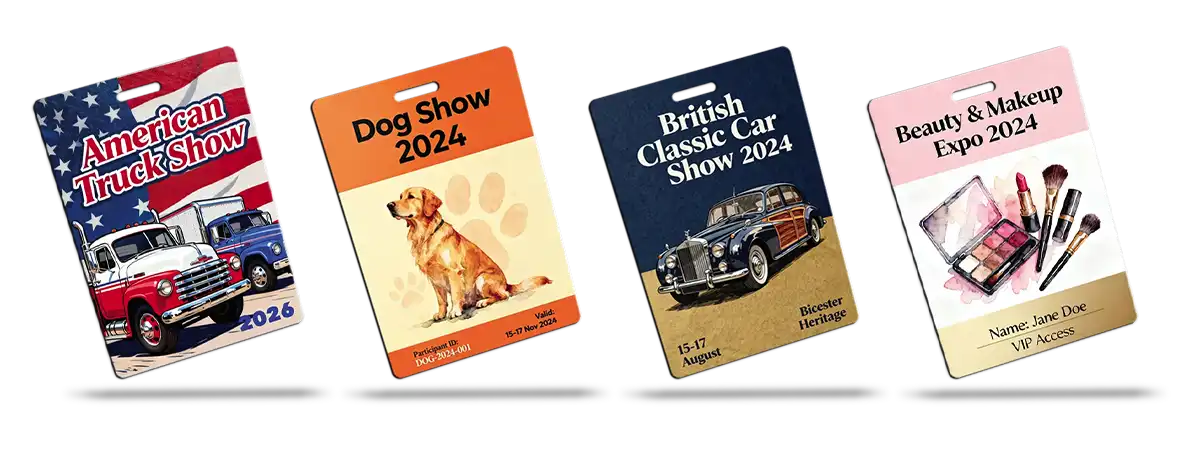
How do you colour-code access levels?
Give each access level its own colour and one large word, and let the colour do most of the work. A steward should be able to tell a backstage pass from a guest pass before the holder reaches the gate.
- One colour, one word. Crew, Artist, Backstage, VIP, Press, Guest: give each level its own colour and print its name large. The whole pass in that colour reads from furthest away.
- Keep the colours well apart. Colours that differ on screen can look the same under coloured stage lighting, as a red and an orange can. Choose colours that differ in lightness too.
- Don’t rely on colour alone. About 1 in 12 men and 1 in 200 women are colour blind, according to Colour Blind Awareness, and can confuse red with green, or blue with purple. The word settles it.
- Print the level on both sides, because passes on lanyards turn round.
- Match the lanyards. Ours come in eight plain colours, one for each level.
One design in a different colour for each access level costs nothing extra in printing when all the colours are ordered as one job.
| Level | Who carries it | Where it gets them |
|---|---|---|
| Crew | Production, stage and site staff | All working areas |
| Artist | Performers and their teams | Backstage and the dressing rooms |
| VIP | Sponsors and invited guests | The VIP area and viewing platform |
| Press | Accredited media | The arena and the press tent |
| Guest | Names on the guest list | The arena |
Accreditation passes
An accreditation pass goes to a named person approved to work at or cover the event: crew, contractors, traders, volunteers or press. It usually shows their name, organisation and role, the areas they can enter and a number that matches your accreditation list, all printed from your spreadsheet.
We can’t print a different photo on each pass. For photo ID, check each pass against the holder’s own ID when they collect it, or use a system that shows their photo when the QR code is scanned.
How do you number and name event passes?
Send them in a spreadsheet. Every pass can carry its own number, name, role and access level, printed in the same run as the design and sealed in with it. For numbers alone, give us a start number and the passes run on from it.
Lay the file out with one row for each pass and one column for each thing that’s printed:
| Row | A | B | C | D |
|---|---|---|---|---|
| 1 | Pass no. | Name | Role | Level |
| 2 | 0417 | Sam Okafor | Stage manager | CREW |
| 3 | 0418 | Priya Nair | Lighting | CREW |
| 4 | 0419 | Tom Hale | Artist liaison | ARTIST |
| ⋮ | ⋮ | ⋮ | ⋮ | ⋮ |

- Only what’s printed. No notes, totals or “TBC”: everything in the file goes onto a pass.
- Format the number column as Text before you paste, or Excel turns 0417 into 417.
- Check every name in your spreadsheet before you send it: each one is printed as it is in the file. Your proof shows how the names and numbers sit in the layout.
- Allow for the longest name, not the average one, so the layout works for all of them.
- Order a few spares with a write-on panel instead of a printed name, for late additions and lost passes on the day.
Names and numbers are normally printed in Arial or Times New Roman, at any size and in any CMYK colour. Our guides to numbered plastic cards and Excel files go into more detail.
Can event passes be scanned at the gate?
Yes. Print a QR code or a barcode on each pass and your ticketing or access system can scan it at the gate. A different code on every pass comes from your spreadsheet, printed with the design and sealed in, so it can’t be scratched off.
Ask your scanning provider what each code must hold before you design the pass, and send us their file.
| QR code | Barcode | |
|---|---|---|
| Size | Square, at least 15mm | Not too small, so the bars scan easily |
| Background | Black on a white square | On a white box, with the number printed underneath |
| Types | Numbers and letters, or a web address | Usually Code39; Code128 and EAN5 too |
| Read by | Phone cameras and 2D scanners | Barcode scanners |
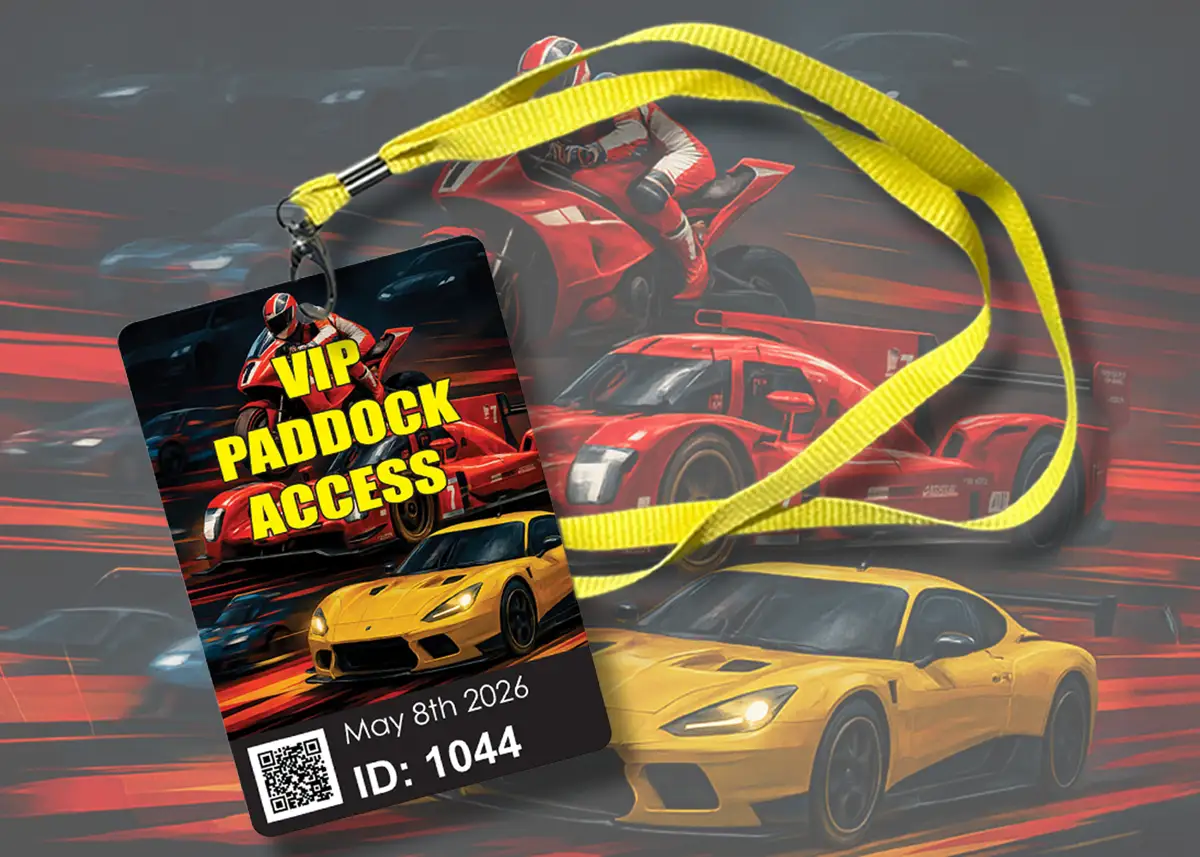
- The same code on every pass? Put it in your artwork and it costs nothing extra. A different code on each pass is an optional extra.
- Premium Matt has no glare, so codes scan more easily under bright lights. It’s £20 +vat per order.
- Test real passes first. We can’t test codes on your scanners, so add a postal proof to your order: a few real passes, £65 +vat, in around 5 working days, before the rest are printed.
- Check every scan against your list. A photocopy still scans, so the security is your system turning away codes that are cancelled or expired and, on a one-entry pass, any already used.
Our free QR code generator and barcode generator make a single code to put in your artwork, and our pages on QR codes and barcodes have the full specifications.
Where does the lanyard hole go?
Centred on the top edge, so the pass hangs straight and reads the right way up. Choose a 5mm round hole for a lanyard hook or a 15 x 3mm slot for a lanyard clip or badge clip: our page on holes and slots gives both sizes. Our 70 x 100mm template marks where each one goes, centred about 6.5mm below the top edge.
Keep words, logos and faces out of the top 12mm across the middle 25mm of the pass. That clears the hole or slot with room to spare. The best designs make a feature of it, with a plain band of colour across the top.
Lanyards
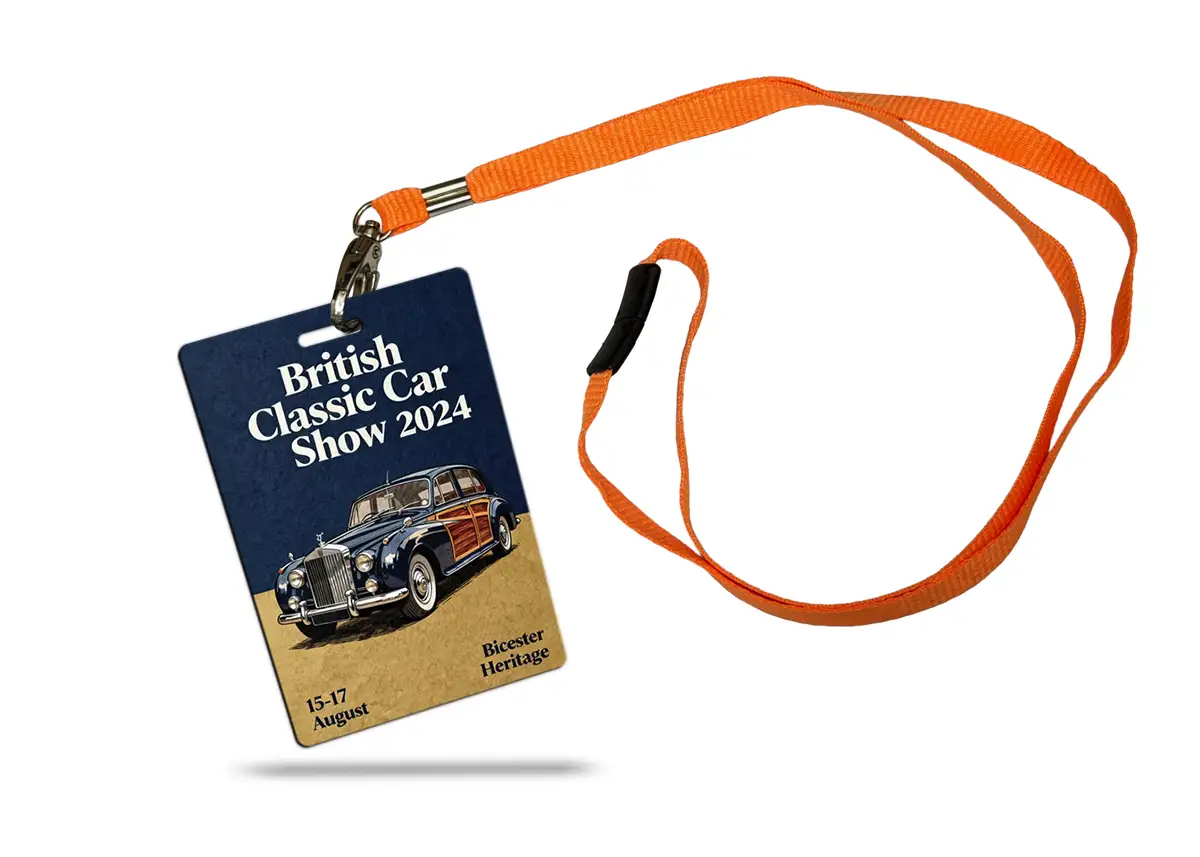
We supply lanyards too, so passes and lanyards can arrive in one order instead of from two suppliers working to the same deadline. They come in eight plain colours (black, light blue, dark blue, dark green, orange, purple, red and yellow) and in pre-printed Staff, Visitor, Student and NHS designs.
Passes handed back at the end of each day, at a conference or on a site, work the same way: our visitor passes are numbered and reusable, with a slot or a hole.
How do you stop event passes being copied?
No printed pass is impossible to copy, but you can make a copy pointless and easy to spot. Solid plastic is much harder to copy or tamper with than paper, and a few simple features do the rest.
Ask crew and guests not to post close-up photos of their passes online: a sharp, flat picture is the easiest thing to copy. Metallic foil and magnetic strips aren’t available on event passes. Our guide to stopping cards being copied covers every option, and our pages on signature strips and scratch-off panels give their sizes.
What’s the difference between a laminated pass and a printed plastic pass?
A laminated pass is a paper print sealed inside a clear plastic pouch. A printed plastic pass is solid plastic all the way through: ours are 680 microns thick, with the print sealed between clear PVC sheets bonded into one. Each suits a different job.
| Laminated paper pass | Printed plastic pass | |
|---|---|---|
| What it is | A paper print in a clear plastic pouch | Solid plastic, the print sealed inside between clear PVC sheets |
| Who makes it | Usually you, with a printer and a laminator | Ordered from us, made in England |
| How many, how soon | Any number, the same day | From 25, in 7 working days from proof approval and payment, or 3 to 4 express |
| Rain and wear | Fine while the seal holds; if the pouch is cut or comes unsealed, water can reach the paper | Water-resistant and tear-resistant, and the print can’t scratch or wear off |
| Names, numbers and QR codes | Printed on your own printer, then laminated one at a time | Printed from your spreadsheet |
| Copying | Anyone with a printer and a laminator can make one | Much harder to copy or tamper with than paper |
| Best for | A handful of passes needed today | 25 or more, outdoor and multi-day events, and scanned passes |
Pricing budget laminated passes for a large event? Price printed plastic as well: at 1,000, our passes start at 43.5p each plus VAT, before extras such as a hole or slot. There are no pouches to buy and nothing to laminate by hand.
Thinking of buying an ID card printer to make passes yourself? Our guide to card printers or printed cards compares the two.
How much do event passes cost?
Our 70 x 100mm plastic event passes start at £119.00 +vat for 25, and the price per pass falls as the quantity rises, to 43.5p a pass at 1,000, before optional extras.
| Quantity | Price | Per pass |
|---|---|---|
| 25 passes | £119.00 +vat | £4.76 |
| 50 passes | £123.00 +vat | £2.46 |
| 100 passes | £144.00 +vat | £1.44 |
| 200 passes | £186.00 +vat | 93p |
| 250 passes | £206.00 +vat | 82.4p |
| 500 passes | £269.00 +vat | 53.8p |
| 1,000 passes | £435.00 +vat | 43.5p |
70 x 100mm, 680 microns, full colour on both sides, High Gloss, with one design printed from your print-ready artwork. Prices exclude VAT and optional extras. Delivery to mainland England is free; our delivery prices list the areas that are charged.
Why does a pass cost more at 25 than at 1,000? Much of the work in an order is the same whatever the quantity. Numbering, names, a different QR code on each pass, a hole or slot, signature strips and lanyards are priced on your quote, as are the 80 x 120mm size and orders over 1,000.
How long do event passes take, and what do we need?
Standard production is 7 working days from proof approval and payment. Express production takes 3 to 4 working days: ask us for cost and availability. Work back from the day you need to hand the passes out, not the day the event opens.
- SendYour access levels, quantities, artwork and spreadsheet.
- ApproveYour free proof, which we aim to email within the hour. Check the layout, and the names and numbers it shows.
- Production7 working days from proof approval and payment, or 3 to 4 working days express.
- DeliveryBy courier: the next working day to England, a little longer to some areas.
Leave time after delivery to sort passes by name and level, and allow around 5 working days more for a postal proof. Our delivery prices list how long delivery takes to each area.
Every order gets a free photorealistic proof by email, so you can check the layout and wording. The colours on the proof are a guide only, because every screen shows colour differently. If a colour has to be right, add a postal proof.
If you send your own artwork, we check it for technical problems such as bleed, resolution and colour mode, and fix them for £10 +vat if needed. The wording on the proof, and the names and numbers in your spreadsheet, are yours to check. No artwork? Our design service is £29 +vat, with no limit on reasonable amends.
What to send us
- The size: 70 x 100mm or 80 x 120mm
- How many passes of each access level
- Your artwork, or your logo and wording for our design service
- Your spreadsheet of names, numbers or codes, if each pass is different
- A PDF visual showing where the names, numbers and codes go
- What your scanning provider needs each QR code or barcode to hold
- A hole or a slot, and any lanyards, with their colours
- High Gloss or Premium Matt
- The date you need them, and where they’re going
Email it all to sales@cpcards.co.uk, or use our event pass quote form. We aim to reply within 10 minutes, 9am to 5pm, Monday to Friday, and everything is agreed in writing.
Questions & Answers
-
What size is an event pass?
Ours are 70 x 100mm and portrait, or 80 x 120mm, and 680 microns thick. That’s bigger than an 86 x 54mm bank card, so the access level can be read from further away. Set up 70 x 100mm artwork at 76 x 106mm, which includes 3mm of bleed.
-
What should be printed on an event pass?
On the front: the event name and dates, the access level in large type, a pass number and, where needed, the holder’s name and a QR code or barcode. On the back: the access level again, the areas it covers, the conditions of entry and what to do if it’s lost.
-
How are custom event passes designed for festivals and live events?
Start with a list of access levels and who gets each one. Design one 70 x 100mm portrait layout, give each level its own colour and one large word, and leave the top clear for a lanyard hole. Names, numbers and QR codes come from a spreadsheet, and you approve a free proof before anything is printed.
-
What’s the difference between a laminate pass and a printed event pass?
A laminated pass is a paper print sealed in a clear plastic pouch; a printed plastic pass is solid plastic with the print sealed inside. Ours are 680 microns thick, water-resistant and tear-resistant, and the print can’t scratch or wear off. Laminating suits a handful of passes needed today; printed plastic suits 25 or more, outdoor and multi-day events, and scanned passes.
-
How much do custom event passes cost for bulk festival orders?
1,000 of our 70 x 100mm plastic event passes start at £435.00 +vat, which is 43.5p a pass, against £4.76 a pass at 25. Optional extras such as names, numbering, a different QR code on each pass and a hole or slot are priced on your quote. Much of the work in an order is the same whatever the quantity, so the price per pass falls as the quantity rises. For more than 1,000, email sales@cpcards.co.uk for a quote.
-
What are the best UK suppliers of custom event passes for festivals?
The best one for your event can print what you need by your date and show you a proof first. Ask where the passes are made, whether the print is sealed inside the plastic, and whether names, numbers, QR codes and lanyards can all come in one order. We supply plastic event passes made in England, from 25, and we’re rated 5.0 on Google from over 240 reviews.
-
Can event passes be scanned at the gate?
Yes, with a QR code or barcode printed on each pass. A different code on every pass comes from your spreadsheet; QR codes should be at least 15mm square on white, and the usual barcode is Code39. To test real passes on your own scanners first, add a postal proof to your order.
-
Can the lanyards match each access level?
Yes. Our lanyards come in eight plain colours (black, light blue, dark blue, dark green, orange, purple, red and yellow), so each level can have its own, and we supply them in the same order as the passes. There are pre-printed Staff, Visitor, Student and NHS designs too. Tell us whether you’d like a 5mm hole or a 15 x 3mm slot in the passes.
-
How far ahead should we order event passes?
Approve your proof and pay at least 7 working days before you need the passes, plus time for delivery, which is the next working day to England. Express production in 3 to 4 working days is also available: ask us for cost and availability. Allow around 5 working days more for a postal proof, and time to sort the passes by name and level before you hand them out.
Planning passes for an event?

Email your access levels, quantities and artwork to sales@cpcards.co.uk, with your names file if each pass is different. We aim to reply within 10 minutes, 9am to 5pm, Monday to Friday.
Your free photorealistic proof shows the layout, the levels and the numbering in place before anything is printed.