


RFID ID Cards for Staff and Door Access
An RFID ID card is a printed ID badge with a chip inside, so the card people wear can also open the door. To order them, match the chip to your readers, send names and numbers in a spreadsheet, and add photos with photoseals. We supply them from 25 cards, unencoded.
This guide is for offices, schools and sites, from choosing the chip to how people wear the cards. For a badge that opens no doors, see plastic ID cards.

The short versionOur RFID cards are 86 x 54mm, in full colour on both sides. Send us your reader’s make and model, or a photo of a card, to help match the chip. Photos go on with photoseals, and people wear the cards in a clear holder on a lanyard, because holes and slots aren’t available.
What is an RFID ID card?
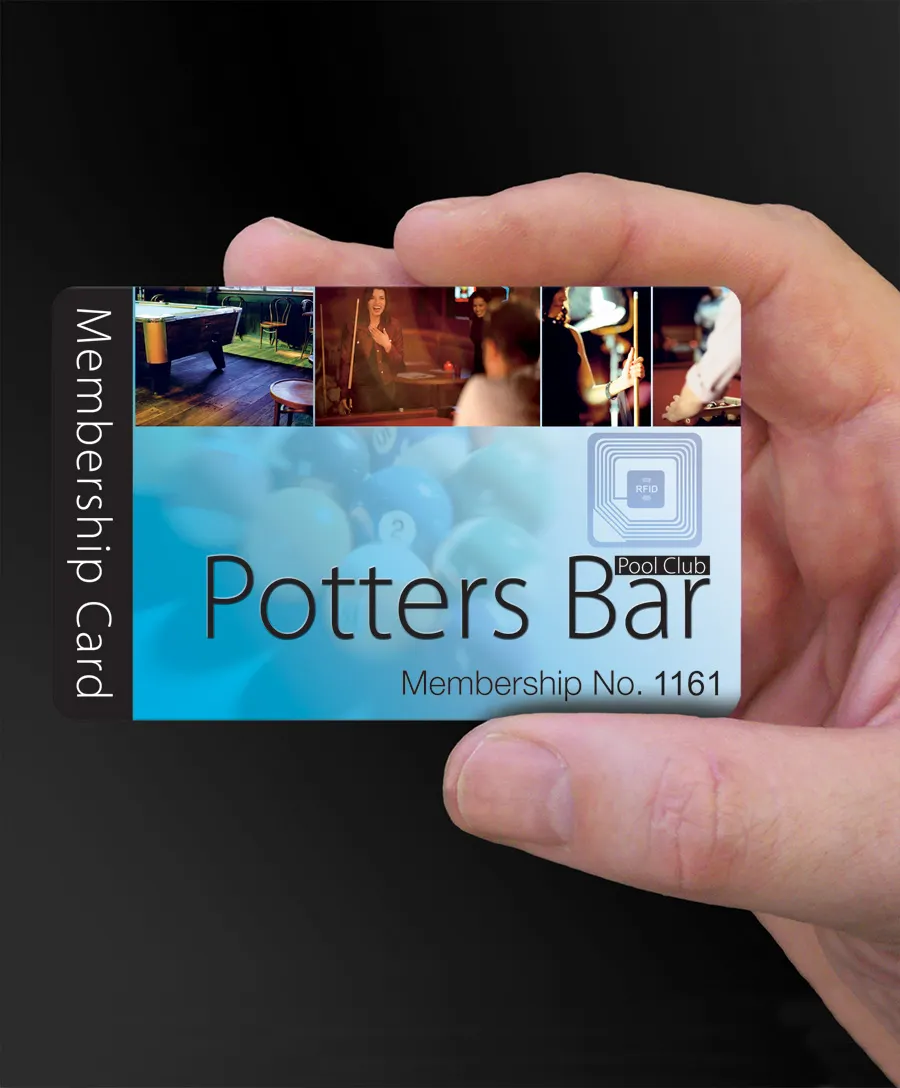
It’s an ID badge with a chip and antenna sealed inside, so one card identifies a person to the eye and to a door reader. RFID stands for radio frequency identification, which is why you’ll also see them called radio frequency ID cards or RFID identity cards. The chip has no battery and can’t be seen, so the whole card is free for your design. Our guide to RFID cards has more.
| Detail | Our RFID cards |
|---|---|
| Size | 86 x 54mm, the size of a bank card |
| Thickness | 0.82mm (820 microns) for our 1K Mifare cards |
| Printing | Full colour (CMYK) on both sides, sealed under clear PVC so the print can’t scratch or wear off |
| Finish | High Gloss, or Premium Matt for £20 +vat per order |
| Chips | Mifare or Fudan, in 1K or 4K, and HID. Ask us about other formats |
| Encoding | We supply them unencoded |
| Holes and slots | Not available on RFID cards |
| Magnetic strip | Can be added |
| Embossing | Not available on RFID cards |
| Minimum order | 25 cards |
How does an RFID card open a door?
The card sends an ID number, and your access control system decides whether that number may come in. On a simple system, the card holds no list of doors: those permissions live in the software. That’s why a lost card can usually be cancelled on the system while everyone else’s carries on working. Ask your installer how yours works. For gyms and clubs, see RFID membership and loyalty cards.
Which chip do I need for my door readers?
The one your readers already read. A card built for one frequency won’t work with a reader built for another, and cards can’t be re-chipped after printing, so settle this before anything else. The names to look for are below, and our RFID cards page has the full specification.
| Chip | Frequency | Worth knowing |
|---|---|---|
| Mifare Classic 1K | 13.56MHz | The standard for most door entry and gym systems. The chip our price table is based on. |
| Mifare DESFire | 13.56MHz | Higher security, used in more complex access systems. |
| HID | HID Prox is 125kHz | For corporate access control. Tell us the exact HID format your system uses. |
| Fudan | Ask us | Often chosen over Mifare to keep the cost down. Check that your system reads it. |
| EM4100 or Indala | 125kHz | Older formats, typically a fixed read-only number. Ask us if your system uses one. |
How to find out which chip you have
- Ordering RFID ID cards?
- Is it a new system, with no readers yet?If yes: Ask your installerChoose the chip with the readers
- If not: Do you know the reader’s make and model?If yes: Send it to usWe can usually identify the chip
- If not: Do you have a card that works now?If yes: Send us a photo of itWe can usually identify it from that
- If not: Ask your installerThen send us the chip’s name
We can’t promise a card will work with a particular system, so ask your access control installer:
- Which frequency and chip do our readers use? An exact name, such as Mifare Classic 1K, not just “RFID”.
- How are new cards added to the system, and who does it? You need this answer before the cards arrive.
Starting from scratch? Our RFID vs NFC guide suggests 13.56MHz for a new system. We supply the cards, not the readers, software or installation, and RFID cards only, not NFC cards.
What can be printed on an RFID ID card?
Your full colour design on both sides, plus a name, role, number or barcode that changes from card to card. Send the details in a spreadsheet with one row per person. The proof shows where the names and numbers sit. Check your spreadsheet before you send it, because our artwork check is technical and doesn’t cover names or spelling.
- Company name and logo. The same on every card. 14 to 24pt.
- The photo. See how photos get on.
- Name. From your spreadsheet, 10 to 14pt.
- Role. 8 to 10pt. Nothing below 6pt.
- Staff number. 10pt or more, matched to a person in your register. An expiry date under it makes an old card stand out.
- The photoseal. A clear seal over this whole side.
- Signature strip. Typically 75 x 8mm, at least 4mm from the edge.
- Barcode or QR code. A fallback if a reader is down.
- If found. A phone number or email, not the site’s address.
- Chip and antenna. Sealed inside the card.
- Print only what the card needs. Under UK GDPR, personal details you print are your responsibility, so keep them to a minimum.
- Leave the address off. A card with a site address tells whoever finds it which door it opens.
- Landscape or portrait. Both are available. Portrait often suits a card worn on a lanyard with a photo. Without a slot, the holder decides how a card hangs, so match the two. See portrait and landscape cards.
- Use our template. RFID card templates are set up at 92 x 60mm with 3mm of bleed. Keep wording 3mm inside the edge, and see our font size guide.
How do photos get on an RFID ID card?
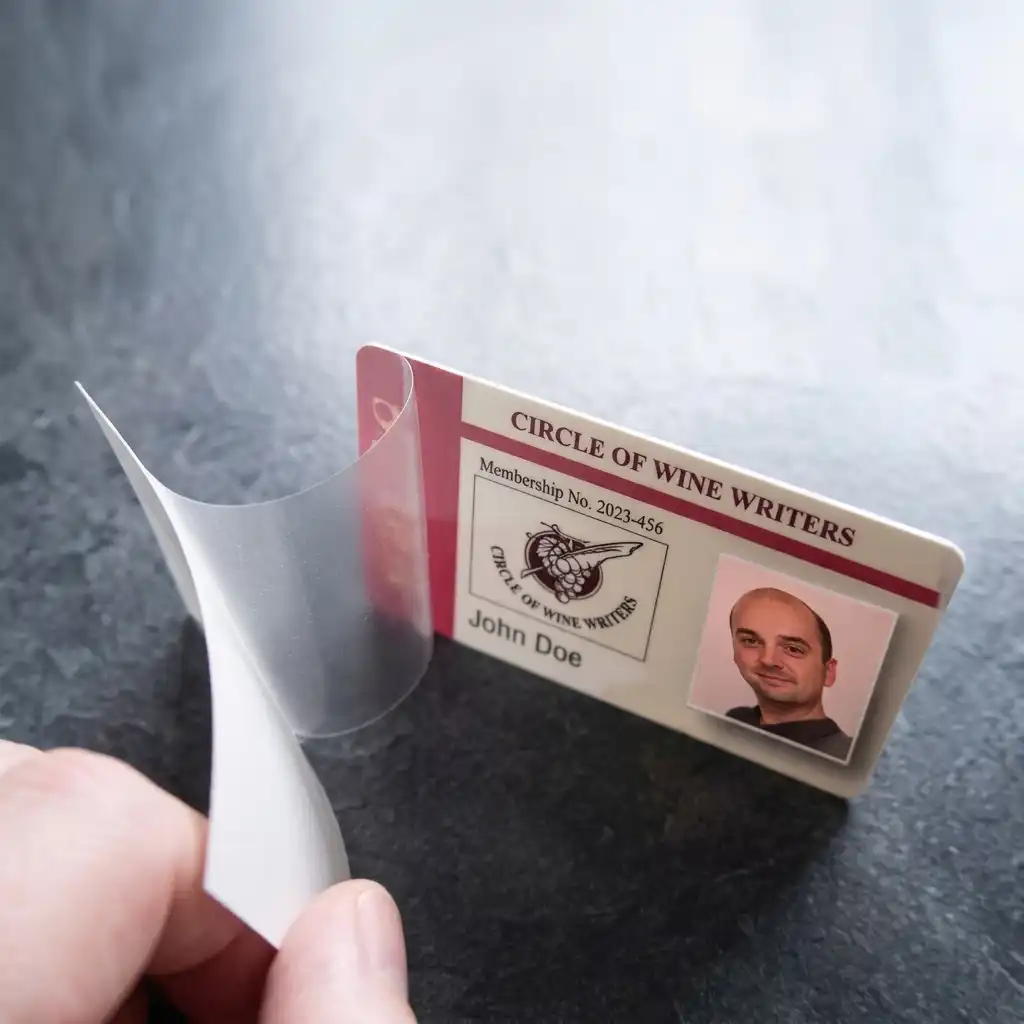
With a photoseal, because we can’t print a different photo on each card. A photoseal makes it a photo ID card: it fixes a passport-sized photo to the card under a clear seal that covers one side. It’s easy to apply yourself, and we can attach them for you if you send the photos.
- Leave a photo space. A UK passport photo is 35mm wide by 45mm high, which fits the 54mm height of a landscape card with room above and below.
- Plan the card round the seal. Put the name, role and number beside the photo, and keep the signature strip on the other side, because the seal covers everything on its side.
- Save time at the desk. Partly attach the photoseal in advance, so there’s less to do when someone joins.
If you need a photo printed on each card as people join, a desktop ID card printer may suit you better, using blank cards with the right chip. Our guide to card printers or printed cards compares the costs. Its figures are for plain cards, so expect blanks with a chip to cost more.
How do people wear RFID ID cards without a hole?

In a clear card holder on a lanyard. Holes and slots aren’t available on RFID cards, because the antenna inside runs as a loop and a hole through it stops the card working. Don’t punch your own, and keep cards flat, because a hard bend can stop them working too. Without holes, we don’t supply RFID key fobs or key tags either.
We supply lanyards from 25, in plain colours and pre-printed Staff, Visitor, Student and NHS designs. We don’t list clear card holders on this site, so buy those from an ID badge supplier, or ask us. Our 1K Mifare cards are 0.82mm, a little thicker than a 0.76mm card, so check that the holder takes them.
How do we issue RFID ID cards to new starters?
Order spare cards, or order again as you need them. Whichever you choose, a new card has to be added to your access system before it opens a door, so ask your installer how that’s done.
Are older 125kHz cards easier to copy?
Yes. Older 125kHz cards send their number with no encryption, so they’re the easiest to copy. CDVI, an access control manufacturer, says copiers sell online for as little as £15. It also says Mifare Classic is harder to clone but not impossible, and that DESFire adds AES encryption.
- The card can’t fix this alone. The chip has to match your readers, so a stronger chip usually means talking to your installer about the readers as well.
- A genuine card works until it’s cancelled. Cancel lost cards on your system as soon as they’re reported. See how to stop cards being copied.
How do I get RFID cards for my organisation?
Find out your chip, then ask us for a quote by email. If you’re an employee or a student, your card comes from whoever runs the door system, not from us: our minimum order is 25 cards.
- ChipFind your chip, or ask us to help identify it.
- QuoteEmail sales@cpcards.co.uk or use our quote form. We often reply within minutes, 9am to 5pm, Monday to Friday.
- ProofWe email a free photorealistic proof, so you can check the layout and wording. The colours on the proof are a guide only, because every screen shows colour differently.
- PrintYour cards are printed in 7 working days from proof approval and payment. Express takes 3 to 4 working days: ask us for cost and availability.
No artwork? Our design service is £29 +vat. If you send your own, our artwork check is technical (bleed, resolution, colour mode and set-up), and we can fix a problem for £10 +vat. You check the wording on your proof.
If a colour has to be right, add a postal proof: optional real cards added to a paid order, for £65 +vat, around 5 working days. To try a real card on your own reader before the full run, ask us about it.
How much do RFID ID cards cost?
The price of RFID ID cards with a Mifare 1K chip starts at £182.00 +vat for 25. The price per card falls as the quantity goes up, because much of the work in an order is the same whatever the quantity.
| Quantity | Price from |
|---|---|
| 25 | £182.00 +vat £7.28 each |
| 50 | £186.00 +vat £3.72 each |
| 100 | £238.00 +vat £2.38 each |
| 200 | £394.00 +vat £1.97 each |
| 250 | £446.00 +vat £1.78 each |
| 500 | £612.00 +vat £1.22 each |
| 1,000 | £1,007.00 +vat £1.01 each |
One design, in full colour on both sides, from your print-ready artwork. Delivery is free within Great Britain, and our delivery prices list the charges for Northern Ireland, the Republic of Ireland and the Channel Islands. Prices exclude VAT and optional extras. Names, numbers, barcodes and photoseals are priced on your quote, and so are other chips and other quantities.
Questions & Answers
-
How do I get an RFID card?
Ask whoever manages the access system at your workplace or school, because they issue the cards. If you run the system, find out which chip your readers use and order printed cards. Our minimum is 25 cards, so we don’t supply single cards.
-
How much does an RFID ID card cost?
With a Mifare 1K chip, from £182.00 +vat for 25. The price per card falls as the quantity goes up. Names, numbers, barcodes and photoseals are priced on your quote, and so are other chips.
-
Will your RFID cards work with my door readers?
Only if the chip matches, so that’s the first thing to check. Send us the make and model of your reader, or a photo of an existing card, and we can usually identify the chip. If you’re unsure, check with your access control installer before you order, because cards can’t be re-chipped after printing.
-
Can you print a photo on each RFID ID card?
No, we can’t print a different photo on each card. A photoseal fixes a passport-sized photo to each card instead, applied by you or by us. If each photo must be printed on the card as people join, a desktop ID card printer may suit you better.
-
Can an RFID ID card have a hole or slot for a lanyard?
No, holes and slots aren’t available on RFID cards, because a hole through the antenna inside stops the card working. Put the card in a clear card holder on a lanyard instead. We supply lanyards, but we don’t list card holders on this site.
-
Where can I get RFID ID cards in the UK?
CP Cards supplies them, printed in England. The minimum order is 25 cards, from £182.00 +vat for 25 with a Mifare 1K chip, with a free email proof. Delivery is free within Great Britain, and our delivery prices list the charges for Northern Ireland, the Republic of Ireland and the Channel Islands. For a quote, email sales@cpcards.co.uk with your quantity and your reader’s make and model. We often reply within minutes, 9am to 5pm, Monday to Friday.
Ready to order RFID ID cards?

Tell us how many cards you need and which chip or reader you have, along with your artwork or your logo and wording. We’ll quote by email, often within minutes, 9am to 5pm, Monday to Friday.