


RFID Membership and Loyalty Cards
An RFID membership or loyalty card lets a member tap a reader instead of having a barcode scanned. It costs more per card and needs readers and software that read that chip, so it’s worth paying for when you already have RFID readers or need tap-in entry. Otherwise a barcode does the job for less.
We supply RFID loyalty cards and membership cards from 25, printed in full colour on both sides. For the technology itself, see what an RFID card is.

The short versionFind out what your readers need before you think about the design: the chip type and frequency must match, and a card can’t be re-chipped after printing. Send us the make and model of your reader, or a photo of a card that already works. We supply the cards unencoded, with no holes or slots, from a minimum of 25.
What does an RFID chip add to a membership or loyalty card?
Tap and go. The member holds the card to a reader, and a chip inside the card passes its number to your system, with no contact and nothing to line up. Your software then finds the member, just as it would from a scanned barcode.
- Quick, with no staff needed. The read takes milliseconds, so members can let themselves through a door or turnstile. That matters most at a busy entrance.
- Nothing to wear out. The card doesn’t need to touch the reader, and the chip is out of sight inside the card.
- One card for two jobs. Many customers use one card for both membership and door entry. For staff badges, see RFID ID cards.
- Harder to copy than a barcode. A photocopy of a barcode still scans. A photocopy of an RFID card is just a picture of a card.
The honest limitHarder to copy isn’t impossible to copy. A 125kHz card often holds just a fixed ID number, with no encryption. Mifare Classic, the usual door entry chip, was cracked by university researchers in 2008, and cloning one takes a reader and some software. Mifare DESFire is a higher security chip. And no chip stops a member lending their card: for that, use a photoseal or signature strip, and check it.
RFID or barcode on a membership or loyalty card?
A barcode is the cheaper choice and works with most tills that have a scanner. RFID costs more per card, but members can tap in without staff. See membership cards with barcodes for the printed option.
| RFID chip | Barcode | |
|---|---|---|
| Cost per card at 100 | £2.38 +vat (Mifare 1K) | 85p +vat, plus the barcode |
| Cost per card at 500 | £1.22 +vat (Mifare 1K) | 35p +vat, plus the barcode |
| Speed | Milliseconds: the member holds it to a reader, with nothing to line up | Fast, once the bars face the scanner, usually at a till or desk |
| Copying | Harder: it can’t be photocopied, though some chips can be cloned | Easy: a photocopy still scans, so your system must reject numbers it shouldn’t accept |
| Reader cost | Usually the bigger outlay, unless you already have readers: they must match the chip, and your software must accept them | Often nothing, if your till already has a scanner |
| If it can’t be read | Add a printed number or barcode as a fallback | Staff type in the number printed under the bars |
We supply the card, not the reader or the software, so ask your system supplier for a reader price. Our guide to membership card systems lists the questions to ask. Our guides to QR codes and barcodes on loyalty cards and loyalty cards and your till cover the printed options.
Is an RFID chip worth paying for?
Yes if a door, turnstile or existing reader needs it. No if staff scan each card at a till, which is the usual way for salons, coffee shops and retail.
- A membership or loyalty card
- Do you already have RFID readers?If yes: An RFID cardMatched to that reader
- If not: Will members let themselves in, with no staff?If yes: An RFID cardTalk to a door entry supplier first
- If not: Do people want it on a key ring?If yes: A barcode key tagThere are no RFID key tags
- If not: A barcode cardScanned at the till or desk
No scanner either? A stamp card needs nothing but a stamp or punch: see our loyalty card ideas. Our guide to plastic cards for gyms covers door entry, key tags and guest passes.
How do I make sure RFID cards work with my readers?
Match the chip type and frequency to your reader before you order. A reader built for 13.56MHz won’t see a 125kHz card at all, and a system set up for one chip may reject another at the same frequency. Cards can’t be re-chipped after printing, so this comes before the design.
| Chip | Frequency | Worth knowing |
|---|---|---|
| Mifare Classic 1K | 13.56MHz | The standard for most door entry and gym systems |
| Mifare DESFire | 13.56MHz | Higher security and more complex access systems |
| Fudan | Ask us | A lower-cost option. Check your system accepts it |
| HID | Depends on the type | Corporate access control |
| EM4100 | 125kHz | Older gym and office systems |
We supply Mifare Classic 1K, Mifare DESFire, Fudan and HID. Mifare and Fudan cards come in 1K or 4K. For HID, tell us the exact format your system uses. If it needs something else, such as EM4100, ask us.
What to send us
- The make and model of your reader, or a photo of a card that already works. We can usually identify the chip from either.
- The chip specification, if you can get it, from whoever supplied or maintains your system.
- How many cards, and your artwork or your logo and wording. If each card needs its own number or name, say so.
Before you order, ask your system supplier what it needs from a new card. Our RFID vs NFC guide explains why a card a phone can read is a different thing: we supply RFID cards only, not NFC cards.
Can you print on RFID cards?
Yes, in full colour on both sides at no extra cost, with the same design freedom as any other full colour card. The chip and antenna are inside the card, so the whole surface is yours. Cards are 86 x 54mm, and 820 microns thick with a Mifare 1K chip. They can have a magnetic strip, but they can’t be embossed, so numbers and names are printed.
- Full colour to the edge. The artwork is 92 x 60mm, with 3mm of bleed. Keep wording 3mm inside the edge.
- Chip and antenna. Sealed inside the card, with no contact plate.
- A tap sign. Your own printed design, if you’d like one to show members what to do.
- A printed number, so a card can be matched to a member in your records.
- A barcode, as a fallback if a reader is down.
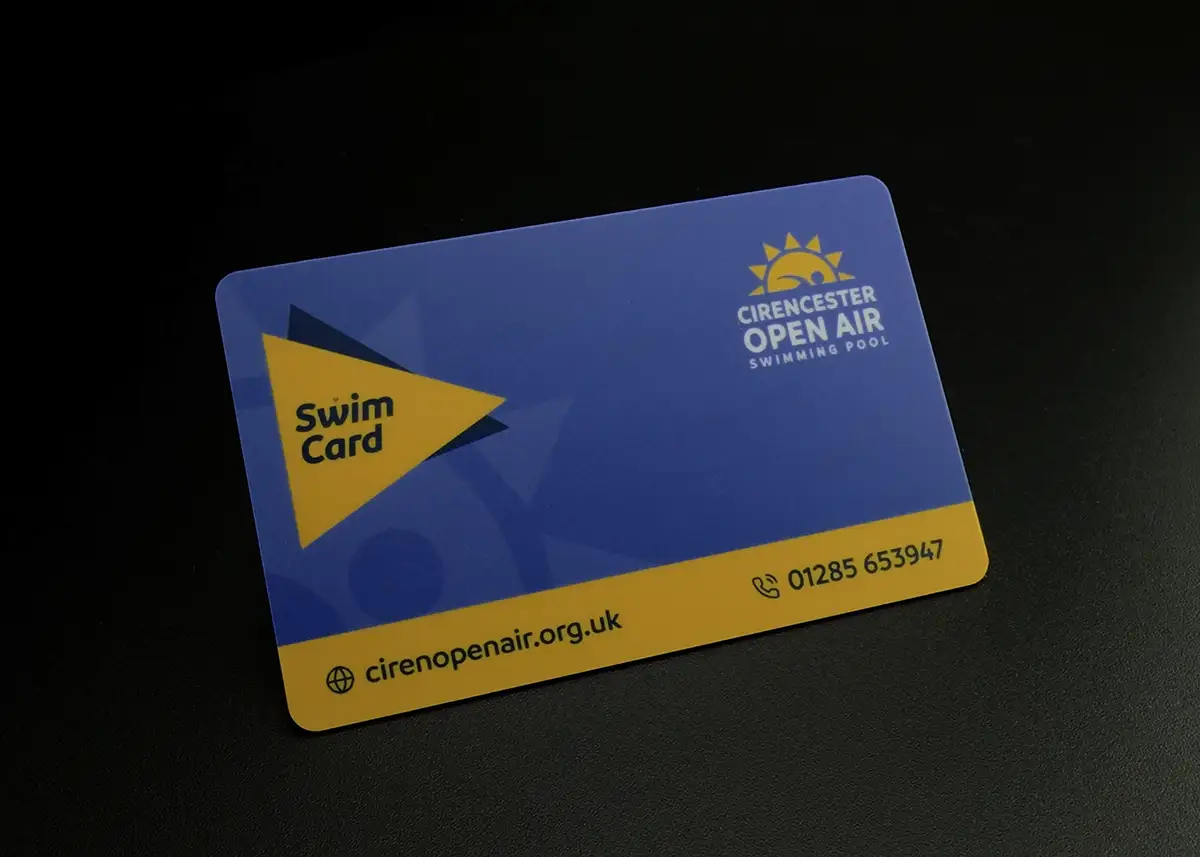
- The print is sealed between clear PVC sheets that are bonded together, so it can’t scratch or wear off. High Gloss is standard, and Premium Matt is £20 +vat per order.
- No artwork? Our design service lays out your card from your logo and wording for £29 +vat.
- Your own artwork gets a technical artwork check of bleed, resolution, colour mode and set-up. We can fix a problem for £10 +vat, and you check the wording.
- Your free email proof lets you check the layout and wording. The colours on the proof are a guide only, because every screen shows colour differently. If a colour has to be right, add a postal proof.
Can a personalised RFID card have its own number?
Yes. A name, number or barcode can be printed on each card. The chip inside is separate, and we don’t write anything to it. To link the two, record which printed number goes with which member when you hand over the card. Need a chip’s own ID printed on the card? Ask us before you order.
- A run of numbers. Give us a start number, and the cards run on from it. See numbered plastic cards.
- Your own list. Send names or numbers in an Excel file, with the column formatted as Text so leading zeros aren’t lost. Check your spreadsheet before you send it, because our artwork check is technical and doesn’t cover names or spelling. The proof shows where the names and numbers sit.
- A photo on each card? We can’t print a different photo on each card, but a photoseal seals a passport-sized photo onto it. Our guide to personalised plastic cards covers the other options.
Can an RFID card have a hole, or be a key tag?
No. Holes and slots aren’t available on RFID cards, so we don’t offer RFID key tags.
How much are RFID loyalty and membership cards?
RFID cards with a Mifare 1K chip start at £182.00 +vat for 25. The minimum order is 25. The price per card falls as the quantity goes up, because much of the work in an order is the same whatever the quantity.
| Quantity | RFID (Mifare 1K) | Standard card |
|---|---|---|
| 25 | £182.00 +vat £7.28 each | £75.00 +vat £3.00 each |
| 50 | £186.00 +vat £3.72 each | £79.00 +vat £1.58 each |
| 100 | £238.00 +vat £2.38 each | £85.00 +vat 85p each |
| 200 | £394.00 +vat £1.97 each | £99.00 +vat 49.5p each |
| 250 | £446.00 +vat £1.78 each | £109.00 +vat 43.6p each |
| 500 | £612.00 +vat £1.22 each | £175.00 +vat 35p each |
| 1,000 | £1,007.00 +vat £1.01 each | £245.00 +vat 24.5p each |
Full colour on both sides, High Gloss, one design, printed from your print-ready artwork. Prices exclude VAT and optional extras: Premium Matt is £20 +vat per order, and numbering and barcodes are priced on your quote. Delivery is free within Great Britain, and our delivery prices list the charges for Northern Ireland, the Republic of Ireland and the Channel Islands. The standard card is what a membership or loyalty card with no chip costs. Fudan chips cost less than Mifare, and other chips and quantities are priced by quote.
How do I order RFID membership or loyalty cards?
Check your reader, then email us for a quote, so the chip you need is in writing from the start.
- CheckFind out what your readers need.
- QuoteEmail sales@cpcards.co.uk or use our quote form. We often reply within minutes, 9am to 5pm, Monday to Friday.
- ProofWe email a free proof of both sides, so you can check the layout and wording.
- Print7 working days from proof approval and payment. Express takes 3 to 4 working days: ask us for cost and availability.
Want to test a printed card on your own system before the rest are made? Add a postal proof to your order: it’s optional, costs £65 +vat and takes around 5 working days. It’s made after the order is paid, and it lets you test a printed barcode. If you also want to try the chip on your reader, ask us before you order, and we’ll tell you what’s possible.
Questions & Answers
-
Are RFID loyalty cards better than barcodes?
Only if you need tapping. A barcode costs less per card and works with most tills that have a scanner, so it suits a loyalty scheme where staff scan the card. RFID suits a scheme that shares a card with door entry, or where you already have RFID readers.
-
Can you print on RFID cards?
Yes. We supply RFID cards printed in full colour on both sides at no extra cost, sealed under clear PVC. High Gloss is standard, and Premium Matt is £20 +vat per order. Names, numbers and barcodes can be printed on each card from your file.
-
How much does an RFID membership card cost?
With a Mifare 1K chip, £182.00 +vat for 25, which is £7.28 a card, falling to £1.22 a card at 500. Fudan chips cost less. Other chips and quantities are priced by quote, by email.
-
Which RFID chip do I need for my membership cards?
The one your readers are set up for. Mifare Classic 1K is the standard for most door entry and gym systems, and older systems often run at 125kHz. Send us the make and model of your reader, or a photo of an existing card, and we can usually identify the chip.
-
Do you encode RFID cards?
No. We supply them unencoded. Before you order, ask your system supplier what it needs from a new card.
-
Can RFID membership cards be copied?
They’re harder to copy than a printed barcode, because a chip can’t be photocopied, but it isn’t impossible. Some chips have known weaknesses, and a member can still lend a card to a friend. Mifare DESFire is a higher security chip, and a photoseal or signature strip ties a card to its holder.
-
Where can I get RFID membership and loyalty cards in the UK?
CP Cards supplies them from a minimum of 25 cards. Mifare 1K cards start at £182.00 +vat for 25, printed in England in full colour on both sides, with a free email proof so you can check the layout and wording. Delivery is free within Great Britain, and our delivery prices list the charges for Northern Ireland, the Republic of Ireland and the Channel Islands. Email sales@cpcards.co.uk or use our quote form, and we’ll reply, often within minutes, 9am to 5pm, Monday to Friday.
Ready to order RFID cards?

Send us your reader’s details and how many cards you need. We’ll quote by email, often within minutes, 9am to 5pm, Monday to Friday.