
Plastic Reward Cards
A plastic reward card is a printed card that gives a customer something back for buying, visiting or doing something for you. The main kinds are stamp or points cards, tier cards, privilege cards, scratch-to-win cards and one-off rewards. We supply them at 86 x 54mm and 760 microns, from 25 cards.
For ideas by type of business, see our loyalty card ideas.

The short versionStamp cards need only a stamp or punch, points cards need a till or software that can find a customer from a scanned code, and privilege cards just get shown. Every kind can be a standard PVC card, printed in full colour on both sides. A plain printed card starts from £75.00 +vat for 25. Numbers, names, barcodes, scratch panels and metallic bases are priced on your quote.
What are the main kinds of reward card?
They differ in how the reward is earned and how you keep track of it. To run one from scratch, see how to start a loyalty card scheme. A stamp card carries its own record. Most of the others carry a number that links the card to your till, your software or a simple list.
| Kind | How it works | What’s printed | What you need to run it |
|---|---|---|---|
| Stamp card | A stamp or punch for each visit or purchase, and a reward when the grid is full. | A grid of boxes and your rules. | A punch, or a stamp with quick-drying ink for non-porous surfaces. |
| Points card | Points build up against what each customer spends. | A different number on each card, as a barcode, QR code or magnetic strip. | A till or loyalty software that can find a customer from that code. |
| Tier card | Silver, gold and so on, with better rewards at each level. | A different colour for each tier, or a metallic silver or gold base, with a number. | A rule for moving up, and a till or list showing who holds which tier. |
| Privilege card | The holder shows the card and gets the same benefit every time, such as 10% off. | The benefit, short terms, a number or name, and any expiry date. | Staff who check the card. A number or barcode lets you see who uses it. |
| Scratch-to-win card | The holder scratches a panel to see a prize, a code or a message. | One or more panels, with hidden wording under each from a spreadsheet. | A spreadsheet of codes, so you decide how many winners there are. |
| One-off reward | Handed over for doing one thing, such as recommending a friend, and used once. | What it’s worth, how to redeem it, a closing date and a code of its own. | A note of who got which code, crossed off when it’s used. |
On a points or tier card the system keeps the record, so a lost card doesn’t have to mean lost points: if your system allows it, they move to a new card. Our guide to loyalty cards and your till covers which code to choose.
Tier designs that differ only in colour cost nothing extra when ordered as one job. Pick colours that are easy to tell apart, so the colour code still works if a shade varies from one order to the next. The metallic base can vary in shade from card to card and from batch to batch, and white can’t be printed on it, so ask us if a metallic tier card also needs a barcode.
Which kind of reward card do you need?
Work down the questions and stop at the first yes.
- What should the card do?
- Give the same benefit every time it’s shown?If yes: Privilege cardA number, an expiry date and short terms
- If not: Offer a prize or a surprise?If yes: Scratch-to-win cardHidden wording from a spreadsheet
- If not: Thank someone for doing one thing, once?If yes: One-off rewardA code of its own and a closing date
- If not: Give your best customers more than the rest?If yes: Tier cardA different look for each level
- If not: Can your till or software find a customer from a scanned code?If yes: Points cardA barcode or QR code on every card
- If not: Stamp cardA grid of boxes, and a stamp or punch
Kinds can share a card: a scratch panel can sit on a discount card, for example. For what the reward should be and how many stamps to ask for, our loyalty card ideas suggest a scheme for twelve kinds of business.
What is a privilege card?
A privilege card gives the holder a standing benefit every time they show it, such as 10% off, a trade rate or priority entry. Customers might pay a yearly fee for one, or you might issue it to staff, students, NHS staff or the members of a local scheme.
A plastic privilege card is one of our standard full colour cards carrying that wording, so the base card is priced the same, with any name, number, barcode or signature strip priced on your quote. See discount cards for schemes built round a fixed percentage. If the card should feel exclusive, VIP cards covers our satin black and metallic hot foil cards, which are quoted from your design. If one of those needs a barcode or QR code, ask us.
- Your name and logo.
- What the card is, so staff recognise it at a glance.
- The benefit, in plain words.
- Name and number, printed from your spreadsheet.
- Expiry date, for schemes that run for a set time.
- Barcode and number, on a white box, if your till reads the card.
- Signature strip, typically 75 x 8mm, where the card can’t be passed on. Keep it on a white background.
- The rules that matter most.
- Where the full terms are, usually your website.
To keep control, number every card and note who holds which number, so you can cancel a number when a card is lost or passed around. If you don’t know the names yet, our bureau personalisation service holds your printed cards, adds each name as people join and posts the cards to you: please allow 3 working days. Those names go on one side in one colour, on the surface of the card rather than sealed in, and postage and packaging is charged.
What should a reward or privilege card say?

It should say what the holder gets, how to claim it and what the conditions are. The usual pattern is the scheme name or the benefit on the front, with the terms and any barcode or number on the back.
- What they get, in plain words, and how to claim it: show the card, scan it or quote the code.
- The rules that stop an awkward conversation, such as “One stamp per visit over £5” or “Not valid with other offers”.
- Any closing date. Put the important terms on the card and the full terms on your website.
- Whether it can be passed on. “This card is not transferable” is common wording.
- Only the personal details the card needs. A name and number are fine, but a home address or date of birth on a card that might be lost is personal data you’re responsible for under UK GDPR.
For bleed, stamp box sizes and the back of the card, see how to design a loyalty card.
What size is a reward card?
Our standard rewards card dimensions are 86 x 54mm, 760 microns thick, the same as a bank card. The full colour print is sealed between clear PVC sheets that are bonded together, so it can’t scratch or wear off.
| Detail | Our reward cards |
|---|---|
| Size | 86 x 54mm |
| Thickness | 760 microns (0.76mm) |
| Artwork size | 92 x 60mm, including 3mm bleed |
| Safe area | 3mm inside the edge |
| Printing | Full colour (CMYK) on both sides |
| Finish | High Gloss, or Premium Matt for £20 +vat per order |
Can a reward card be a key tag or combo card?
Yes, and both suit people who have their keys to hand more often than a wallet. A key tag has room for a logo and a barcode or number, or a short run of stamp boxes at most. See loyalty stamp cards for what fits on a full-size card. A combo card gives people a full-size card and a snap-off tag in one piece, both with the same number. See how to design a combo card. Our guide to designing a key tag shows what fits.


| Card | Key tag | Combo | |
|---|---|---|---|
| Size | 86 x 54mm | 54 x 29mm | Both, joined |
| Thickness | 760 microns | 760 microns | 680 microns |
| Barcode, QR code, number | Yes | Yes | Yes |
| Magnetic strip | Yes | No | No |
| Embossing | Yes | No | No |
| Metallic foil or base | Yes | No | No |
| Price for 25, from | £75.00 +vat | £98.00 +vat | £224.00 +vat |
What about promotional plastic cards and prizes?
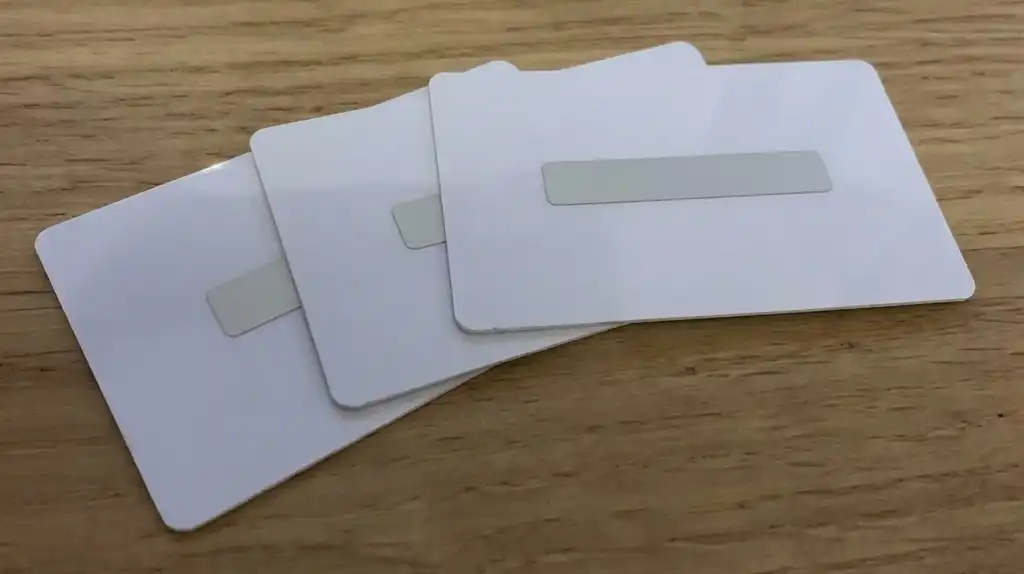
A promotional card is any reward card you hand out to bring people in, such as a scratch card at an exhibition stand or a discount card in a mailing. Plastic earns its place when the card has a job to do afterwards. If it will be thrown away once scratched and you need tens of thousands, paper is the cheaper choice.
Scratch panels can go anywhere if they stop at least 4mm from the edge, and wording can be printed under them from an Excel file. See scratch cards.
Check the rules before you print the codes. Prize promotions have rules, particularly where a purchase is involved, and we can’t advise on them. Start with the CAP Code section on promotional marketing and the ASA’s guidance on free entry routes. For refer a friend offers, see referral cards.
How do I order printed reward cards?
Reward card printing starts with three things: the kind of card, how many, and what changes from card to card. Send those with your artwork, or your logo and wording.
- How many? Enough for about a year of new customers is a good start. See how many loyalty cards to order.
- Numbers or names? Give us a start number, or send an Excel file with one row per card. See numbered and personalised cards. We can’t print a different photo on each card.
- Which barcode? Ask your till provider, then see our barcode page.
- No artwork? Our design service is £29 +vat. If you send your own, our artwork check is technical only, and a technical fix is £10 +vat.
- QuoteEmail sales@cpcards.co.uk or use our quote form. We often reply within minutes, 9am to 5pm, Monday to Friday.
- ProofWe email a free photorealistic proof, so you can check the layout and wording. The colours on the proof are a guide only, because every screen shows colour differently.
- Test, if you need toAdd a postal proof to your order to scan real cards on your own till: £65 +vat, around 5 working days.
- PrintYour cards are printed in 7 working days from proof approval and payment. Express takes 3 to 4 working days: ask us for cost and availability.
On an order with names or numbers, the proof shows where the names and numbers sit. Check your spreadsheet before you send it, because our artwork check is technical and doesn’t cover names or spelling. If a colour has to be right, add a postal proof.
How much do plastic reward cards cost?
Standard full colour customer reward cards start at £75.00 +vat for 25, the same price as our loyalty, discount and gift cards. The price per card falls as the quantity goes up, because much of the work in an order is the same whatever the quantity.
| Quantity | Price | Per card |
|---|---|---|
| 25 | £75.00 +vat | £3.00 each |
| 50 | £79.00 +vat | £1.58 each |
| 100 | £85.00 +vat | 85p each |
| 200 | £99.00 +vat | 49.5p each |
| 250 | £109.00 +vat | 43.6p each |
| 500 | £175.00 +vat | 35p each |
| 1,000 | £245.00 +vat | 24.5p each |
Full colour on both sides, from one design. Extras such as numbering, names, barcodes, scratch-off panels and metallic bases are priced on your quote.
Questions & Answers
-
What is a plastic reward card?
A plastic reward card is a printed card that gives a customer something back for buying, visiting or doing something for you. It might collect stamps or points, unlock a tier, give a standing discount, reveal a prize or be worth one free item.
-
What size is a rewards card?
Our standard rewards card is 86 x 54mm and 760 microns thick, the same as a bank card. Artwork is set up at 92 x 60mm, which includes 3mm of bleed all round. A key tag is 54 x 29mm.
-
What is a privilege card?
A privilege card gives the holder the same benefit every time they show it, such as 10% off or a trade rate. Nothing has to be collected. The base card is priced like our other full colour cards, and any name, number or barcode is priced on your quote.
-
Is a reward card the same as a loyalty card?
A loyalty card is one kind of reward card: it rewards people for coming back, usually with stamps or points. Reward card is the wider term, and also covers privilege cards, scratch-to-win cards and one-off rewards.
-
Do I need a till system to run a reward card scheme?
No. A stamp card needs only a stamp or a punch, and a privilege card only needs showing. A points card does need a till or loyalty software that can find a customer from a scanned or swiped card, so test a printed card on your own till first.
-
Can each reward card have its own number or barcode?
Yes. Give us a start number and the cards run on from it, or send the numbers in an Excel file, with the column formatted as Text so leading zeros aren’t lost.
-
Where can I get plastic reward cards printed in the UK?
CP Cards supplies plastic reward cards from a minimum of 25 cards, with plain printed cards from £75.00 +vat for 25. They are printed in England, with a free email proof. Delivery is free within Great Britain, and our delivery prices list the charges for Northern Ireland, the Republic of Ireland and the Channel Islands. For a quote, email sales@cpcards.co.uk or use our quote form. We often reply within minutes, 9am to 5pm, Monday to Friday.
Ready to order your reward cards?

Tell us the kind of reward card and how many you need, and send your logo and wording or your finished artwork. We’ll quote by email, often within minutes.