


How to Design a Combo Card
A combo card is a full-size 86 x 54mm plastic card and a 54 x 29mm key tag printed as one piece, which snap apart so one goes in a wallet and one on a keyring. To design one, treat it as two small designs on one 121 x 60mm template, with the same number on both.
This guide is for loyalty, gym and membership schemes.
The short versionCombo cards are 680 microns thick and printed in full colour on both sides. Set the artwork up on our 121 x 60mm templates, with the split at 89mm on the front and 32mm on the back. Keep wording 3mm inside every edge, and put the same number or barcode on both parts. Magnetic strips, embossing, metallic foiling and metallic base cards aren’t available.
What is a combo card, and how do the two parts come apart?
A combo card is one piece of plastic that becomes two: a full-size card and a key tag, joined along the card’s short edge. Some people call them 2 part cards or snap-off cards. The person you give it to snaps the two apart, so your scheme works whichever one they have on them.
Combo cards are 680 microns thick, slightly slimmer than a standard 760 micron card, which is what lets the parts separate cleanly. Both parts are solid PVC, printed in full colour on both sides at no extra cost. The print is sealed between clear PVC sheets, so it can’t scratch or wear off in a wallet or on a keyring. The finish is High Gloss, or Premium Matt for £20 +vat per order, and the minimum order is 25.

How do I set up combo card artwork?
Start from our two Photoshop templates, front and back, on our artwork guides page. Each is 121 x 60mm: the whole piece, 115 x 54mm, plus 3mm of bleed all round. On the front, the card is on the left and the tag on the right, split at 89mm. On the back they swap, split at 32mm, because it’s the same piece seen from behind.
- Bleed: 3mm past the outer edge.
- Trim: where the piece is cut.
- Safe area: 3mm inside every edge of both parts.
- The hole, marked on the template.
- Clear of the hole: about 3mm, our suggestion.
- The same number on the card and the tag.
- A signature panel, at least 4mm from the edges.
- CMYK, with pictures at 600 dpi. In a PDF, EPS or Illustrator file, convert fonts to outlines.
- Black as C0 M0 Y0 K100 for text and backgrounds, for a deep black.
- The front and back as separate files, with the template’s outlines hidden: no crop marks or outline of the card.
- Leave the space for numbers and barcodes that change from card to card, and send a PDF visual showing where they go.
No Photoshop? Other software is fine: set up a 121 x 60mm file with the same split. EPS, PDF, Illustrator and Photoshop files are recommended. No artwork? Our design service lays out both parts from your logo and wording for £29 +vat, with no limit on reasonable changes. If you send your own, our free artwork check covers bleed, resolution, colour mode and set-up, and we can fix a technical problem for £10 +vat. We don’t check the wording or spelling.
Where does the hole go, and which way does the tag read?
The hole is at the top of the tag, centred across its 29mm width, with its centre 7mm from the end. That’s the same place as on our key tags, and the template marks it, so you don’t need to measure. Keep wording and codes about 3mm clear of it. That margin is our suggestion, and it leaves about 39 x 23mm on each side of the tag.

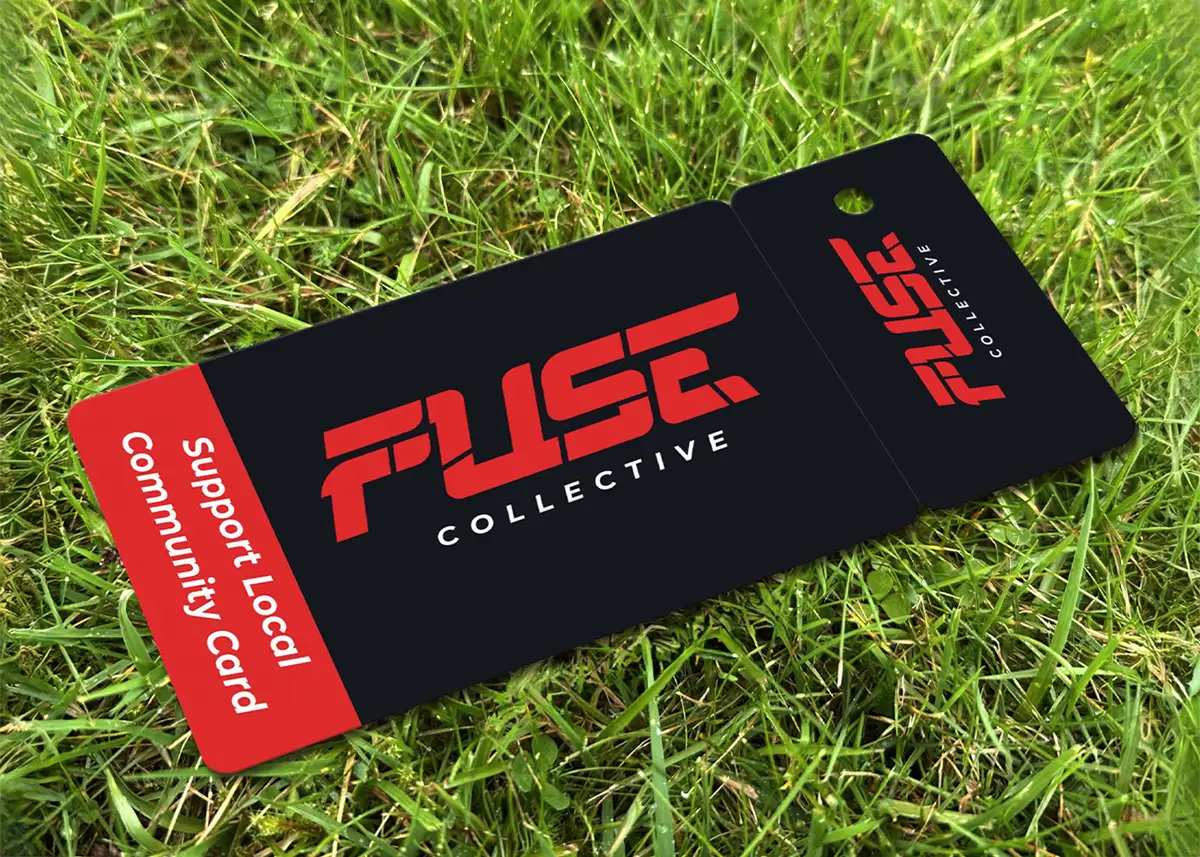
In the photos on this page, the tag’s wording runs up the tag, with the hole at the top. Turn the tag a quarter turn clockwise and it reads like a landscape key tag, with the hole at the right-hand end.
Key tags can also read upright, as on some of our key tag examples, so ask us if you’d like that on a combo card. Check which way up each side goes on your proof. Our guide to designing a key tag covers small layouts in more depth.
How should I design across the join?
We suggest running one background colour across the join and treating it as an edge. The two parts become separate pieces, so keep wording 3mm back on both sides. The template has no bleed between the parts, just the split, and printing and cutting can move by around 1mm, so a colour change placed right on the join could show as a thin line on the wrong part. All the photos on this page use one background across the join. If you want a different colour on each part, ask us first.
Avoid a thin border round each part too: a border 4mm from an edge can end up 3mm from one side and 5mm from the other.
What goes on the card, and what goes on the tag?
Put the detail on the card and the essentials on the tag. The tag has about a third of the card’s area, so a card design shrunk to fit rarely works. Give the tag the name or a simple version of your logo, and the code.
| The card | The tag | |
|---|---|---|
| Room for wording | About 80 x 48mm | About 39 x 23mm |
| Front | Logo, name and what the card is for | A simple logo or the name |
| Back | Barcode or number, terms, contact details, signature panel | For a scheme, the same barcode or number, and nothing else |
Three layouts for the front
These show the front of each part. The businesses and phone numbers are made up. Our combo card examples page shows a real design.
- Nothing below 6pt, where capital letters are about 1.5mm tall.
- Numbers at 10pt or more, in a plain sans-serif. Our guide to font sizes on plastic cards shows each size to scale.
Can both parts have the same barcode, QR code or number?
Yes, and for a scheme they should. If the card and the tag carry different numbers, a member who scans one this week and the other next week has their history split across two accounts. Give us a start number and the combo cards run on from it, or send the exact numbers in an Excel file.
- One row per combo card, with a printed number and its barcode in separate columns of the same row. See numbered plastic cards.
- Format the column as Text before you type or paste, or Excel drops leading zeros.
- Check your spreadsheet before you send it, because our artwork check is technical and doesn’t cover names or spelling.
- Let the tag set the barcode’s length. Ask your till or software supplier which barcode type it reads, because the same number has to fit the smaller part. Our guide to membership cards with barcodes has the widths. As a guide, at a 0.25mm narrowest bar, about 6 characters of Code 39 or 18 digits of Code 128 fit along the tag: see the table in our key tag guide.
- Black bars on a white box, with the number underneath. Premium Matt has no glare, so it scans more easily. More on barcodes on plastic cards.
- A QR code at least 15 x 15mm, in black on a white square, which fits the tag’s width. A different code on each card comes from your Excel file. More on QR codes on plastic cards.
What can’t a combo card have?
A combo card can’t have a magnetic strip, embossing, metallic foiling, a metallic base or an RFID chip. Numbers and names can be printed instead of embossed. Our optional extras page has the details.
If your system reads a magnetic strip, choose a full-size card with the strip on it. A separate key tag can’t have a strip. All a system can read on it is a printed barcode, QR code or number, so it works only if your system reads those too. If your system needs an RFID chip, choose a full-size RFID card. We supply them unencoded, and we don’t supply RFID key tags. See RFID membership cards if your door readers need a chip.
| Extra | On a combo card? | Worth knowing |
|---|---|---|
| Barcode or QR code | Yes | On either part, on either side. |
| Printed numbers and names | Yes | From a start number or Excel. |
| Signature or write-on panel | Yes | A standard panel is 75 x 8mm, so it suits the card part. |
| Scratch-off panel or photoseal | Ask us | Tell us which part you have in mind. |
Should I order a combo card, or a separate card and key tag?
Choose a combo card if everyone in your scheme gets both, because it’s one item to order and hand over. Choose a separate card and key tag if only some people want both, if the card needs a magnetic strip, or at smaller quantities, where two separate prices can add up to less.
A separate card and tag are both 760 microns, against 680 for a combo card. A numbered combo card takes one row of your file, while separate parts mean two orders, with numbers to match.
How much do combo cards cost?
Combo cards start at £224.00 +vat for 25. Delivery is free within Great Britain, and our delivery prices list the charges for Northern Ireland, the Republic of Ireland and the Channel Islands. The price per pair falls as the quantity goes up, because much of the work in an order is the same whatever the quantity. Before numbering and barcodes, and at today’s prices, a separate card and tag cost less up to 200, and a combo card costs less from 250.
| Quantity | Combo cards | Separate card and tag |
|---|---|---|
| 25 | £224.00 £8.96 a pair | £173.00 £6.92 a pair |
| 50 | £226.00 £4.52 a pair | £181.00 £3.62 a pair |
| 100 | £229.00 £2.29 a pair | £198.00 £1.98 a pair |
| 200 | £234.00 £1.17 a pair | £227.00 £1.14 a pair |
| 250 | £239.00 95.6p a pair | £243.00 97.2p a pair |
| 500 | £290.00 58p a pair | £329.00 65.8p a pair |
| 1,000 | £425.00 42.5p a pair | £503.00 50.3p a pair |
From print-ready artwork. The separate column adds our standard card and key tag prices, each for one design. Both columns are before numbering, barcodes and other optional extras. For a numbered scheme, ask us and we’ll quote both ways.
What are combo cards used for?
Any scheme where a person wants a card in their wallet and a quick way to scan in from their keys. For gyms and clubs, membership card systems explains how a scan finds the member.
That covers gyms and leisure centres, loyalty schemes, clubs and libraries, gift cards for shops that scan them at the till, referral schemes, with the tag for your customer and the card for a friend, and business cards with a key tag.
How do I order, and what does the proof show?
Ask for a quote, approve a free email proof of both sides, and your combo cards follow in 7 working days from proof approval and payment. On a numbered order, the proof shows where the names and numbers sit.
- QuoteEmail sales@cpcards.co.uk or use our quote form. We often reply within minutes, 9am to 5pm, Monday to Friday.
- ProofWe email a free photorealistic proof, so you can check the layout and wording. The colours on the proof are a guide only, because every screen shows colour differently.
- Test, if you need toAdd a postal proof to your order to scan a real combo card on your own system: £65 +vat, around 5 working days.
- Print7 working days from proof approval and payment. Express takes 3 to 4 working days: ask us for cost and availability.
Most customers don’t add a postal proof, and a revised one is £35 +vat. If a colour has to be right, add a postal proof.
Questions & Answers
-
What is a combo card?
A full-size 86 x 54mm plastic card and a 54 x 29mm key tag printed as one piece, which the holder snaps apart. The card goes in a wallet and the tag on a keyring, and both usually carry the same number or barcode, so either one works with your scheme.
-
How do the two parts of a combo card come apart?
They snap apart at the join, and the person you give it to does this themselves. Combo cards are 680 microns thick, slightly slimmer than a standard 760 micron card, which is what lets the parts separate cleanly.
-
Can both parts of a combo card have the same number?
Yes, and for a scheme they should, so the card and the tag find the same account. Give us a start number, or send an Excel file with one row per combo card.
-
What fits on the key tag part of a combo card?
A simple logo or the name, and one barcode, QR code or number. With 3mm kept clear at the edges and about 3mm round the hole, which is our suggestion, each side has about 39 x 23mm. Nothing should be below 6pt, so put terms and contact details on the card.
-
Can I have a business card with a key tag?
Yes. A combo card works as a business card key tag: your customer keeps the card in a wallet and snaps off the tag for their keys. Put your full details on the card, and just your name and phone number on the tag, because it has no barcode to carry. If you only want the tag, see our key tags.
-
How do I set up artwork for a combo card?
Use our two Photoshop templates, front and back, which are 121 x 60mm including 3mm of bleed. On the front the card is on the left and the tag on the right, split at 89mm, and on the back they swap, split at 32mm. Keep wording 3mm inside every edge, and we suggest the join too. Other software is fine at the same size, with the front and back as separate files.
-
Is a combo card cheaper than a separate card and key tag?
It depends on the quantity. Before numbering and barcodes, and at today’s prices, a separate card and tag cost less up to 200, and a combo card costs less from 250. If your scheme is numbered, ask us to quote both ways, because separate parts mean numbering two orders.
-
Where can I get combo cards printed in the UK?
CP Cards supplies combo cards printed in England, with a minimum order of 25. Prices start at £224.00 +vat for 25. Delivery is free within Great Britain, and our delivery prices list the charges for Northern Ireland, the Republic of Ireland and the Channel Islands. Every order gets a free email proof, and you can get a quote by emailing sales@cpcards.co.uk with your quantity and what will scan the cards. We often reply within minutes, 9am to 5pm, Monday to Friday.
Ready to design your combo cards?

Send us your logo and wording, or your finished artwork, and tell us how many you need and what will scan them. We’ll quote by email, often within minutes.