


Types of Membership Card
A membership card is a card that proves someone belongs to a club, gym, society or other organisation. The main types differ in four ways: how the card is read, what it’s made of, what shape it is and who it’s for. Start with what you have at the door.
A chart at the end picks the right card in five questions.
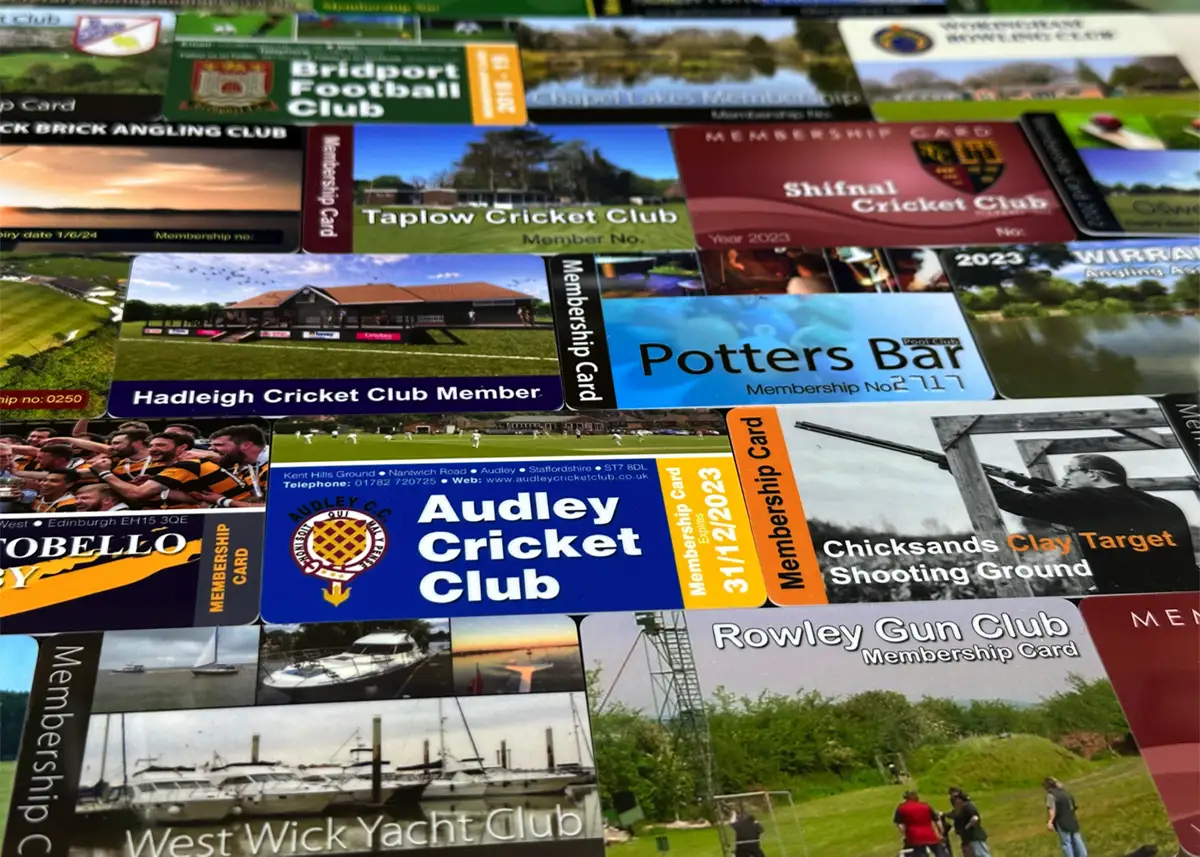
The short versionStart with a full colour PVC card, 86 x 54mm and 760 microns thick, with a name, number and date. Add a barcode or QR code if you’ll scan it, and a magnetic strip or RFID chip only if you have the readers. Choose a key tag or combo card if members carry keys, and hot foil for a premium look.
What is a membership card?
Usually it’s a plastic card the size of a bank card, with the member’s name and number on it. It’s used to:
- Show who’s a member. Staff can check the name and date, and a colour or a word shows the category.
- Let people in. A barcode, magnetic strip or RFID chip is read at a door, till or turnstile.
- Link to your records. The number finds the member, records a visit or shows who needs to renew.
What does a membership card look like?
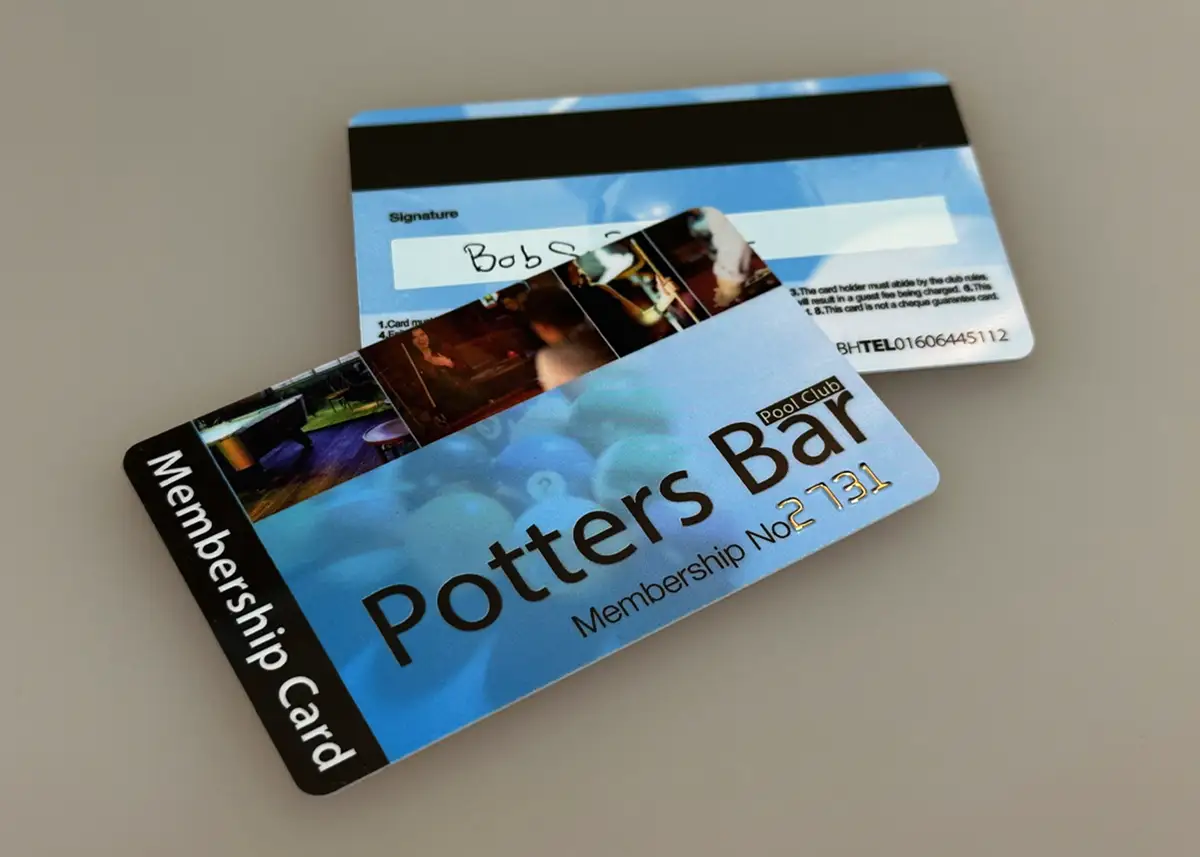
Most look like a bank card: 86 x 54mm with rounded corners, printed on both sides. The front identifies the club and the member. The back usually carries whatever gets scanned or signed, and the small print.
- Logo and name.
- Member’s name.
- Membership number, which ties the card to your records.
- Category, if members have different rights.
- Expiry date or season year.
- Barcode or QR code, if something will read it.
- Signature strip.
- Terms and a return line.
- Your contact details.
See what to put on a membership card for wording you can copy, how to design a membership card for the layout, and our membership card examples by type of club.
How is a membership card read?
In one of five ways: by eye, or with a barcode scanner, a QR code reader, a magnetic strip reader or an RFID reader. Start with what you already have at the door, because a barcode or chip with nothing to read it does nothing. Our guide to membership card systems shows how cards, readers and software fit together.
| Type | You need | Worth knowing |
|---|---|---|
| Plain card | Staff who check it | Add a signature strip or a photoseal, which attaches a passport-sized photo, because we can’t print a different photo on each card. |
| Barcode | A scanner and software that looks up the number | Code 39 is the most popular on the cards we supply. Ask your software provider which type it reads. |
| QR code | A phone, or a scanner that reads 2D codes | At least 15 x 15mm. A standard till scanner can’t read one. See QR code or barcode. |
| Magnetic strip | A swipe reader | 13 x 86mm across the back, HiCo or LoCo. We can encode it or leave it blank. Do you still need one? |
| RFID chip | An RFID reader that matches the chip | The chip and antenna are inside the card. The 1K Mifare card is 820 microns. We supply them unencoded, and not as NFC cards. Holes, slots and embossing aren’t available. |
Most can be combined, and barcodes, QR codes and numbers can change from card to card, from a start number or an Excel file. A barcode or QR code can go anywhere on the card, front or back. See all our optional extras.
What are membership cards made of?
Most are solid PVC, but we supply nine materials, all 86 x 54mm, printed one of two ways. Full colour (CMYK) can print photographs, gradients and brand colours. Hot foil suits logos and clean type rather than photographs.
| Material | Thickness | Printing | Print sealed? | Worth knowing |
|---|---|---|---|---|
| Standard PVC | 760 microns | Full colour | Yes | Takes every standard extra. Also comes in 680 and 420 microns, but a magnetic strip needs the 760 micron card. |
| Recycled PVC | 760 microns | Full colour | Yes | 98% recycled PVC. Takes the same extras as standard PVC. |
| Biodegradable | 800 microns | Full colour | Yes | An additive is designed to speed up breakdown in the right conditions. |
| EcoTough | 360 microns | Full colour | No | PVC-free, with 20% recycled content. Takes a pen anywhere. 5 working days. |
| Plastic-Free Board | 620 microns | Full colour | No | Recyclable board, no plastic. Takes pen and ink stamps anywhere. For very high-use door access, PVC may be more suitable. |
| Frosted | 760 microns | Hot foil | No | Semi-transparent PVC, so print on one side shows through the other. |
| Satin black | 760 microns | Hot foil | No | Black all the way through, including the edges. |
| Metallic | 760 microns | Hot foil | No | A gold or silver base. |
| White | 760 microns | Hot foil | No | Takes numbering and signature strips. Full colour on white is standard PVC. |
Sealed print. On standard, recycled and biodegradable cards, the print is sealed between clear PVC sheets that are bonded together, so it can’t scratch or wear off. EcoTough, board and hot foil cards aren’t made this way.
Eco card materials. EcoTough and board don’t take magnetic strips, metallic foiling or scratch-off panels, or offer a choice of finish. Our guide to paper and board membership cards compares them with PVC. See our eco card materials comparison.

Hot foil prints flat colour: up to 4 colours, no photographs or gradients, and nothing within 3mm of the two long edges (what hot foil can’t do). A white hot foil card can carry a barcode or QR code if it’s the same on every card. For the other three, ask us, and ask what names and numbers any of them can carry. A different code on each card means full colour.


A premium look with a different code on each card? Choose full colour PVC with metallic foiling, which keeps the white box a code needs to scan. A metallic base (a full colour extra, not the hot foil metallic range) can’t have white printed on it, so ask us about codes on one.
What shapes do membership cards come in?
Four: a landscape card, a portrait card, a key tag and a combo card. The first two are the same card turned round, at the same price. A key tag goes on a member’s keys, and a combo card gives them a tag for their keys and a card for their wallet. Our guide to designing a combo card shows what fits on each part.
| Shape | Best for | Worth knowing |
|---|---|---|
| Landscape card | Wallets and purses, and cards that are swiped | The usual choice. An email address fits on one line. |
| Portrait card | Lanyards, and cards with a photoseal for the holder’s photo | A 15 x 3mm slot in the short edge hangs it straight. A magnetic strip runs down one side. |
| Key tag | Members who always have their keys | Room for a logo and a barcode or number. No magnetic strip, embossing, metallic foiling, metallic base or RFID chip. See how to design a key tag. |
| Combo card | Giving each member both a card and a tag | Snaps apart, with the same number on both parts. No magnetic strip, embossing, metallic foiling, metallic base or RFID chip. |


What types of membership are there?
They differ by who the member is (individual, family, junior, corporate or life) and how long the membership runs (annual, rolling or for life). Each changes what goes on the card and how you order it.
| Type | On the card | How to handle it |
|---|---|---|
| Individual | Name, number, category and date | Send an Excel file: see personalised plastic cards. |
| Family | Each person’s own name, against a shared account number | Order one card per person and send the names in your Excel file. See our gym and leisure club examples. |
| Junior | The word Junior, and often a different colour | Colour variants cost nothing extra when ordered as one job. Pick colours that are easy to tell apart, so the colour code still works if a shade varies from one order to the next. |
| Corporate | The word Corporate, and the employer’s name if you want it | Add it as a category in your Excel file, with a column for the employer’s name. |
| Life | Member since a year, and no expiry date | A metallic base or foil shows the tier at a glance. |
| Annual | The season year, such as 2026/27 | Everyone’s card ends together, so you order new cards each season. |
| Rolling | A fixed date, such as Valid until 31 March 2027 | Use a write-on date panel, or bureau personalisation: we hold your printed cards, add the details you email, and dispatch them to you, so allow 3 working days. |
What about digital membership cards?
A digital membership card lives in an app or phone wallet, and both digital and plastic cards work. We supply plastic cards, so we’re not neutral, but if an app suits your members better, use one.
- An app suits members who already book through one. It usually means a subscription, needs a smartphone, and doesn’t work with no signal or a flat battery.
- A plastic card needs nothing from the member, and you pay per order.
- A plastic card with a barcode or QR code lets your system record visits against its number, with nothing to download.
We don’t make app or phone wallet cards: those come from your software provider, and many organisations offer both. See digital v plastic cards for the full comparison.
How much do membership cards cost?
Standard full colour PVC cards start at £75.00 +vat for 25, and come to 24.5p each at 1,000. Small orders cost more per card because much of the work in an order is the same whatever the quantity.
| Type | 25 | 100 | 1,000 |
|---|---|---|---|
| Standard PVC | £75 | £85 | £245 |
| Recycled PVC | £88 | £99 | £280 |
| Biodegradable | £88 | £99 | £280 |
| EcoTough | £75 | £85 | £206 |
| Plastic-Free Board | £89 | £103 | £318 |
| Key tag | £98 | £113 | £258 |
| Combo card | £224 | £229 | £425 |
| RFID card (1K Mifare) | £182 | £238 | £1,007 |
| Hot foil ranges | Quoted individually from your design | ||
One design from print-ready artwork. Delivery is free within Great Britain, and our delivery prices list the charges for Northern Ireland, the Republic of Ireland and the Channel Islands. Prices exclude VAT and optional extras such as numbering and barcodes.
To order, email your artwork, or your logo and wording, to sales@cpcards.co.uk. Our design service is £29 +vat. Production is 7 working days from proof approval and payment. Express is 3 to 4 working days: ask us for cost and availability.
Every order gets a free photorealistic email proof, so you can check the layout and wording. With names or numbers, the proof shows where the names and numbers sit, so check your spreadsheet before you send it, because our artwork check is technical and doesn’t cover names or spelling.
The colours on the proof are a guide only, because every screen shows colour differently. If a colour has to be right on a full colour card, add a postal proof: £65 +vat, around 5 working days. On a hot foil card, the same foil can look different on a frosted, white, satin black or metallic card. If in doubt, email sales@cpcards.co.uk to ask about a sample colour being posted to you for approval.
Which type of membership card do you need?
Start at the top, and stop at your first yes.
- Choosing a membership card?
- Do members tap in at a reader?If yes: RFID cardWith a chip that matches your reader
- If not: Do you have swipe readers?If yes: Magnetic stripOn a full colour PVC card
- If not: Do members carry keys more than a wallet?If yes: Key tag or combo cardWith a barcode, QR code or number
- If not: Will you scan the card?If yes: Barcode or QR codeBarcode for a till scanner, QR code for a phone
- If not: Is this a premium tier?If yes: Satin black, metallic or frostedHot foil, quoted from your design. Ask us what names and numbers they can carry
- If not: A plain full colour PVC cardWith a name, number and date
Questions & Answers
-
What is a membership card?
A membership card is a card that proves someone belongs to a club, gym, society or other organisation. It usually carries the organisation’s name, the member’s name and number, and an expiry date. Many also carry a barcode, QR code, magnetic strip or RFID chip, so a machine can read it.
-
What are the different types of membership card?
They differ in four ways, starting with how they’re read (by eye, barcode, QR code, magnetic strip or RFID) and what they’re made of (PVC, an eco material or a hot foil card). They also differ in shape (landscape, portrait, key tag or combo card) and in who they’re for (such as individual, family, junior, corporate or life members).
-
What does a membership card look like?
Most look like a bank card: 86 x 54mm, printed on both sides. The front shows the club’s logo and name, the member’s name and number, and an expiry date. The back usually carries any barcode or magnetic strip, a signature strip, the terms and contact details.
-
What is a membership card used for?
It’s used to prove someone is a member and to let them in. Staff can read it by eye, or scan, swipe or tap it so your system records the visit.
-
What are membership cards made of?
Most are solid PVC, 760 microns thick, the same as a bank card. We also supply recycled PVC (760 microns), biodegradable (800), EcoTough (360) and Plastic-Free Board (620), plus hot foil cards in frosted, satin black, metallic and white (760).
-
Are digital membership cards better than plastic ones?
Neither is better for every club. An app suits members who already book through one, but it needs a smartphone and a charged battery. A plastic card needs nothing from the member, and one with a barcode or QR code lets your system record visits with nothing to download.
-
Where can I get membership cards printed in the UK?
CP Cards supplies plastic membership cards, printed in England, with a minimum order of 25, from £75.00 +vat. Delivery is free within Great Britain, and our delivery prices list the charges for Northern Ireland, the Republic of Ireland and the Channel Islands. Every order gets a free photorealistic email proof to check the layout and wording. For a quote, email sales@cpcards.co.uk or use our quote form: we often reply within minutes, 9am to 5pm, Monday to Friday.
Ready to order your membership cards?

Tell us how many cards you need and what will read them, and we’ll tell you which types fit. We quote by email, often within minutes, 9am to 5pm, Monday to Friday, and we have over 240 Google reviews.